

Physicists Predict the Universe Could End in a “Big Crunch”
New research from Cornell University suggests that the universe’s expansion may not continue forever. Instead, it could reverse course and collapse in a dramatic “big crunch” roughly 20 billion years from now—ending space and time as we know them.
According to physicist Henry Tye, Horace White Professor of Physics Emeritus at Cornell’s College of Arts and Sciences, the universe may be nearing the midpoint of a 33-billion-year lifespan. His updated cosmological model, published in the Journal of Cosmology and Astro particle Physics, incorporates new findings from dark energy surveys that challenge long-held assumptions about the universe’s fate.
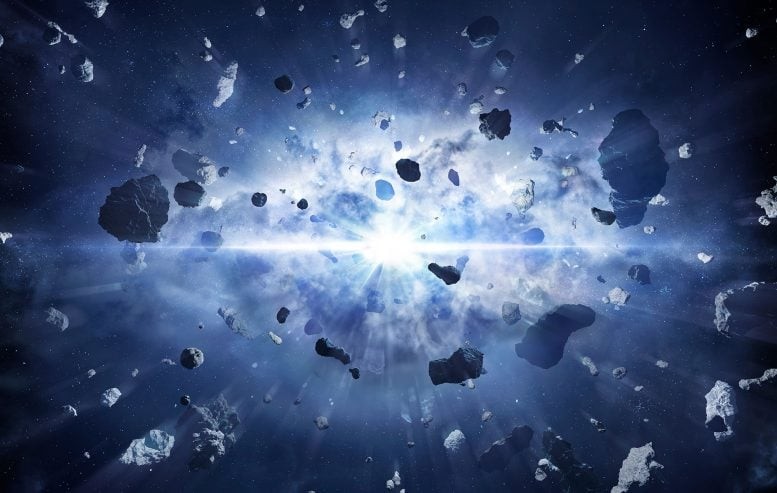
Figure 1. Big Crunch.
“For the last two decades, most scientists believed the cosmological constant was positive, meaning the universe would expand forever,” Tye explained. “But new data indicate it might actually be negative—which means the universe will eventually stop expanding and collapse back into itself.” Figure 1 shows Big Crunch.
The cosmological constant, introduced by Albert Einstein more than a century ago, describes the energy density driving cosmic expansion. If positive, the universe expands eternally. If negative, it will reach a maximum size before contracting. Tye’s calculations support the latter scenario: the universe expanding for another 11 billion years before reversing into a final collapse—the big crunch.
Recent observations from the Dark Energy Survey (DES) in Chile and the Dark Energy Spectroscopic Instrument (DESI) in Arizona played a crucial role in this conclusion [1]. Both projects, which measure dark energy by studying millions of galaxies, suggest that dark energy—comprising nearly 68% of the universe—may not be a static force after all.
Tye and his collaborators propose the existence of a hypothetical, ultra-light particle that once behaved like a cosmological constant but has since evolved, pushing the overall energy balance of the universe into negative territory. “It’s not new to say a negative cosmological constant would lead to collapse,” Tye said. “What’s new is that our model predicts how and when it will happen.”
Future observatories—including NASA’s Sphere mission, the Euclid space telescope, and the Vera C. Rubin Observatory—are expected to refine these measurements further.
For Tye, the ability to predict both the beginning and end of the universe marks a milestone for cosmology. “In the 1960s, we learned the universe had a beginning,” he said. “Now we may finally understand how—and when—it will end.”
Reference:
- https://scitechdaily.com/the-universe-will-end-in-a-big-crunch-physicists-warns/
Cite this article:
Keerthana S (2025), Physicists Predict the Universe Could End in a “Big Crunch”, AnaTechMaz, pp.565
Recent Post
-
ESA Mars Orbiters Capture Rare Interstellar Comet Older Than the Sun
ESA’s ExoMars Trace Gas Orbiter (TGO) and Mars Express....
-
Scientists Suggest Dark Matter Could Leave a Distinct ‘Fingerprint’ on Light
Dark matter, the enigmatic substance that makes up about 27%...
-
World’s Strongest Rocket Successfully Completes 11th Suborbital Test Ahead of Moon and Mars Missions
SpaceX’s colossal Starship...
-

Human Missions to Mars Could Shrink Hearts and Weaken Bones: The Deadly Risks Explained
It’s been more than 50 years since humans last walked on the....
-
Cosmic Timekeepers Uncover Mysterious Ripples in Spacetime
A recent study introduces a novel way to tell apart different origins of nanohertz gravitational waves....
-
“An Astonishing Discovery” – Scientists Detect a Supermassive Black Hole Where None Was Expected
In a discovery that defies ....
-
Scientists Detect Black Hole “Ringing,” Proving Hawking’s Long-Standing Theory
Ten years after humanity first detected gravitational waves, scientists...
-
Cosmic Enigma: Brightest-Ever Fast Radio Burst Stuns Astronomers with Its Silence
Astronomers have traced the brightest Fast Radio Burst (FRB) ever...
-
JWST Discovers a “Impossible” Planet Composed Mostly of Carbon
In a finding that challenges existing models of how planets form, astronomers using the James...
Physicists Predict the Universe Could End in a “Big Crunch”
New research from Cornell University suggests that the universe’s expansion may not continue forever.....
-

This Simple Earth Organism Might Be Able to Live on Mars
A team of Indian scientists has found that baker’s yeast can withstand harsh, Mars-like conditions involving....
-
This Minuscule Dark Object Might Change our Understanding of the Universe
Because the object emits no light or detectable radiation, researchers spotted it...
-
Astronomers Shocked as Black Hole Surpasses Known Growth Limits
The black hole powers a quasar—a brilliant celestial object that outshines...
-
Century-Old Black Hole Mystery Finally Solved by Scientists
For almost two centuries, astronomers were puzzled by a bright object in the constellation Virgo..
-
Closest Alien Civilization May Lurk 33,000 Light-Years from Earth
A planet’s carbon dioxide levels play a crucial role in sustaining life. With enough CO₂, a planet can...