

JWST Discovers a “Impossible” Planet Composed Mostly of Carbon
In a finding that challenges existing models of how planets form, astronomers using the James Webb Space Telescope (JWST) have detected a planet with an atmosphere made almost entirely of carbon—orbiting a pulsar. The discovery, detailed in a recent arXiv preprint, could signal a paradigm shift in our understanding of planetary evolution.
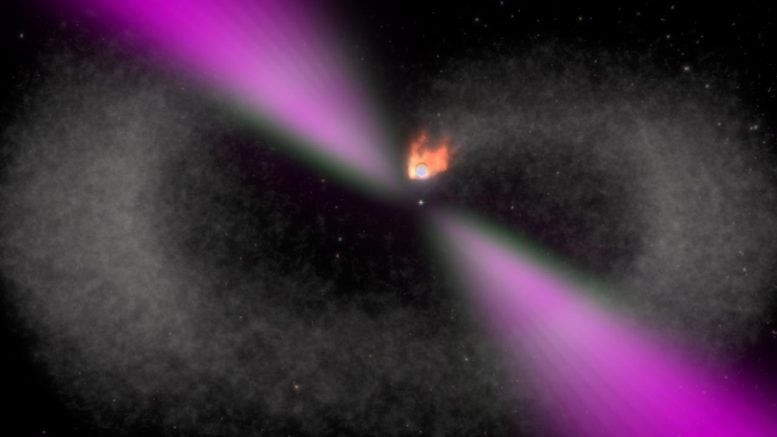
Figure 1. black widow pulsar burning its companion.
The planet orbits PSR J2322-2650, a “black widow” pulsar—an ultra-dense neutron star that emits powerful radiation while stripping material from its companion star. Over time, this process leaves behind a shrunken, Jupiter-sized remnant that circles the pulsar every few hours. In this case, the companion completes an orbit every 7.8 hours, a classic hallmark of black widow systems. Figure 1 shows black widow pulsar burning its companion.
What makes PSR J2322-2650b extraordinary is its composition. While such remnants are typically helium-rich, JWST’s infrared spectroscopy revealed a startling anomaly: the planet’s atmosphere is dominated by pure carbon, mostly in molecular forms such as dicarbon (C₂) and tricarbon (C₃). These compounds are usually seen in comet tails or flames on Earth, making their presence in a planetary atmosphere unprecedented.
The planet also exhibits dramatic day-night contrasts. Its dayside, permanently facing the pulsar, reaches temperatures above 2,000°C, producing distinct chemical signatures [1]. The nightside, however, appears featureless—possibly cloaked in a layer of carbon soot that absorbs nearly all light.
Quantitatively, the planet’s carbon-to-oxygen ratio exceeds 100, and its carbon-to-nitrogen ratio surpasses 10,000—figures far beyond anything observed in our solar system (for comparison, Earth’s ratios are 0.01 and 40, respectively). Such extreme carbon dominance doesn’t fit current theories, which predict that the pulsar’s radiation should have stripped or burned away lighter elements long ago.
Researchers suggest that only an exotic process—perhaps a white dwarf merger or a rare carbon-star interaction—could have produced such a composition, though even these explanations fall short.
Interestingly, JWST data also revealed that the planet’s hottest region is offset about 12 degrees west of its substellar point. This supports predictions from circulation models that “black widow” planets, due to their rapid rotation, exhibit westerly winds—a phenomenon never before observed directly.
The discovery of PSR J2322-2650b’s carbon-rich atmosphere underscores the limits of current planetary formation theories—and highlights how JWST continues to rewrite our understanding of the cosmos.
Reference:
- https://scitechdaily.com/jwst-finds-a-planet-that-shouldnt-exist-and-its-made-almost-entirely-of-carbon/
Cite this article:
Keerthana S (2025), JWST Discovers a “Impossible” Planet Composed Mostly of Carbon, AnaTechMaz, pp.564
Recent Post
-
ESA Mars Orbiters Capture Rare Interstellar Comet Older Than the Sun
ESA’s ExoMars Trace Gas Orbiter (TGO) and Mars Express....
-
Scientists Suggest Dark Matter Could Leave a Distinct ‘Fingerprint’ on Light
Dark matter, the enigmatic substance that makes up about 27%...
-

World’s Strongest Rocket Successfully Completes 11th Suborbital Test Ahead of Moon and Mars Missions
SpaceX’s colossal Starship...
-

Human Missions to Mars Could Shrink Hearts and Weaken Bones: The Deadly Risks Explained
It’s been more than 50 years since humans last walked on the....
-
Cosmic Timekeepers Uncover Mysterious Ripples in Spacetime
A recent study introduces a novel way to tell apart different origins of nanohertz gravitational waves....
-
“An Astonishing Discovery” – Scientists Detect a Supermassive Black Hole Where None Was Expected
In a discovery that defies ....
-
Scientists Detect Black Hole “Ringing,” Proving Hawking’s Long-Standing Theory
Ten years after humanity first detected gravitational waves, scientists...
-

Cosmic Enigma: Brightest-Ever Fast Radio Burst Stuns Astronomers with Its Silence
Astronomers have traced the brightest Fast Radio Burst (FRB) ever...
-
JWST Discovers a “Impossible” Planet Composed Mostly of Carbon
In a finding that challenges existing models of how planets form, astronomers using the James...

Physicists Predict the Universe Could End in a “Big Crunch”
New research from Cornell University suggests that the universe’s expansion may not continue forever.....
-

This Simple Earth Organism Might Be Able to Live on Mars
A team of Indian scientists has found that baker’s yeast can withstand harsh, Mars-like conditions involving....
-
This Minuscule Dark Object Might Change our Understanding of the Universe
Because the object emits no light or detectable radiation, researchers spotted it...
-
Astronomers Shocked as Black Hole Surpasses Known Growth Limits
The black hole powers a quasar—a brilliant celestial object that outshines...
-
Century-Old Black Hole Mystery Finally Solved by Scientists
For almost two centuries, astronomers were puzzled by a bright object in the constellation Virgo..
-
Closest Alien Civilization May Lurk 33,000 Light-Years from Earth
A planet’s carbon dioxide levels play a crucial role in sustaining life. With enough CO₂, a planet can...