

Scientists Detect Black Hole “Ringing,” Proving Hawking’s Long-Standing Theory
Ten years after humanity first detected gravitational waves, scientists have recorded their clearest signal yet — and it has confirmed one of Stephen Hawking’s most famous predictions about black holes.
Using the newly upgraded LIGO detectors, researchers observed two black holes colliding more than a billion light-years away, generating ripples in space-time so precise that astronomers could, for the first time, “hear” the black holes ring like cosmic bells.
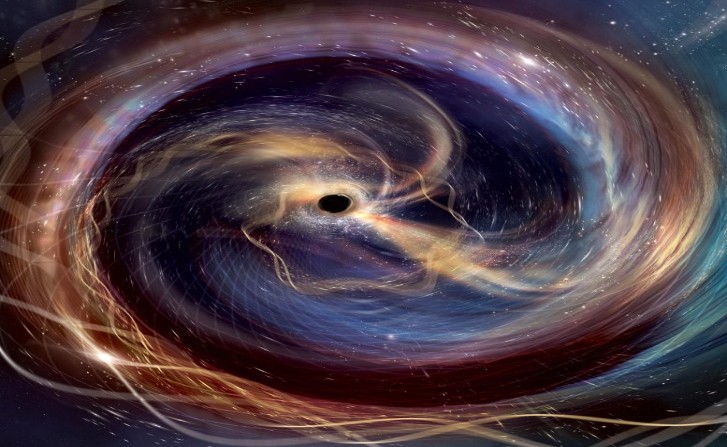
Figure 1. Black Hole “Ringing”.
A Decade of Discovery
In 2015, astronomy changed forever with the first detection of gravitational waves—tiny ripples in space-time produced by the collision of two massive black holes. These distortions had traveled 1.3 billion years before reaching Earth. Figure 1 shows the phenomenon of black hole “ringing.”
First predicted by Albert Einstein in 1916, these waves were captured by the Laser Interferometer Gravitational-Wave Observatory (LIGO), marking the dawn of a new era in astronomy. The discovery earned LIGO’s founders—Rainer Weiss, Barry Barish, and Kip Thorne—the 2017 Nobel Prize in Physics.
Today, LIGO’s two U.S. observatories work in harmony with Virgo in Italy and KAGRA in Japan, forming the LVK (LIGO–Virgo–KAGRA) network. Together, these instruments detect roughly one black hole merger every three days, totaling over 300 confirmed events. Their unmatched sensitivity—made possible through cutting-edge quantum engineering—makes them the most precise scientific instruments ever built.
The Clearest Cosmic Signal Yet
The latest discovery, designated GW250114 (January 14, 2025), mirrors the first detection a decade earlier: two black holes, each 30–40 times the mass of our Sun, colliding 1.3 billion light-years away.
However, this time the data was crystal clear. A tenfold reduction in background noise allowed scientists to isolate the distinct “ringing” of the merged black hole with unprecedented accuracy.
“We can hear it loud and clear,” said Katerina Chatziioannou, Caltech physicist and lead author of the study in Physical Review Letters. “That lets us test the fundamental laws of physics in ways we couldn’t before.”
Proving Hawking’s Black Hole Area Theorem
This remarkably clean signal provided the strongest confirmation yet of Stephen Hawking’s 1971 black hole area theorem—which states that the total surface area of black holes can never decrease.
When two black holes merge, they radiate energy through gravitational waves, yet their combined area must still expand. The new findings confirm this with 99.999% certainty, a major leap from the 95% confidence achieved in earlier studies.
During the GW250114 event, the two merging black holes had a combined area of 240,000 square kilometers—about the size of the United Kingdom—while the resulting black hole spanned 400,000 square kilometers, roughly the size of Sweden [1].“If Hawking were alive, he would have been thrilled to see this,” said Nobel laureate Kip Thorne, recalling how Hawking once phoned him after the 2015 detection to ask if his theorem could be tested.
Hearing the Cosmic Ringdown
After merging, the new black hole vibrates in what scientists call the ringdown phase—the gravitational equivalent of a struck bell fading into silence.
For the first time, researchers identified two distinct gravitational-wave tones during this phase, precisely matching theoretical models. They also placed limits on a potential third tone, providing a powerful new validation of Einstein’s general relativity. “These are the characteristic ‘notes’ of the universe,” said one LIGO scientist. “We’re literally hearing space-time sing.”
A Global Collaboration Pushing the Frontier
The success of the LVK network highlights the power of international collaboration.“At any given moment, scientists around the world are watching over these detectors,” said Nicolas Arnaud, Virgo coordinator at CNRS. “The Sun never sets on our collaboration.”
Beyond black holes, LVK has also detected neutron star collisions, including the famous 2017 kilonova—the first time both light and gravitational waves were observed from the same event. That discovery revealed how gold and other heavy elements are forged in cosmic explosions.
Listening Deeper into the Universe
Over the next decade, upcoming observatories such as LIGO-India, the underground Einstein Telescope in Europe, and the Cosmic Explorer in the U.S. will push humanity’s hearing deeper into space and further back in time—possibly to the echoes of the Big Bang itself.
“This is a revolution in how we explore the cosmos,” said Massimo Carpinelli, director of the European Gravitational Observatory. “We are listening to a dark universe that was once silent to us—and what we’re hearing is rewriting the story of creation.”
Reference:
- https://scitechdaily.com/scientists-finally-hear-black-holes-ring-confirming-hawkings-famous-prediction/
Cite this article:
Keerthana S (2025), Scientists Detect Black Hole “Ringing,” Proving Hawking’s Long-Standing Theory, AnaTechMaz, pp.562
Recent Post
-
ESA Mars Orbiters Capture Rare Interstellar Comet Older Than the Sun
ESA’s ExoMars Trace Gas Orbiter (TGO) and Mars Express....
-
Scientists Suggest Dark Matter Could Leave a Distinct ‘Fingerprint’ on Light
Dark matter, the enigmatic substance that makes up about 27%...
-

World’s Strongest Rocket Successfully Completes 11th Suborbital Test Ahead of Moon and Mars Missions
SpaceX’s colossal Starship...
-

Human Missions to Mars Could Shrink Hearts and Weaken Bones: The Deadly Risks Explained
It’s been more than 50 years since humans last walked on the....
-
Cosmic Timekeepers Uncover Mysterious Ripples in Spacetime
A recent study introduces a novel way to tell apart different origins of nanohertz gravitational waves....
-
“An Astonishing Discovery” – Scientists Detect a Supermassive Black Hole Where None Was Expected
In a discovery that defies ....
-
Scientists Detect Black Hole “Ringing,” Proving Hawking’s Long-Standing Theory
Ten years after humanity first detected gravitational waves, scientists...
-
Cosmic Enigma: Brightest-Ever Fast Radio Burst Stuns Astronomers with Its Silence
Astronomers have traced the brightest Fast Radio Burst (FRB) ever...
-
JWST Discovers a “Impossible” Planet Composed Mostly of Carbon
In a finding that challenges existing models of how planets form, astronomers using the James...
Physicists Predict the Universe Could End in a “Big Crunch”
New research from Cornell University suggests that the universe’s expansion may not continue forever.....
-

This Simple Earth Organism Might Be Able to Live on Mars
A team of Indian scientists has found that baker’s yeast can withstand harsh, Mars-like conditions involving....
-
This Minuscule Dark Object Might Change our Understanding of the Universe
Because the object emits no light or detectable radiation, researchers spotted it...
-
Astronomers Shocked as Black Hole Surpasses Known Growth Limits
The black hole powers a quasar—a brilliant celestial object that outshines...
-
Century-Old Black Hole Mystery Finally Solved by Scientists
For almost two centuries, astronomers were puzzled by a bright object in the constellation Virgo..
-
Closest Alien Civilization May Lurk 33,000 Light-Years from Earth
A planet’s carbon dioxide levels play a crucial role in sustaining life. With enough CO₂, a planet can...