

Cosmic Enigma: Brightest-Ever Fast Radio Burst Stuns Astronomers with Its Silence
Astronomers have traced the brightest Fast Radio Burst (FRB) ever recorded to a nearby galaxy—offering the clearest insight yet into one of the universe’s most puzzling phenomena. The discovery, led by an international team including researchers from the University of Toronto, sheds new light on where and how these powerful cosmic flashes originate.
FRBs are intense bursts of radio waves lasting only milliseconds, capable of briefly outshining every other radio source in their galaxy. Their origins remain uncertain, though they are thought to result from extreme astrophysical processes such as magnetars or stellar collisions. Since 2018, the Canadian Hydrogen-Intensity Mapping Experiment (CHIME) has cataloged thousands of FRBs, but precisely pinpointing their sources has been a persistent challenge.
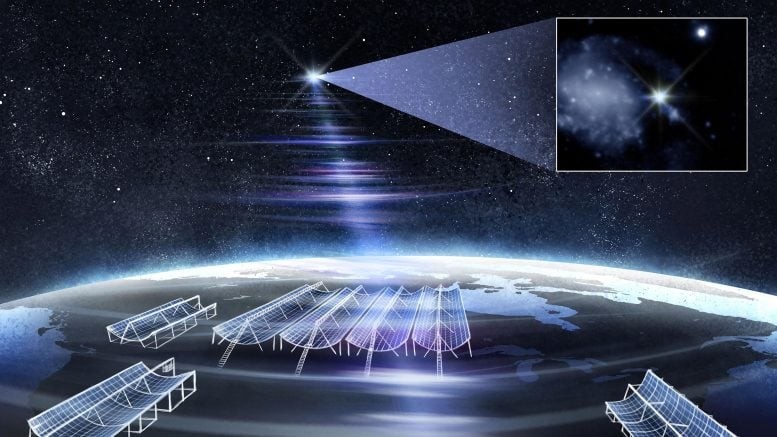
Figure 1. Fast Radio Burst.
The newly identified event, dubbed FRB 20250316A—or RBFLOAT (“Radio Brightest Flash of All Time”)—was located with exceptional precision using CHIME’s network of FRB Outrigger telescopes in British Columbia, Northern California, and West Virginia. These instruments rely on Very Long Baseline Interferometry (VLBI) to triangulate signals with extraordinary accuracy. Figure 1 shows Fast Radio Burst.
“We were incredibly lucky to capture it,” said Mattias Lazda, a doctoral researcher at the University of Toronto. “Just hours later, a power outage struck one of our key telescope sites. Had the burst arrived any later, we might have missed it entirely.”
RBFLOAT, detected on March 16, 2025, lasted just 0.2 seconds but shone brighter than any FRB ever observed. Its remarkable luminosity is partly due to its origin in NGC 4141, a galaxy roughly 130 million light-years away in Ursa Major [1]. The team pinpointed the burst’s source to a region only 45 light-years across—an unprecedented level of precision, comparable to locating a guitar pick from 1,000 kilometers away.
Follow-up observations with the James Webb Space Telescope (JWST) revealed a faint infrared signal matching RBFLOAT’s position. This unexpected detection could represent a red giant star or a light echo from the burst itself, suggesting JWST’s potential to explore the stellar environments surrounding FRBs in detail.
“This is the first time we’ve been able to resolve individual stars around an FRB,” noted Peter Blanchard, a Harvard postdoctoral fellow and lead author of the JWST companion study. “It gives us a powerful new tool to investigate what kinds of stars and environments produce these extraordinary bursts.”
Despite its brilliance, RBFLOAT has not repeated, even after reviewing more than six years of CHIME data. This challenges one of the field’s central assumptions—that all FRBs repeat over time.
“This event breaks the pattern,” said Amanda Cook, a postdoctoral researcher at McGill University. “Its silence suggests that at least some FRBs may stem from explosive, one-time cosmic events rather than ongoing processes.”
Two studies detailing the discovery were published on August 25 in The Astrophysical Journal Letters. Together, they mark a milestone in understanding FRBs—not just as cosmic curiosities, but as powerful probes into the structure and evolution of the universe.
Reference:
- https://scitechdaily.com/cosmic-mystery-brightest-frb-ever-seen-doesnt-repeat-baffling-astronomers/
Cite this article:
Keerthana S (2025), Cosmic Enigma: Brightest-Ever Fast Radio Burst Stuns Astronomers with Its Silence, AnaTechMaz, pp.563
Recent Post
-
ESA Mars Orbiters Capture Rare Interstellar Comet Older Than the Sun
ESA’s ExoMars Trace Gas Orbiter (TGO) and Mars Express....
-
Scientists Suggest Dark Matter Could Leave a Distinct ‘Fingerprint’ on Light
Dark matter, the enigmatic substance that makes up about 27%...
-
World’s Strongest Rocket Successfully Completes 11th Suborbital Test Ahead of Moon and Mars Missions
SpaceX’s colossal Starship...
-
Human Missions to Mars Could Shrink Hearts and Weaken Bones: The Deadly Risks Explained
It’s been more than 50 years since humans last walked on the....
-
Cosmic Timekeepers Uncover Mysterious Ripples in Spacetime
A recent study introduces a novel way to tell apart different origins of nanohertz gravitational waves....
-
“An Astonishing Discovery” – Scientists Detect a Supermassive Black Hole Where None Was Expected
In a discovery that defies ....
-
Scientists Detect Black Hole “Ringing,” Proving Hawking’s Long-Standing Theory
Ten years after humanity first detected gravitational waves, scientists...
-
Cosmic Enigma: Brightest-Ever Fast Radio Burst Stuns Astronomers with Its Silence
Astronomers have traced the brightest Fast Radio Burst (FRB) ever...
-
JWST Discovers a “Impossible” Planet Composed Mostly of Carbon
In a finding that challenges existing models of how planets form, astronomers using the James...
Physicists Predict the Universe Could End in a “Big Crunch”
New research from Cornell University suggests that the universe’s expansion may not continue forever.....
-
This Simple Earth Organism Might Be Able to Live on Mars
A team of Indian scientists has found that baker’s yeast can withstand harsh, Mars-like conditions involving....
-
This Minuscule Dark Object Might Change our Understanding of the Universe
Because the object emits no light or detectable radiation, researchers spotted it...
-
Astronomers Shocked as Black Hole Surpasses Known Growth Limits
The black hole powers a quasar—a brilliant celestial object that outshines...
-
Century-Old Black Hole Mystery Finally Solved by Scientists
For almost two centuries, astronomers were puzzled by a bright object in the constellation Virgo..
-
Closest Alien Civilization May Lurk 33,000 Light-Years from Earth
A planet’s carbon dioxide levels play a crucial role in sustaining life. With enough CO₂, a planet can...