

“An Astonishing Discovery” – Scientists Detect a Supermassive Black Hole Where None Was Expected
In a discovery that defies expectations, astronomers have observed the fastest and brightest radio flares ever produced by a black hole devouring a star — and it happened far from the center of its galaxy.
For the first time, researchers have identified a tidal disruption event (TDE) — when a black hole tears apart a passing star — occurring well outside a galactic core. The rare outburst, named AT 2024tvd, challenges the long-held belief that supermassive black holes remain anchored at the heart of galaxies. Instead, it suggests these cosmic giants can wander and stay active in unexpected regions of space.
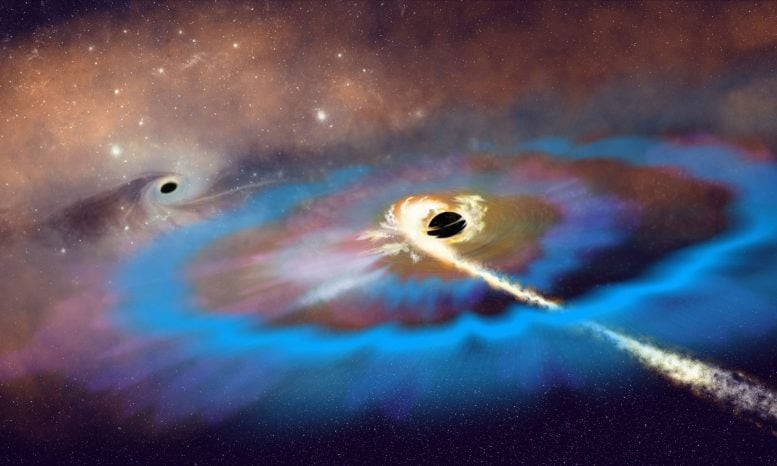
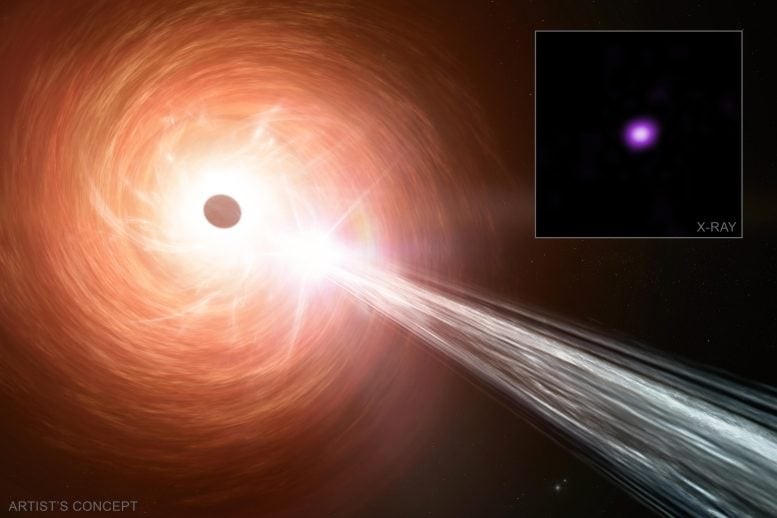
Figure 1. Supermassive Black Hole.
The event’s intense and rapidly changing radio waves point to new, unexplored mechanisms governing how black holes eject material long after consuming a star. The discovery was led by Dr. Itai Safadi and Prof. Raffaella Margutti of the University of California, Berkeley, in collaboration with an international team that included Prof. Assaf Horesh from the Hebrew University of Jerusalem. Figure 1 shows Supermassive Black Hole.
“This is truly extraordinary,” said Dr. Sfaradi, lead author of the study. “We’ve never seen such bright, rapidly evolving radio emission from a black hole destroying a star — and certainly not one located this far from a galaxy’s center. It forces us to rethink how and where supermassive black holes can exist.”
Prof. Horesh, Sfaradi’s former graduate advisor, added, “It’s one of the most remarkable discoveries I’ve been involved in — and even more meaningful to see it led by my former student. It’s another milestone placing Israel at the forefront of global astrophysics.”
A Black Hole Far from Home
Tidal disruption events occur when a star strays too close to a massive black hole and is ripped apart by its gravity [1]. In this case, the black hole sits around 2,600 light-years (0.8 kiloparsecs) from the galaxy’s nucleus — clear evidence that supermassive black holes can exist well beyond galactic centers.
Radio Telescopes Reveal the Mystery
The finding was made possible through observations from several of the world’s top radio observatories — including the Very Large Array (VLA), ALMA, ATA, SMA, and the Arcminute Microkelvin Imager Large Array (AMI-LA) in the UK.
The Hebrew University team’s AMI data proved pivotal in tracking the event’s unusually fast-evolving radio signals — the quickest ever recorded from a TDE. The data revealed two distinct radio flares, evolving more rapidly than any previously known event.
These results suggest that powerful outflows of material were launched from the black hole months after the star’s destruction, pointing to a delayed, multi-phase process. Modeling shows at least two separate ejection episodes, revealing that black holes can periodically “reignite” — awakening from apparent dormancy long after a cataclysmic feast.
Reference:
- https://scitechdaily.com/truly-extraordinary-supermassive-black-hole-found-in-the-last-place-scientists-expected/
Cite this article:
Keerthana S (2025), “An Astonishing Discovery” – Scientists Detect a Supermassive Black Hole Where None Was Expected, AnaTechMaz, pp.561
Recent Post
-
ESA Mars Orbiters Capture Rare Interstellar Comet Older Than the Sun
ESA’s ExoMars Trace Gas Orbiter (TGO) and Mars Express....
-
Scientists Suggest Dark Matter Could Leave a Distinct ‘Fingerprint’ on Light
Dark matter, the enigmatic substance that makes up about 27%...
-

World’s Strongest Rocket Successfully Completes 11th Suborbital Test Ahead of Moon and Mars Missions
SpaceX’s colossal Starship...
-

Human Missions to Mars Could Shrink Hearts and Weaken Bones: The Deadly Risks Explained
It’s been more than 50 years since humans last walked on the....
-
Cosmic Timekeepers Uncover Mysterious Ripples in Spacetime
A recent study introduces a novel way to tell apart different origins of nanohertz gravitational waves....
-
“An Astonishing Discovery” – Scientists Detect a Supermassive Black Hole Where None Was Expected
In a discovery that defies ....
-
Scientists Detect Black Hole “Ringing,” Proving Hawking’s Long-Standing Theory
Ten years after humanity first detected gravitational waves, scientists...
-
Cosmic Enigma: Brightest-Ever Fast Radio Burst Stuns Astronomers with Its Silence
Astronomers have traced the brightest Fast Radio Burst (FRB) ever...
-
JWST Discovers a “Impossible” Planet Composed Mostly of Carbon
In a finding that challenges existing models of how planets form, astronomers using the James...
Physicists Predict the Universe Could End in a “Big Crunch”
New research from Cornell University suggests that the universe’s expansion may not continue forever.....
-

This Simple Earth Organism Might Be Able to Live on Mars
A team of Indian scientists has found that baker’s yeast can withstand harsh, Mars-like conditions involving....
-
This Minuscule Dark Object Might Change our Understanding of the Universe
Because the object emits no light or detectable radiation, researchers spotted it...
-
Astronomers Shocked as Black Hole Surpasses Known Growth Limits
The black hole powers a quasar—a brilliant celestial object that outshines...
-
Century-Old Black Hole Mystery Finally Solved by Scientists
For almost two centuries, astronomers were puzzled by a bright object in the constellation Virgo..
-
Closest Alien Civilization May Lurk 33,000 Light-Years from Earth
A planet’s carbon dioxide levels play a crucial role in sustaining life. With enough CO₂, a planet can...