

Cosmic Timekeepers Uncover Mysterious Ripples in Spacetime
A recent study introduces a novel way to tell apart different origins of nanohertz gravitational waves—ultra–low-frequency ripples in spacetime that pulsars may be subtly revealing.
In 2023, international pulsar timing array collaborations detected signals hinting at these faint cosmic vibrations. The findings could represent either a stochastic gravitational-wave background—the blended hum of countless distant sources—or emissions from a single, nearby pair of orbiting supermassive black holes.
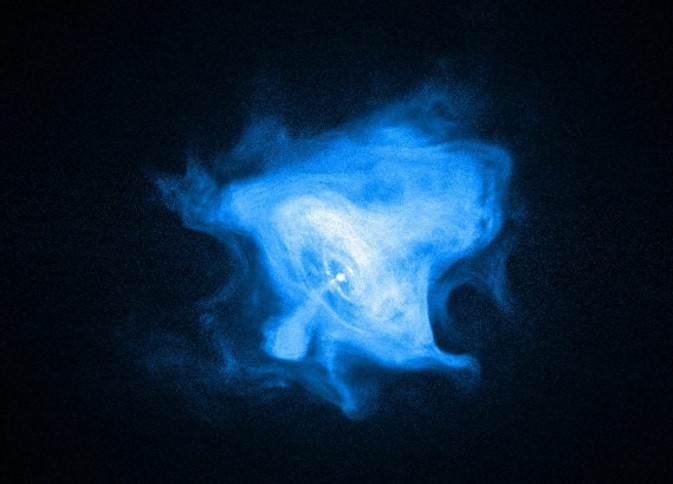
Figure 1. Ripples in Spacetime.
To differentiate between these possibilities, theoretical physicist Hideki Asada, a professor at Hirosaki University, and Shun Yamamoto, a researcher at the same institution, have proposed an innovative method. Their approach focuses on identifying beat phenomena—interference patterns produced when gravitational waves of nearly identical frequencies overlap. These beats leave subtle but detectable signatures in the timing of pulsar radio pulses recorded on Earth. Figure 1 shows Ripples in Spacetime.
The study, published in the Journal of Cosmology and Astroparticle Physics (JCAP), builds on the extraordinary precision of pulsars—dense, rapidly spinning neutron stars that act as natural “cosmic clocks.” Astronomers track their steady radio pulses to probe both the pulsars and the very fabric of the universe. When gravitational waves pass between a pulsar and Earth, they minutely alter the rhythm of these pulses, creating telltale, coordinated distortions across multiple pulsars.
Growing Evidence for Nanohertz Gravitational Waves
“As of 2023, several major collaborations—including NANOGrav in the US and European teams—reported strong evidence for nanohertz gravitational waves,” Asada explains [1]. These waves, with periods spanning months to years and wavelengths stretching across light-years, can only be detected through long-term monitoring of distant, stable pulsars. “The signals are statistically solid but still shy of the 5-sigma confidence level required for a formal discovery,” he adds. “Even so, many in the field believe we’re on the verge of confirming nanohertz gravitational waves.”
Once confirmed, the next step will be to pinpoint their source. Acc ording to Asada, there are two main contenders:
- Cosmic inflation, which could have produced primordial spacetime ripples in the early universe.
- Supermassive black hole binaries, formed when galaxies merge and their central black holes orbit each other.
Listening for the Universe’s “Beats”
“If two nearby supermassive black hole binaries emit waves with similar frequencies, their signals can interfere—creating a beat pattern, much like overlapping musical notes,” says Asada. Detecting this modulation in pulsar data could reveal whether the signal originates from discrete nearby binaries rather than from a diffuse cosmological background.
Their approach, inspired by familiar acoustic principles, transforms pulsar timing arrays into instruments capable of “listening” for these cosmic beats.
As the precision of pulsar timing improves, Asada believes the method could soon be put to the test. “Once we reach a confirmed 5-sigma detection—perhaps within a few years—the next frontier will be identifying the source. That’s where our technique can help determine whether these gravitational waves come from the earliest moments of the universe or from orbiting supermassive black holes nearby.”
Reference:
- https://scitechdaily.com/cosmic-clocks-reveal-hidden-ripples-in-spacetime/
Cite this article:
Keerthana S (2025), Cosmic Timekeepers Uncover Mysterious Ripples in Spacetime, AnaTechMaz, pp.560
Recent Post
-
ESA Mars Orbiters Capture Rare Interstellar Comet Older Than the Sun
ESA’s ExoMars Trace Gas Orbiter (TGO) and Mars Express....
-
Scientists Suggest Dark Matter Could Leave a Distinct ‘Fingerprint’ on Light
Dark matter, the enigmatic substance that makes up about 27%...
-

World’s Strongest Rocket Successfully Completes 11th Suborbital Test Ahead of Moon and Mars Missions
SpaceX’s colossal Starship...
-

Human Missions to Mars Could Shrink Hearts and Weaken Bones: The Deadly Risks Explained
It’s been more than 50 years since humans last walked on the....
-
Cosmic Timekeepers Uncover Mysterious Ripples in Spacetime
A recent study introduces a novel way to tell apart different origins of nanohertz gravitational waves....
-
“An Astonishing Discovery” – Scientists Detect a Supermassive Black Hole Where None Was Expected
In a discovery that defies ....
-
Scientists Detect Black Hole “Ringing,” Proving Hawking’s Long-Standing Theory
Ten years after humanity first detected gravitational waves, scientists...
-
Cosmic Enigma: Brightest-Ever Fast Radio Burst Stuns Astronomers with Its Silence
Astronomers have traced the brightest Fast Radio Burst (FRB) ever...
-
JWST Discovers a “Impossible” Planet Composed Mostly of Carbon
In a finding that challenges existing models of how planets form, astronomers using the James...
Physicists Predict the Universe Could End in a “Big Crunch”
New research from Cornell University suggests that the universe’s expansion may not continue forever.....
-

This Simple Earth Organism Might Be Able to Live on Mars
A team of Indian scientists has found that baker’s yeast can withstand harsh, Mars-like conditions involving....
-
This Minuscule Dark Object Might Change our Understanding of the Universe
Because the object emits no light or detectable radiation, researchers spotted it...
-
Astronomers Shocked as Black Hole Surpasses Known Growth Limits
The black hole powers a quasar—a brilliant celestial object that outshines...
-
Century-Old Black Hole Mystery Finally Solved by Scientists
For almost two centuries, astronomers were puzzled by a bright object in the constellation Virgo..
-
Closest Alien Civilization May Lurk 33,000 Light-Years from Earth
A planet’s carbon dioxide levels play a crucial role in sustaining life. With enough CO₂, a planet can...