

This Simple Earth Organism Might Be Able to Live on Mars
A team of Indian scientists has found that baker’s yeast can withstand harsh, Mars-like conditions involving intense shock waves and toxic perchlorate salts.
Baker’s yeast (Saccharomyces cerevisiae)—best known for its role in baking, brewing, and biotechnology—may now also hold clues to how life could survive on other planets. In a new study, researchers from the Indian Institute of Science (IISc) and the Physical Research Laboratory (PRL) in Ahmedabad discovered that this common microorganism can endure the kinds of stresses found on Mars.
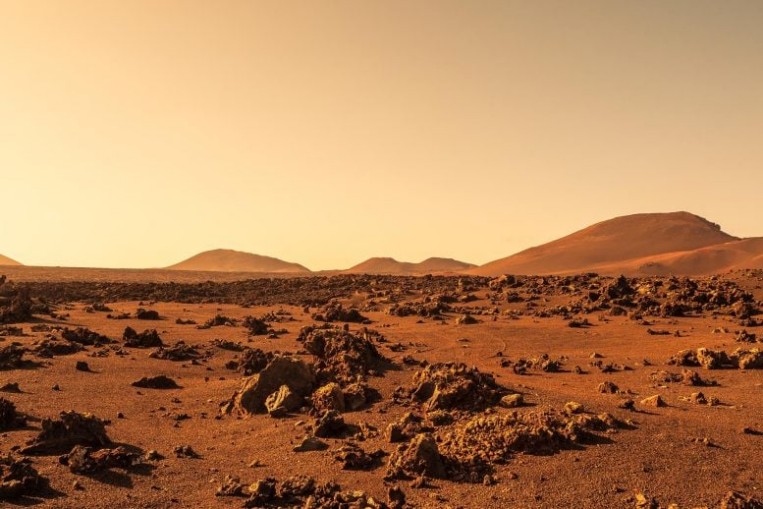
Figure 1. Mars.
To test its limits, the team exposed yeast cells to shock waves similar to those produced by meteorite impacts on the Martian surface, as well as to perchlorate salts—highly toxic compounds detected in Martian soil. Using the High-Intensity Shock Tube for Astrochemistry (HISTA), developed in Balamurugan Sivaraman’s PRL lab, they created shock waves traveling at Mach 5.6 and treated the yeast with 100 mM sodium perchlorate, both separately and together. Figure 1 shows Mars.
“One of the biggest challenges was setting up the HISTA system to expose live yeast cells to shock waves—something never done before—and then recovering them without contamination,” said lead author Riya Dhage, a project assistant in the lab of IISc biochemist Purusharth I. Rajyaguru.
A Resilient Survival Strategy
Surprisingly, the yeast survived both the shock and chemical stress, though their growth slowed. The researchers traced this resilience to the formation of ribonucleoprotein (RNP) condensates—tiny, membrane-less compartments that protect and reorganize RNA under stress [1]. Shock waves triggered two kinds of RNPs—stress granules and P-bodies—while perchlorate exposure led mainly to P-body formation. Mutant yeast unable to form these structures showed far lower survival rates.
This finding suggests that RNP condensates could serve as biomarkers for cellular stress in extraterrestrial environments. “What’s remarkable about this study is how it combines shock-wave physics, astrochemistry, and molecular cell biology to explore how life might adapt to Mars-like extremes,” said Dhage.
According to Rajyaguru, the results highlight baker’s yeast as a valuable model organism for astrobiology research in India. Understanding how cells reorganize RNA and proteins under mechanical and chemical stress could reveal key principles of survival beyond Earth—and even guide future experiments in space.
“We were amazed to see yeast enduring the kinds of extreme conditions we mimicked from Mars,” said Rajyaguru. “Our findings could inspire future missions to include yeast as a test organism for studying life’s resilience in space.”
Reference:
- https://scitechdaily.com/this-common-organism-could-survive-on-mars/
Cite this article:
Keerthana S (2025), This Simple Earth Organism Might Be Able to Live on Mars, AnaTechMaz, pp.566
Recent Post
-
ESA Mars Orbiters Capture Rare Interstellar Comet Older Than the Sun
ESA’s ExoMars Trace Gas Orbiter (TGO) and Mars Express....
-
Scientists Suggest Dark Matter Could Leave a Distinct ‘Fingerprint’ on Light
Dark matter, the enigmatic substance that makes up about 27%...
-
World’s Strongest Rocket Successfully Completes 11th Suborbital Test Ahead of Moon and Mars Missions
SpaceX’s colossal Starship...
-

Human Missions to Mars Could Shrink Hearts and Weaken Bones: The Deadly Risks Explained
It’s been more than 50 years since humans last walked on the....
-
Cosmic Timekeepers Uncover Mysterious Ripples in Spacetime
A recent study introduces a novel way to tell apart different origins of nanohertz gravitational waves....
-
“An Astonishing Discovery” – Scientists Detect a Supermassive Black Hole Where None Was Expected
In a discovery that defies ....
-
Scientists Detect Black Hole “Ringing,” Proving Hawking’s Long-Standing Theory
Ten years after humanity first detected gravitational waves, scientists...
-
Cosmic Enigma: Brightest-Ever Fast Radio Burst Stuns Astronomers with Its Silence
Astronomers have traced the brightest Fast Radio Burst (FRB) ever...
-
JWST Discovers a “Impossible” Planet Composed Mostly of Carbon
In a finding that challenges existing models of how planets form, astronomers using the James...
Physicists Predict the Universe Could End in a “Big Crunch”
New research from Cornell University suggests that the universe’s expansion may not continue forever.....
-
This Simple Earth Organism Might Be Able to Live on Mars
A team of Indian scientists has found that baker’s yeast can withstand harsh, Mars-like conditions involving....
-
This Minuscule Dark Object Might Change our Understanding of the Universe
Because the object emits no light or detectable radiation, researchers spotted it...
-
Astronomers Shocked as Black Hole Surpasses Known Growth Limits
The black hole powers a quasar—a brilliant celestial object that outshines...
-
Century-Old Black Hole Mystery Finally Solved by Scientists
For almost two centuries, astronomers were puzzled by a bright object in the constellation Virgo..
-
Closest Alien Civilization May Lurk 33,000 Light-Years from Earth
A planet’s carbon dioxide levels play a crucial role in sustaining life. With enough CO₂, a planet can...