

ESA Mars Orbiters Capture Rare Interstellar Comet Older Than the Sun
ESA’s ExoMars Trace Gas Orbiter (TGO) and Mars Express spacecraft have captured remarkable images of the interstellar comet 3I/ATLAS as it passed close to Mars, revealing a faint but distinct glowing coma around its icy core. Scientists are now studying the data to uncover new insights about this rare cosmic visitor from beyond our Solar System.
A Rare Encounter Near Mars
Between October 1 and 7, both orbiters turned their instruments toward comet 3I/ATLAS as it made a close approach to Mars—coming within about 30 million kilometers on October 3. These two ESA spacecrafts had the best vantage points for observing the comet, despite the immense distance and faintness of the target.
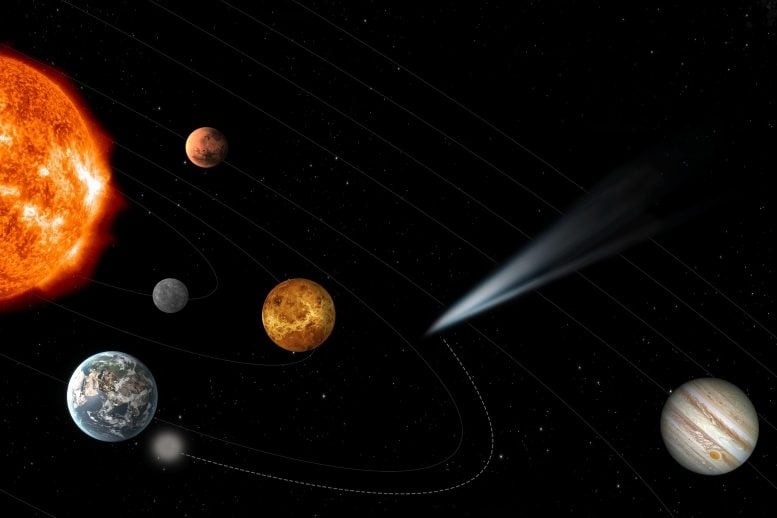
Figure 1. Interstellar Comet.
The CaSSIS camera on ExoMars TGO captured a sequence of images showing 3I/ATLAS as a tiny, slightly blurred white dot drifting across space. That faint speck marks the comet’s nucleus and the surrounding coma, a hazy envelope of gas and dust released as the comet warms while approaching the Sun. The nucleus itself is only about a kilometer wide—detecting it from Mars is as difficult as spotting a mobile phone on the Moon from Earth. Figure 1 shows interstellar comet.
The Awakening Coma
The coma, stretching thousands of kilometers, forms as sunlight heats the comet, releasing gas and dust from its frozen surface. While the CaSSIS images couldn’t capture the entire coma or the comet’s faint tail, future observations may reveal more detail as 3I/ATLAS grows more active on its journey toward the Sun.
Nick Thomas, Principal Investigator of CaSSIS, explained, “This was an extremely challenging observation. The comet is tens of thousands of times fainter than our usual targets.”
Searching the Data
The Mars Express images have yet to reveal 3I/ATLAS clearly due to their shorter exposure times, but scientists plan to stack multiple images to enhance visibility. Researchers are also analyzing data from OMEGA, SPICAM, and NOMAD spectrometers to determine the comet’s composition, though it remains uncertain whether the object was bright enough for detailed spectral measurements.
Colin Wilson, ESA’s Mars Express and ExoMars project scientist, said, “While our orbiters continue to make major contributions to Mars research, it’s thrilling to see them respond to unexpected cosmic events like this one. We’re eager to see what the analysis uncovers.”
An Ancient Traveler from Beyond the Solar System
Comet 3I/ATLAS is only the third known interstellar comet, following 1I/ʻOumuamua in 2017 and 2I/Borisov in 2019. Unlike typical comets that formed within our Solar System, interstellar comets are true outsiders—ancient remnants from other star systems.
Discovered on July 1, 2025, by the ATLAS telescope in Chile, 3I/ATLAS could be three billion years older than the Solar System itself, making it one of the oldest known objects ever observed.
Looking Ahead: Future Missions and Discoveries
Next month, ESA’s Jupiter Icy Moons Explorer (Juice) will observe 3I/ATLAS as it becomes more active near the Sun. Although farther from the comet than the Mars orbiters, Juice will capture valuable data during its post-perihelion phase, with results expected in early 2026.
ESA is also preparing for the Comet Interceptor mission, launching in 2029, which will wait in orbit to intercept a pristine comet—or perhaps another interstellar object like 3I/ATLAS.
Michael Kueppers, ESA’s Comet Interceptor project scientist, said, “When Comet Interceptor was first proposed, we knew of only one interstellar object. Now we’ve found more, each very different. Reaching one could revolutionize our understanding of these mysterious visitors.”
These encounters mark humanity’s growing ability to study the oldest, most distant materials in the galaxy—relics that hold clues to how stars, planets, and possibly life itself first formed.
Reference:
- https://scitechdaily.com/rare-comet-older-than-the-sun-seen-by-mars-orbiters/
Cite this article:
Keerthana S (2025), ESA Mars Orbiters Capture Rare Interstellar Comet Older Than the Sun, AnaTechMaz, pp.556
Recent Post
-
ESA Mars Orbiters Capture Rare Interstellar Comet Older Than the Sun
ESA’s ExoMars Trace Gas Orbiter (TGO) and Mars Express....
-
Scientists Suggest Dark Matter Could Leave a Distinct ‘Fingerprint’ on Light
Dark matter, the enigmatic substance that makes up about 27%...
-

World’s Strongest Rocket Successfully Completes 11th Suborbital Test Ahead of Moon and Mars Missions
SpaceX’s colossal Starship...
-

Human Missions to Mars Could Shrink Hearts and Weaken Bones: The Deadly Risks Explained
It’s been more than 50 years since humans last walked on the....
-
Cosmic Timekeepers Uncover Mysterious Ripples in Spacetime
A recent study introduces a novel way to tell apart different origins of nanohertz gravitational waves....
-
“An Astonishing Discovery” – Scientists Detect a Supermassive Black Hole Where None Was Expected
In a discovery that defies ....
-
Scientists Detect Black Hole “Ringing,” Proving Hawking’s Long-Standing Theory
Ten years after humanity first detected gravitational waves, scientists...
-

Cosmic Enigma: Brightest-Ever Fast Radio Burst Stuns Astronomers with Its Silence
Astronomers have traced the brightest Fast Radio Burst (FRB) ever...
-
JWST Discovers a “Impossible” Planet Composed Mostly of Carbon
In a finding that challenges existing models of how planets form, astronomers using the James...

Physicists Predict the Universe Could End in a “Big Crunch”
New research from Cornell University suggests that the universe’s expansion may not continue forever.....
-

This Simple Earth Organism Might Be Able to Live on Mars
A team of Indian scientists has found that baker’s yeast can withstand harsh, Mars-like conditions involving....
-
Astronomers Shocked as Black Hole Surpasses Known Growth Limits
The black hole powers a quasar—a brilliant celestial object that outshines...
-
Century-Old Black Hole Mystery Finally Solved by Scientists
For almost two centuries, astronomers were puzzled by a bright object in the constellation Virgo..
-
Closest Alien Civilization May Lurk 33,000 Light-Years from Earth
A planet’s carbon dioxide levels play a crucial role in sustaining life. With enough CO₂, a planet can...