

Scientists Suggest Dark Matter Could Leave a Distinct ‘Fingerprint’ on Light
Dark matter, the enigmatic substance that makes up about 27% of the universe, may not be as invisible as once thought. While its existence is inferred from its gravitational effects on galaxies and clusters, scientists have yet to directly observe it. A few faint particle interactions have been detected, but they account for only a tiny fraction of the mystery.
Researchers at the University of York suggest a new approach: dark matter could leave subtle “fingerprints” on light. Their study, published in Physics Letters B, proposes that as starlight passes through dark matter, it could acquire a faint red or blue tint depending on the type of dark matter it encounters.
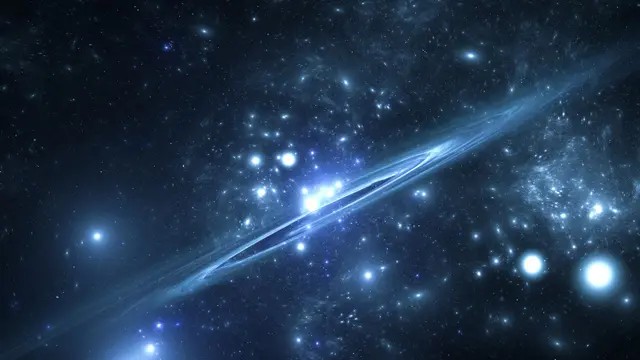
Figure 1. ‘Fingerprint’ on Starlight.
A Potential ‘Color Signature’ of Dark Matter
This theoretical work challenges the long-standing belief that dark matter does not interact with light. Dr. Mikhail Bashkanov of the University of York explains, “Most researchers would agree that dark matter is dark, but we have shown that even the darkest type could still have a kind of color signature. Under certain conditions, this ‘color’ might actually be detectable.” Figure 1 shows ‘Fingerprint’ on Starlight.
With advanced next-generation telescopes, scientists might measure these subtle shifts in light, opening a new avenue to study dark matter and better understand its composition.
The York team’s study is theoretical and draws on a concept they call the “six handshake rules,” suggesting that even if dark matter doesn’t directly interact with light, other particles could mediate the effect, leaving a detectable footprint [1]. Candidate dark matter particles, such as weakly interacting massive particles (WIMPs), might influence light indirectly through interactions with particles like the top quark or Higgs boson.
Searching for the Universe’s Hidden Mass
Dark matter was first proposed in the 1930s and is thought to account for roughly a quarter of the universe’s total mass, with dark energy driving the universe’s accelerating expansion. In 1998, the DAMA experiment in Italy claimed to detect dark matter in the form of WIMPs, though results remain unconfirmed.
Today, billions are being invested in experiments to detect WIMPs, axions, and dark photons. Dr. Bashkanov believes the York study could help focus these efforts: “Our results suggest we can narrow down where and how we should look in the sky, potentially save time and guide the search for dark matter more efficiently.”This new approach could bring astronomers closer than ever to unraveling one of the universe’s greatest mysteries.
Reference:
- https://interestingengineering.com/space/dark-matter-might-interact-with-light
Cite this article:
Keerthana S (2025), Scientists Suggest Dark Matter Could Leave a Distinct ‘Fingerprint’ on Light, AnaTechMaz, pp.557
Recent Post
-
ESA Mars Orbiters Capture Rare Interstellar Comet Older Than the Sun
ESA’s ExoMars Trace Gas Orbiter (TGO) and Mars Express....
-
Scientists Suggest Dark Matter Could Leave a Distinct ‘Fingerprint’ on Light
Dark matter, the enigmatic substance that makes up about 27%...
-

World’s Strongest Rocket Successfully Completes 11th Suborbital Test Ahead of Moon and Mars Missions
SpaceX’s colossal Starship...
-

Human Missions to Mars Could Shrink Hearts and Weaken Bones: The Deadly Risks Explained
It’s been more than 50 years since humans last walked on the....
-
Cosmic Timekeepers Uncover Mysterious Ripples in Spacetime
A recent study introduces a novel way to tell apart different origins of nanohertz gravitational waves....
-
“An Astonishing Discovery” – Scientists Detect a Supermassive Black Hole Where None Was Expected
In a discovery that defies ....
-
Scientists Detect Black Hole “Ringing,” Proving Hawking’s Long-Standing Theory
Ten years after humanity first detected gravitational waves, scientists...
-
Cosmic Enigma: Brightest-Ever Fast Radio Burst Stuns Astronomers with Its Silence
Astronomers have traced the brightest Fast Radio Burst (FRB) ever...
-
JWST Discovers a “Impossible” Planet Composed Mostly of Carbon
In a finding that challenges existing models of how planets form, astronomers using the James...
Physicists Predict the Universe Could End in a “Big Crunch”
New research from Cornell University suggests that the universe’s expansion may not continue forever.....
-

This Simple Earth Organism Might Be Able to Live on Mars
A team of Indian scientists has found that baker’s yeast can withstand harsh, Mars-like conditions involving....
-
This Minuscule Dark Object Might Change our Understanding of the Universe
Because the object emits no light or detectable radiation, researchers spotted it...
-
Astronomers Shocked as Black Hole Surpasses Known Growth Limits
The black hole powers a quasar—a brilliant celestial object that outshines...
-
Century-Old Black Hole Mystery Finally Solved by Scientists
For almost two centuries, astronomers were puzzled by a bright object in the constellation Virgo..
-
Closest Alien Civilization May Lurk 33,000 Light-Years from Earth
A planet’s carbon dioxide levels play a crucial role in sustaining life. With enough CO₂, a planet can...