

AI Uncovers Hidden Martian Storms Blasting Across the Planet At 160 Km/H
Mars may look calm and lifeless from a distance, but new research reveals that the planet is alive with powerful winds and towering dust devils racing across its surface.
By applying deep learning to tens of thousands of images captured by European orbiters, scientists have discovered that Martian winds can reach speeds of up to 160 km/h — far stronger than previously thought. These fast-moving air currents play a major role in shaping Mars’ climate by lifting massive amounts of dust into the atmosphere, influencing everything from weather patterns to surface formations.
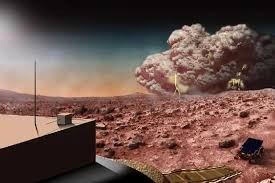
Figure 1. Martian Storms.
Hidden Winds of the Red Planet
The breakthrough comes from an international research team led by the University of Bern, which used advanced AI to analyze data from the CaSSIS (Color and Stereo Surface Imaging System) and HRSC (High Resolution Stereo Camera) onboard ESA’s ExoMars Trace Gas Orbiter and Mars Express missions. Despite its thin atmosphere, Mars experiences winds strong enough to form swirling columns of dust — known as dust devils — that tower high above the surface. Figure 1 shows Martian Storms.
“These dust devils act like natural tracers, revealing how dynamic the Martian atmosphere really is,” said Dr. Valentin Bickel, lead researcher from the University of Bern’s Center for Space and Habitability. “Our findings show that both the winds and dust devils are much faster and more powerful than we ever expected.”
Deep Learning Uncovers Thousands of Dust Devils
Using a state-of-the-art deep learning system, Bickel’s team analyzed over 50,000 satellite images, identifying thousands of dust devils across Mars. By comparing stereo images — pairs of photos taken seconds apart — they could measure the motion and speed of these dust columns [1]. The results revealed winds moving as fast as 44 m/s (160 km/h), far exceeding earlier estimates that placed average Martian winds below 50 km/h.
“These strong, straight-line winds likely inject far more dust into the Martian atmosphere than we previously believed,” said Bickel. “For the first time, we now have global data showing when and where Mars’ winds are powerful enough to lift dust from the surface — spanning nearly two decades of observations.”
Guiding the Future of Mars Exploration
The findings have crucial implications for future Mars missions, according to Dr. Daniela Tirsch of the German Aerospace Center (DLR). “Understanding wind dynamics helps us design safer landings and more resilient equipment,” she explained. The improved atmospheric models will also aid research into Mars’ dunes, slope streaks, and overall climate evolution.
Looking ahead, the research team plans to expand their studies by coordinating more detailed, global observations of dust devils using CaSSIS and HRSC. “Ultimately, this work brings us closer to a complete picture of Martian weather — and to smarter, more efficient exploration of the Red Planet,” Bickel concluded.
Reference:
- https://scitechdaily.com/ai-reveals-mars-hidden-storms-racing-at-160-km-h/
Cite this article:
Keerthana S (2025), AI Uncovers Hidden Martian Storms Blasting Across the Planet At 160 Km/H, AnaTechMaz, pp.554
Recent Post
-
Webb Telescope Spots Uranus’ 29th Moon Missed by Voyager 2 Nearly 40 Years Ago
NASA’s James Webb Space Telescope has uncovered a previously...
-
Small Magnets, Big Impact: A Low-Power Breakthrough for Space Oxygen Generation
Who would have thought a simple magnet could help solve one of..
-
Moon Formation Spotted Around Wandering Planets Drifting Through Space
Free-floating planetary-mass objects — giant, starless bodies....
-
US Classified Military Space Plane Set for New Mission with Hidden Objective
A secret space plane is set to embark on its new mission. The X-37B....
-
NASA’s Space Solar Designs May Cut Battery Use by 70% and Increase Power Output
A new study led by King’s College London suggests that...
-
NASA Spots New Interstellar Object Entering Solar System: Alien Probe Possible?
On July 1, astronomers observed a fast-moving object heading toward....
-
Perseverance Rover Uncovers Possible First Evidence of Life on Mars
A rock sample called “Sapphire Canyon,” taken from the Bright....
-
Physicists Say Black Hole May Explode Within This Decade with 90% Probability
Physicists have traditionally believed that black holes end their lives....
-
Planetary Collisions May Reveal Clues to Alien Habitability
Researchers at Southwest Research Institute, in collaboration with Yale University, have published a....
Earliest Cosmic Magnetic Fields Were as Weak as Brain Waves
Magnetic fields emerging in the Universe’s earliest moments were billions of times weaker than a....
-
Solar Flares Are 6.5 Times Hotter Than Previously Estimated
Researchers at the University of St Andrews have found that particles in solar flares can become up to 6.5.....
-
The Milky Way’s Habitable Zone May Be Larger Than Previously Believed
The Galactic Habitable Zone (GHZ)—the area of a galaxy considered....
-
Researchers Discover Stark Differences Between the Moon’s Near and Far Sides
New insights from China’s Chang’e 6 mission suggest that the....
-
AI Uncovers Hidden Martian Storms Blasting Across the Planet At 160 Km/H
Mars may look calm and lifeless from a distance, but new research...
-
NASA’s Terra Satellite Detects Strength of Tropical Storm 07W from the Side
Wind shear can push clouds and thunderstorms away from...