

Moon Formation Spotted Around Wandering Planets Drifting Through Space
Free-floating planetary-mass objects — giant, starless bodies drifting untethered through the galaxy — appear capable of forming their own moon systems, creating miniature versions of planetary systems.
Fresh observations from the James Webb Space Telescope (JWST) reveal that several rogue planets, each with a mass between five and 10 Jupiters, are surrounded by disks rich in crystalline silicates. These structures strongly resemble the protoplanetary disks found around young stars, the very environments where planets are born.
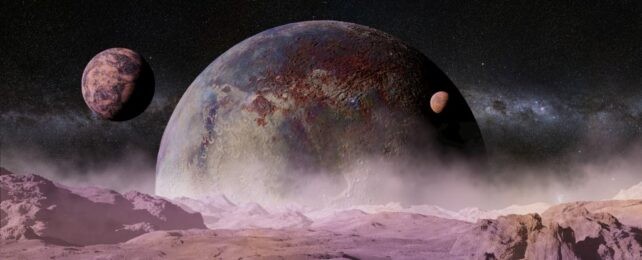
Figure 1. Planets.
“These studies show that objects with masses similar to giant planets can potentially build their own scaled-down planetary systems,” explains Aleks Scholz, an astronomer at the University of St Andrews. “They could mirror the Solar System, only reduced by a factor of 100 or more in size and mass. Whether such systems actually exist remains to be proven.” Figure 1 shows Planets.
Rogue planets, also known as free-floating planetary-mass objects (FFPMOs), have only recently come into focus. JWST has uncovered dozens of these lonely wanderers in nebulae where stars are actively forming. Their origins are uncertain: some may be planets ejected from newborn solar systems by gravitational chaos, while others could have formed directly from collapsing gas clouds, much like stars themselves.
Previous studies showed that FFPMOs can carry surrounding disks of dust and gas. JWST’s latest findings take this further. By examining eight FFPMOs in the Orion Nebula, astronomers detected hydrocarbon and silicate grains within their disks, with evidence of dust growth and crystallization — processes also seen in young star systems on the path to planet formation.
This discovery hints that rogue planets could one day host moons, rings, and possibly complex satellite systems, much like scaled-down versions of Jupiter or Saturn [1]. Considering that astronomers have yet to confirm a single exomoon beyond the Solar System, the possibility that free-floating worlds might be building them is groundbreaking.
“The building blocks for planetary formation exist even around objects barely larger than Jupiter, drifting alone in space,” notes astrophysicist Belinda Damian of the University of St Andrews, who led the study. “This means planetary systems are not limited to stars — they might also emerge around solitary, starless worlds.”
Reference:
- https://www.sciencealert.com/rogue-planets-floating-in-space-appear-to-be-forming-their-own-moons
Cite this article:
Keerthana S (2025), Moon Formation Spotted Around Wandering Planets Drifting Through Space, AnaTechMaz, pp.543
Recent Post
-
Webb Telescope Spots Uranus’ 29th Moon Missed by Voyager 2 Nearly 40 Years Ago
NASA’s James Webb Space Telescope has uncovered a previously...
-
Small Magnets, Big Impact: A Low-Power Breakthrough for Space Oxygen Generation
Who would have thought a simple magnet could help solve one of..
-
Moon Formation Spotted Around Wandering Planets Drifting Through Space
Free-floating planetary-mass objects — giant, starless bodies....
-
US Classified Military Space Plane Set for New Mission with Hidden Objective
A secret space plane is set to embark on its new mission. The X-37B....
-
NASA’s Space Solar Designs May Cut Battery Use by 70% and Increase Power Output
A new study led by King’s College London suggests that...
-
NASA Spots New Interstellar Object Entering Solar System: Alien Probe Possible?
On July 1, astronomers observed a fast-moving object heading toward....
-
Perseverance Rover Uncovers Possible First Evidence of Life on Mars
A rock sample called “Sapphire Canyon,” taken from the Bright....
-
Physicists Say Black Hole May Explode Within This Decade with 90% Probability
Physicists have traditionally believed that black holes end their lives....
-
Planetary Collisions May Reveal Clues to Alien Habitability
Researchers at Southwest Research Institute, in collaboration with Yale University, have published a....
Earliest Cosmic Magnetic Fields Were as Weak as Brain Waves
Magnetic fields emerging in the Universe’s earliest moments were billions of times weaker than a....
-
Solar Flares Are 6.5 Times Hotter Than Previously Estimated
Researchers at the University of St Andrews have found that particles in solar flares can become up to 6.5.....
-
The Milky Way’s Habitable Zone May Be Larger Than Previously Believed
The Galactic Habitable Zone (GHZ)—the area of a galaxy considered....
-
Researchers Discover Stark Differences Between the Moon’s Near and Far Sides
New insights from China’s Chang’e 6 mission suggest that the....
-
AI Uncovers Hidden Martian Storms Blasting Across the Planet At 160 Km/H
Mars may look calm and lifeless from a distance, but new research...
-
NASA’s Terra Satellite Detects Strength of Tropical Storm 07W from the Side
Wind shear can push clouds and thunderstorms away from...