

Planetary Collisions May Reveal Clues to Alien Habitability
The history of planetary impacts should be regarded as a crucial factor when assessing the habitability of Earth-like exoplanets.
Researchers at Southwest Research Institute, in collaboration with Yale University, have published a review summarizing recent progress in understanding the formation and evolution of rocky inner planets, or terrestrial planets. Their Nature Reviews paper explores the role of late accretion in shaping these planets’ physical and chemical properties and its implications for their potential to support life.
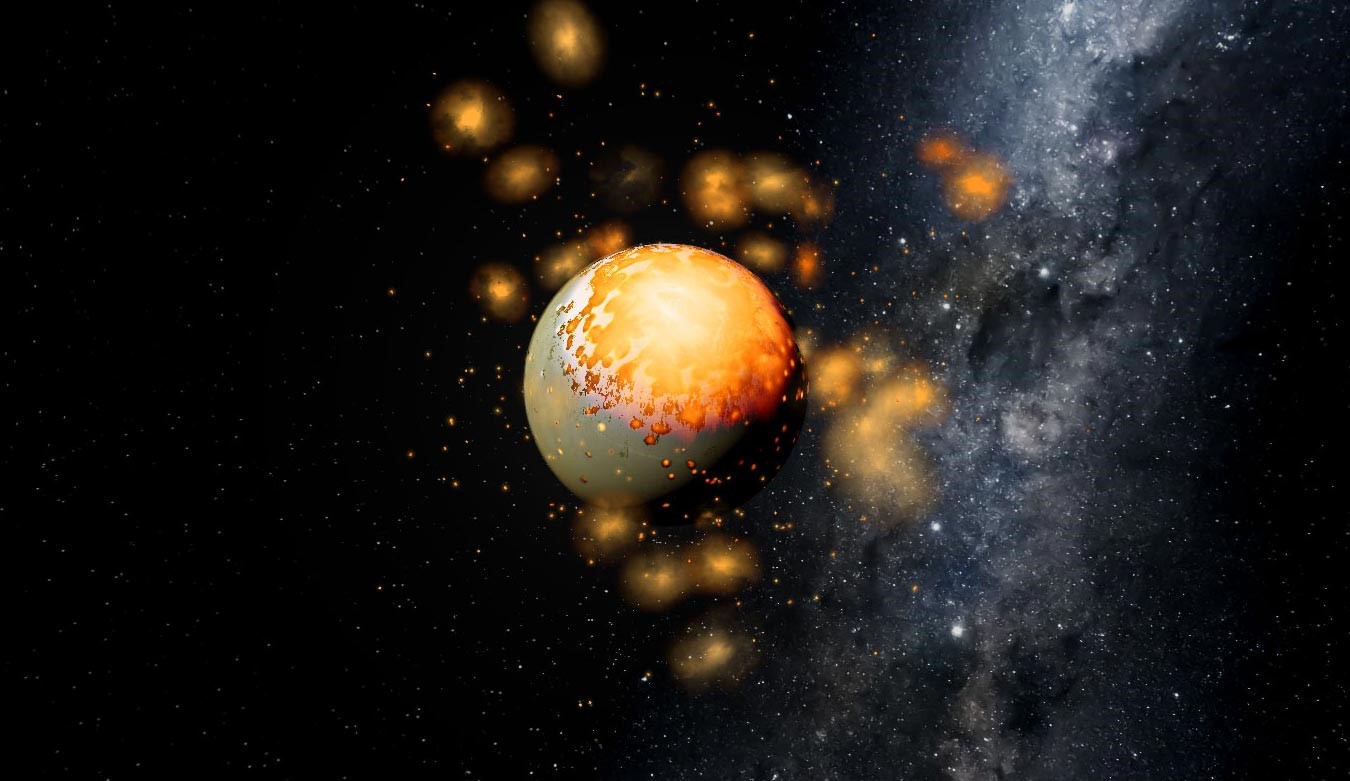
Figure 1. Early Venus-Earth Impact Comparison
Stars and planets form when massive clouds of gas and dust collapse under gravity, creating a central star, like the Sun, surrounded by a disk of material that gradually coalesces. Within this disk, terrestrial planets—Mercury, Venus, Earth, and Mars—emerged as small rocky fragments collided to form larger planetesimals, which then grew into protoplanets. Late collisions were particularly influential during this stage. Earth, for example, was the last of the four to fully form, reaching about 99% of its final size within 60 to 100 million years after the first solid materials appeared. Figure 1 shows Early Venus-Earth Impact Comparison.
The Impact of Late Accretion
“Late accretion—the final 1% of a planet’s growth—plays a disproportionately large role in shaping the long-term evolution of Earth and other terrestrial planets,” said Dr. Simone Marchi, lead author and researcher at SwRI’s Solar System Science and Exploration Division in Boulder, Colorado. “Variations in late accretion may help explain the differences in planetary properties. Using large-scale impact simulations, we have made progress in constraining the history of these late collisions and understanding their effects on a planet’s interior, crust, and atmosphere.”
Recent geochemical analyses of meteorites and Earth rocks have improved our understanding of planetary formation. These studies highlight that collisions and their consequences are key drivers in the long-term evolution of terrestrial planets. For example, Venus and Earth’s tectonics, atmospheres, and water inventories appear linked to late accretion, while Mars’ surface diversity and Mercury’s high metal-to-silicate ratio are also tied to major late impacts.
Following the Journey of Impacting Bodies
“The fate of material from an impactor is key to understanding how a planet’s physical and chemical characteristics evolve,” said Marchi. “By examining elements that preferentially bond with metals in a planet’s mantle and crust, we can trace the timing and processes that shaped the formation of its core, mantle, and crust.”
Impacts also have a major effect on planetary atmospheres, particularly the levels of volatile elements like water and carbon [1]. Collisions can strip away existing atmospheres or, alternatively, deliver volatile-rich material to a planet’s surface and atmosphere. Studying these volatiles provides important insights into the formation, evolution, and potential habitability of terrestrial planets.
“These processes likely influenced early Earth’s prebiotic chemistry, though their exact role in the origin of life remains unknown,” Marchi said.
Reference:
- https://scitechdaily.com/planetary-collisions-could-hold-the-key-to-alien-habitability/
Cite this article:
Janani R (2025), Planetary Collisions May Reveal Clues to Alien Habitability, AnaTechMaz, pp.549
Recent Post
-
Webb Telescope Spots Uranus’ 29th Moon Missed by Voyager 2 Nearly 40 Years Ago
NASA’s James Webb Space Telescope has uncovered a previously...
-
Small Magnets, Big Impact: A Low-Power Breakthrough for Space Oxygen Generation
Who would have thought a simple magnet could help solve one of..
-
Moon Formation Spotted Around Wandering Planets Drifting Through Space
Free-floating planetary-mass objects — giant, starless bodies....
-
US Classified Military Space Plane Set for New Mission with Hidden Objective
A secret space plane is set to embark on its new mission. The X-37B....
-
NASA’s Space Solar Designs May Cut Battery Use by 70% and Increase Power Output
A new study led by King’s College London suggests that...
-
NASA Spots New Interstellar Object Entering Solar System: Alien Probe Possible?
On July 1, astronomers observed a fast-moving object heading toward....
-
Perseverance Rover Uncovers Possible First Evidence of Life on Mars
A rock sample called “Sapphire Canyon,” taken from the Bright....
-
Physicists Say Black Hole May Explode Within This Decade with 90% Probability
Physicists have traditionally believed that black holes end their lives....
-
Planetary Collisions May Reveal Clues to Alien Habitability
Researchers at Southwest Research Institute, in collaboration with Yale University, have published a....
Earliest Cosmic Magnetic Fields Were as Weak as Brain Waves
Magnetic fields emerging in the Universe’s earliest moments were billions of times weaker than a....
-
Solar Flares Are 6.5 Times Hotter Than Previously Estimated
Researchers at the University of St Andrews have found that particles in solar flares can become up to 6.5.....
-
The Milky Way’s Habitable Zone May Be Larger Than Previously Believed
The Galactic Habitable Zone (GHZ)—the area of a galaxy considered....
-
Researchers Discover Stark Differences Between the Moon’s Near and Far Sides
New insights from China’s Chang’e 6 mission suggest that the....
-
AI Uncovers Hidden Martian Storms Blasting Across the Planet At 160 Km/H
Mars may look calm and lifeless from a distance, but new research...
-
NASA’s Terra Satellite Detects Strength of Tropical Storm 07W from the Side
Wind shear can push clouds and thunderstorms away from...