

Webb Telescope Spots Uranus’ 29th Moon Missed by Voyager 2 Nearly 40 Years Ago
NASA’s James Webb Space Telescope has uncovered a previously unknown moon orbiting Uranus, raising the planet’s tally to 29. The discovery, led by scientists from the Southwest Research Institute (SwRI), adds a new piece to the puzzle of Uranus’ intricate satellite system.
The faint object was detected on February 2 using Webb’s Near-Infrared Camera (NIRCam), appearing in a sequence of ten long-exposure images.
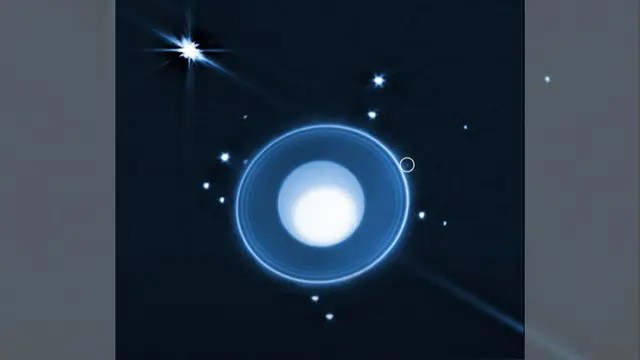
Figure 1. Webb Telescope Spots Uranus.
“This moon was spotted across a series of 40-minute exposures captured by NIRCam,” explained Maryame El Moutamid, lead scientist at SwRI’s Solar System Science and Exploration Division in Boulder, Colorado. “Although it’s small, it’s a remarkable find—something even Voyager 2 missed during its historic flyby almost 40 years ago.” Figure 1 shows Webb Telescope Spots Uranus.
Based on brightness comparisons with Uranus’ other small moons, researchers estimate the new satellite to be just six miles (10 kilometers) across. Its diminutive size likely kept it hidden from Voyager 2 and ground-based telescopes.
A crowded inner system
The new addition further complicates Uranus’ unusually dense collection of inner moons. “No other planet has as many small inner satellites as Uranus,” said Matthew Tiscareno of the SETI Institute, a member of the research team. “Their interactions with the rings hint at a chaotic past that blurs the line between a moon system and a ring system.”
This newly spotted body is even smaller and fainter than Uranus’ faintest known inner moons, suggesting the planet’s satellite network may be more complex than previously thought. It becomes the 14th known object orbiting inside Uranus’ five major moons—Miranda, Ariel, Umbriel, Titania, and Oberon. In keeping with tradition, the International Astronomical Union (IAU) will later assign it an official name.
Orbit and origin
Calculations show the moon circles Uranus at about 35,000 miles (56,000 kilometers) from the planet’s center, between the orbits of Ophelia and Bianca. Its nearly circular path suggests it likely formed close to its current location.
The find underscores the power of Webb’s infrared instruments, which can reveal faint and distant objects that earlier missions and observatories could not. With this discovery, Uranus’ mysterious system of moons and rings has become even more intriguing.
Reference:
- https://interestingengineering.com/space/uranus-29th-moon-webb-discovery
Cite this article:
Keerthana S (2025), Webb Telescope Spots Uranus’ 29th Moon Missed by Voyager 2 Nearly 40 Years Ago, AnaTechMaz, pp.541
Recent Post
-
Webb Telescope Spots Uranus’ 29th Moon Missed by Voyager 2 Nearly 40 Years Ago
NASA’s James Webb Space Telescope has uncovered a previously...
-
Small Magnets, Big Impact: A Low-Power Breakthrough for Space Oxygen Generation
Who would have thought a simple magnet could help solve one of..
-
Moon Formation Spotted Around Wandering Planets Drifting Through Space
Free-floating planetary-mass objects — giant, starless bodies....
-

US Classified Military Space Plane Set for New Mission with Hidden Objective
A secret space plane is set to embark on its new mission. The X-37B....
-
NASA’s Space Solar Designs May Cut Battery Use by 70% and Increase Power Output
A new study led by King’s College London suggests that...
-
NASA Spots New Interstellar Object Entering Solar System: Alien Probe Possible?
On July 1, astronomers observed a fast-moving object heading toward....
-
Perseverance Rover Uncovers Possible First Evidence of Life on Mars
A rock sample called “Sapphire Canyon,” taken from the Bright....
-

Physicists Say Black Hole May Explode Within This Decade with 90% Probability
Physicists have traditionally believed that black holes end their lives....
-
Planetary Collisions May Reveal Clues to Alien Habitability
Researchers at Southwest Research Institute, in collaboration with Yale University, have published a....
Earliest Cosmic Magnetic Fields Were as Weak as Brain Waves
Magnetic fields emerging in the Universe’s earliest moments were billions of times weaker than a....
-
Solar Flares Are 6.5 Times Hotter Than Previously Estimated
Researchers at the University of St Andrews have found that particles in solar flares can become up to 6.5.....
-
The Milky Way’s Habitable Zone May Be Larger Than Previously Believed
The Galactic Habitable Zone (GHZ)—the area of a galaxy considered....
-
Researchers Discover Stark Differences Between the Moon’s Near and Far Sides
New insights from China’s Chang’e 6 mission suggest that the....
-
AI Uncovers Hidden Martian Storms Blasting Across the Planet At 160 Km/H
Mars may look calm and lifeless from a distance, but new research...
-
NASA’s Terra Satellite Detects Strength of Tropical Storm 07W from the Side
Wind shear can push clouds and thunderstorms away from...