

Researchers Discover Stark Differences Between the Moon’s Near and Far Sides
New insights from China’s Chang’e 6 mission suggest that the Moon’s far side is significantly cooler than the side facing Earth, hinting that the “two-faced” nature of the Moon extends deep beneath its surface. Researchers from UCL (University College London) and Peking University analyzed lunar rock and soil samples collected last year from a massive crater on the far side, revealing that lava there formed at temperatures roughly 100 °C lower than comparable near-side samples.
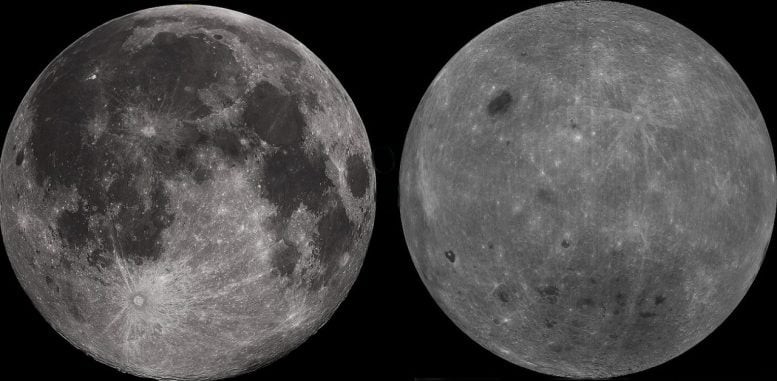
Figure 1. Moon’s Near and Far Sides.
The study, published in Nature Geoscience, confirms that the sample is around 2.8 billion years old. Its mineral composition indicates formation from lava deep inside the Moon at approximately 1,100 °C, cooler than near-side equivalents. Professor Yang Li, co-author, described the findings as the first concrete evidence supporting the long-standing hypothesis that the Moon’s mantle has a significant thermal contrast between near and far sides. Figure 1 shows Moon’s Near and Far Sides.
The far side of the Moon is characterized by a thicker crust, rugged mountains, and more craters, with fewer dark basaltic plains, suggesting reduced volcanic activity. Scientists propose that the cooler interior may result from fewer heat-producing elements like uranium, thorium, and potassium [1]. One possibility is that a giant ancient impact shifted denser, heat-rich materials toward the near side, creating an enduring temperature imbalance.
Alternative explanations include a possible early collision with a smaller moon, giving the near and far sides distinct thermal histories, or that Earth’s gravity keeps the near side slightly warmer. To probe these hypotheses, researchers analyzed 300 g of lunar soil using precision tools, including electron and ion probes, to determine the rock’s composition and age. Comparisons with Apollo mission samples confirmed the ~100 °C temperature difference between the two sides at the time of formation.
Satellite data from Shandong University further supported these findings, indicating a 70 °C difference between the far and near sides’ parent rock temperatures. The distribution of KREEP-rich materials—uranium, thorium, potassium, phosphorus, and rare earth elements—appears concentrated on the near side, potentially explaining its greater volcanic activity.
The results provide fresh insight into the Moon’s formation following a massive collision between Earth and a Mars-sized protoplanet, suggesting that thermal asymmetries created billions of years ago may persist today. While the current temperature difference in the mantle remains uncertain, the study brings scientists closer to unraveling the enduring mystery of the Moon’s two faces, with further research ongoing.
Reference:
- https://scitechdaily.com/scientists-find-a-chilling-divide-between-the-moons-two-faces/
Cite this article:
Keerthana S (2025), Researchers Discover Stark Differences Between the Moon’s Near and Far Sides, AnaTechMaz, pp.553
Recent Post
-
Webb Telescope Spots Uranus’ 29th Moon Missed by Voyager 2 Nearly 40 Years Ago
NASA’s James Webb Space Telescope has uncovered a previously...
-
Small Magnets, Big Impact: A Low-Power Breakthrough for Space Oxygen Generation
Who would have thought a simple magnet could help solve one of..
-

Moon Formation Spotted Around Wandering Planets Drifting Through Space
Free-floating planetary-mass objects — giant, starless bodies....
-
US Classified Military Space Plane Set for New Mission with Hidden Objective
A secret space plane is set to embark on its new mission. The X-37B....
-
NASA’s Space Solar Designs May Cut Battery Use by 70% and Increase Power Output
A new study led by King’s College London suggests that...
-
NASA Spots New Interstellar Object Entering Solar System: Alien Probe Possible?
On July 1, astronomers observed a fast-moving object heading toward....
-
Perseverance Rover Uncovers Possible First Evidence of Life on Mars
A rock sample called “Sapphire Canyon,” taken from the Bright....
-
Physicists Say Black Hole May Explode Within This Decade with 90% Probability
Physicists have traditionally believed that black holes end their lives....
-
Planetary Collisions May Reveal Clues to Alien Habitability
Researchers at Southwest Research Institute, in collaboration with Yale University, have published a....
Earliest Cosmic Magnetic Fields Were as Weak as Brain Waves
Magnetic fields emerging in the Universe’s earliest moments were billions of times weaker than a....
-
Solar Flares Are 6.5 Times Hotter Than Previously Estimated
Researchers at the University of St Andrews have found that particles in solar flares can become up to 6.5.....
-
The Milky Way’s Habitable Zone May Be Larger Than Previously Believed
The Galactic Habitable Zone (GHZ)—the area of a galaxy considered....
-
Researchers Discover Stark Differences Between the Moon’s Near and Far Sides
New insights from China’s Chang’e 6 mission suggest that the....
-
AI Uncovers Hidden Martian Storms Blasting Across the Planet At 160 Km/H
Mars may look calm and lifeless from a distance, but new research...
-
NASA’s Terra Satellite Detects Strength of Tropical Storm 07W from the Side
Wind shear can push clouds and thunderstorms away from...