

Astrophysicists Pinpoint Source of Mysterious Gamma-Ray Signals
NASA’s Perseverance rover has uncovered its strongest evidence so far of ancient microbial life on Mars
A rock sample called “Sapphire Canyon,” taken from the Bright Angel formation in Jezero Crater, contains mineral and chemical patterns resembling biosignatures—potential signs of ancient microbial life. The iron-rich “leopard spots” may have formed through microbial activity, though geological processes remain a possible explanation.
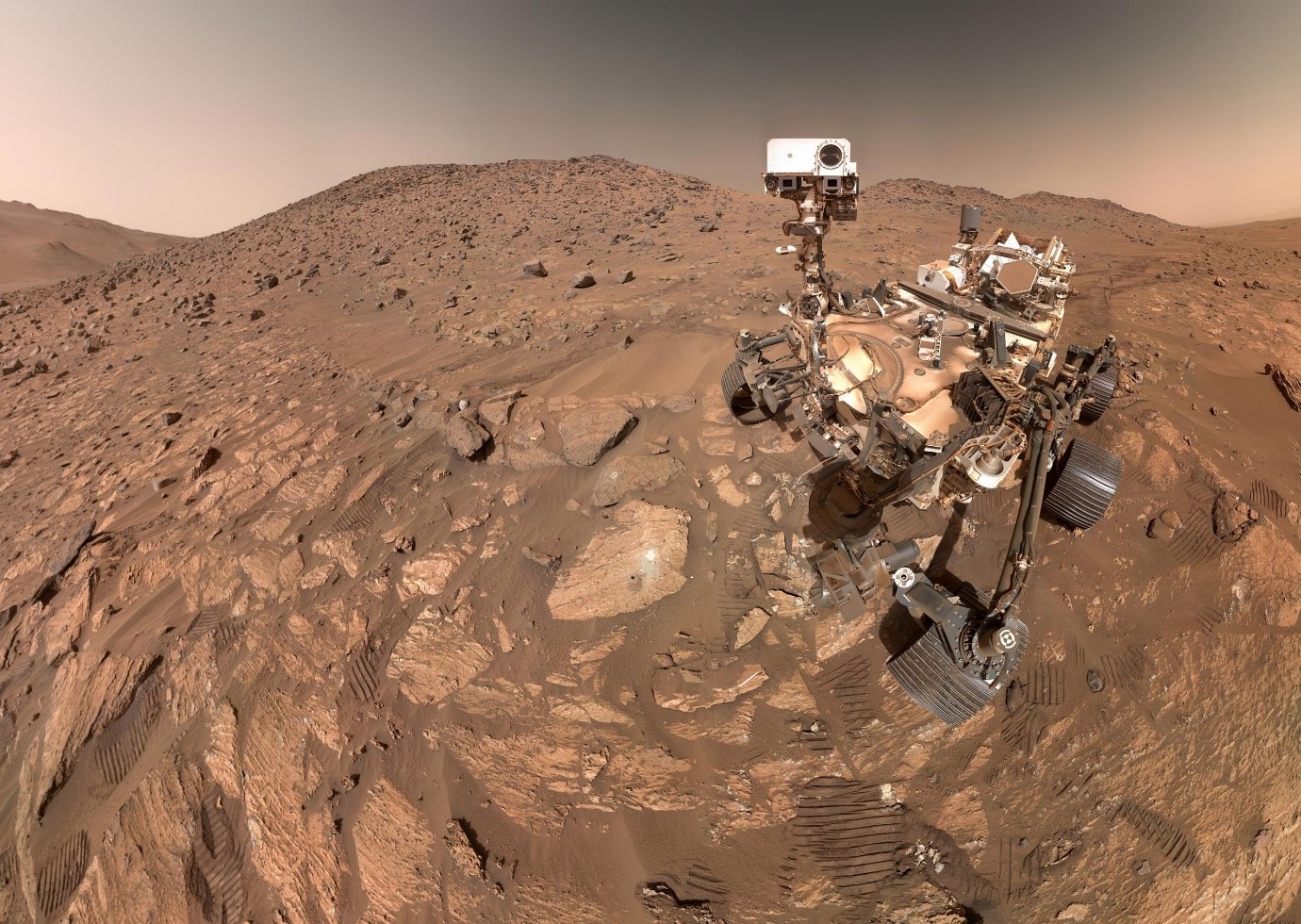
Figure 1. Perseverance Selfie with “Cheyava Falls” Rock
Potential Evidence of Ancient Life on Mars
A rock sample named “Sapphire Canyon,” collected by NASA’s Perseverance rover in 2024 from the ancient riverbed of Jezero Crater, may preserve signs of past microbial life. Retrieved from a rock called “Cheyava Falls,” it is now considered one of the mission’s strongest candidates for containing potential biosignatures, according to a new study in Nature. Scientists describe potential biosignatures as materials or structures that might have formed through biological activity but need further analysis to confirm any link to life. Figure 1 shows Perseverance Selfie with “Cheyava Falls” Rock.
“This discovery by Perseverance, launched during President Trump’s first term, marks our closest step yet toward finding life on Mars,” said acting NASA Administrator Sean Duffy. “Identifying a potential biosignature on the Red Planet is a groundbreaking milestone that deepens our understanding of Mars. NASA remains committed to conducting Gold Standard Science as we work toward our goal of landing Americans on Mars.”
Investigating the Bright Angel Formation in Jezero Crater
In July 2024, Perseverance arrived at Cheyava Falls to investigate the “Bright Angel” formation—a group of rocky outcrops lining both sides of Neretva Vallis, a river valley roughly 400 meters wide that was shaped by ancient water flow into Jezero Crater.
“This discovery reflects NASA’s strategic planning and execution of a mission designed to achieve exactly this kind of science—the detection of a potential biosignature on Mars,” said Nicky Fox, associate administrator of NASA’s Science Mission Directorate. “With this peer-reviewed result now published, NASA is sharing the data with the broader scientific community to further investigate and determine whether it has a biological origin.”
Organic-Rich Sedimentary Rocks
Perseverance’s instruments revealed that the sedimentary rocks in the Bright Angel formation are made of clay and silt—materials on Earth known to preserve ancient microbial life. These rocks also contain abundant organic carbon, sulfur, oxidized iron (rust), and phosphorus. “The mix of chemical compounds we detected could have provided energy for microbial metabolisms,” said Perseverance scientist Joel Hurowitz of Stony Brook University, lead author of the study. “However, observing these chemical signatures alone didn’t confirm a potential biosignature; we had to carefully interpret what the data might indicate.”
Unusual Patterns and Chemical Signatures
Perseverance’s PIXL (Planetary Instrument for X-ray Lithochemistry) and SHERLOC (Scanning Habitable Environments with Raman & Luminescence for Organics & Chemicals) instruments were the first to study this rock. While examining Cheyava Falls, an arrowhead-shaped rock measuring 1 meter by 0.6 meters, they observed colorful spots. These spots may have been created by microbial life using the rock’s organic carbon, sulfur, and phosphorus as an energy source.
“Leopard Spots” in Mineral Patterns: Possible Clues
High-resolution images revealed a distinct mineral pattern in the rock, forming reaction fronts the team dubbed “leopard spots.” These spots contain two iron-rich minerals: vivianite (hydrated iron phosphate) and greigite (iron sulfide). On Earth, vivianite is commonly found in sediments, peat bogs, and around decaying organic matter, while certain microbes can produce greigite.
The mineral combination, likely formed through electron-transfer reactions between sediment and organic matter, could serve as a potential microbial fingerprint, as such reactions can provide energy for growth. However, these minerals can also form abiotically under conditions like high temperatures, acidity, or binding with organic compounds. The Bright Angel rocks show no signs of high heat or acidic conditions, and it remains uncertain whether the present organic compounds could have catalyzed the reaction at low temperatures.
Implications for Mars’ Habitability
The discovery was unexpected because it involves some of the youngest sedimentary rocks Perseverance has studied. Previously, scientists assumed signs of ancient life would be limited to older formations. This finding suggests that Mars may have remained habitable later in its history than previously thought, and that older rocks might also contain evidence of life that is simply harder to detect.
Rigorous Evidence Required
“Astrobiological claims, especially regarding potential past extraterrestrial life, demand extraordinary evidence,” said Katie Stack Morgan, Perseverance’s project scientist at NASA’s Jet Propulsion Laboratory. “Publishing a potential biosignature in a peer-reviewed journal is a critical step, ensuring the rigor, validity, and significance of the results [1]. While abiotic explanations for the Bright Angel findings are less likely, they cannot be entirely ruled out.” Scientists use tools like the CoLD scale and Standards of Evidence to evaluate whether data meaningfully addresses the question, Are we alone? These frameworks help determine the confidence level in potential signs of life beyond Earth.
Perseverance’s Expanding Rock Collection
“Sapphire Canyon” is one of 27 rock cores Perseverance has collected since landing in Jezero Crater in February 2021. The rover also carries a suite of instruments, including a weather station providing environmental data for future human missions and samples of spacesuit material to test its durability on Mars.
Reference:
- https://scitechdaily.com/nasa-perseverance-rovers-stunning-find-may-be-mars-first-sign-of-life/
Cite this article:
Janani R (2025), Perseverance Rover Uncovers Possible First Evidence of Life on Mars, AnaTechMaz, pp.547
Recent Post
-
Webb Telescope Spots Uranus’ 29th Moon Missed by Voyager 2 Nearly 40 Years Ago
NASA’s James Webb Space Telescope has uncovered a previously...
-
Small Magnets, Big Impact: A Low-Power Breakthrough for Space Oxygen Generation
Who would have thought a simple magnet could help solve one of..
-

Moon Formation Spotted Around Wandering Planets Drifting Through Space
Free-floating planetary-mass objects — giant, starless bodies....
-

US Classified Military Space Plane Set for New Mission with Hidden Objective
A secret space plane is set to embark on its new mission. The X-37B....
-

NASA’s Space Solar Designs May Cut Battery Use by 70% and Increase Power Output
A new study led by King’s College London suggests that...
-
NASA Spots New Interstellar Object Entering Solar System: Alien Probe Possible?
On July 1, astronomers observed a fast-moving object heading toward....
-
Perseverance Rover Uncovers Possible First Evidence of Life on Mars
A rock sample called “Sapphire Canyon,” taken from the Bright....
-

Physicists Say Black Hole May Explode Within This Decade with 90% Probability
Physicists have traditionally believed that black holes end their lives....
-
Planetary Collisions May Reveal Clues to Alien Habitability
Researchers at Southwest Research Institute, in collaboration with Yale University, have published a....
Earliest Cosmic Magnetic Fields Were as Weak as Brain Waves
Magnetic fields emerging in the Universe’s earliest moments were billions of times weaker than a....
-
Solar Flares Are 6.5 Times Hotter Than Previously Estimated
Researchers at the University of St Andrews have found that particles in solar flares can become up to 6.5.....
-
The Milky Way’s Habitable Zone May Be Larger Than Previously Believed
The Galactic Habitable Zone (GHZ)—the area of a galaxy considered....
-
Researchers Discover Stark Differences Between the Moon’s Near and Far Sides
New insights from China’s Chang’e 6 mission suggest that the....
-
AI Uncovers Hidden Martian Storms Blasting Across the Planet At 160 Km/H
Mars may look calm and lifeless from a distance, but new research...
-

NASA’s Terra Satellite Detects Strength of Tropical Storm 07W from the Side
Wind shear can push clouds and thunderstorms away from...