

Martian "Spiderwebs" Unveiled in Curiosity's Striking 360° Panorama
NASA’s Curiosity rover has created a stunning 360° color-balanced panorama of Gale Crater by stitching together 291 Mastcam images. The panorama showcases “boxwork” ridges—spiderweb-like stone patterns formed when ancient groundwater hardened mineral-filled cracks, which were later exposed as wind eroded the surrounding rock. Viewers can explore an interactive version of the scene, featuring the rover’s wheel tracks, the butte known as “Texoli,” and the distant crater rim.
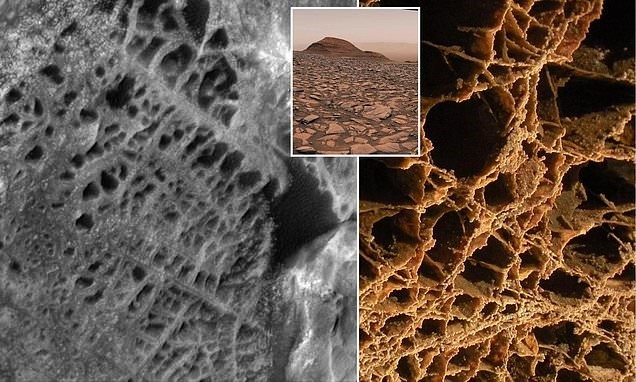
Figure 1. Ancient Groundwater Created Martian Boxwork Ridges
NASA’s Curiosity rover has captured a stunning 360-degree panorama of the Martian landscape, showcasing unusual stone ridges known as boxwork patterns. Composed of 291 images taken by the rover’s Mastcam between May 15 and May 18, 2025 (Martian days 4,451 to 4,454), the panorama offers a vivid, Earth-like view thanks to carefully color-balanced adjustments. The result is a detailed and lifelike glimpse of this unique Martian terrain. Figure 1 shows Ancient Groundwater Created Martian Boxwork Ridges.
From space, the boxwork patterns resemble spiderwebs, as shown in the image above. These formations have intrigued scientists since before Curiosity’s 2012 landing on Mars. They likely formed billions of years ago when groundwater seeped through rock cracks, depositing minerals that hardened like cement. Over time, wind erosion wore away the surrounding rock, leaving behind the durable networks of ridges.
In the image, Curiosity’s tracks are visible near the center. To the right, a butte known as “Texoli” stands out, while the distant rim of Gale Crater is seen at the top center. Since 2014, Curiosity has been exploring the foothills of Mount Sharp, a towering 3-mile (5-kilometer) mountain inside the crater.
Curiosity is a Mars rover developed by NASA’s Jet Propulsion Laboratory (JPL), a division of Caltech in Pasadena, California, and operates as part of NASA’s Mars Exploration Program. Since its 2012 landing, the rover has been exploring Gale Crater, investigating Mars' geology and climate to determine if the planet could have once supported life [1]. The mission is led by JPL for NASA’s Science Mission Directorate in Washington, with the Mastcam imaging system—used to capture Curiosity’s detailed photos—developed and managed by Malin Space Science Systems in San Diego.
Reference:
- https://scitechdaily.com/martian-spiderwebs-revealed-curiosity-captures-stunning-360-panorama/
Cite this article:
Janani R (2025), Martian "Spiderwebs" Unveiled in Curiosity's Striking 360° Panorama, AnaTechMaz, pp.449
Recent Post
-
Scientists Uncover Strange Earth-Like Patterns in Mars Soil
Wave-like formations on Mars offer insights into the planet’s icy past, its potential to support life...
-
Webb Snaps First Direct Image of Exoplanet Shaping Cosmic Rings
This newly discovered planet marks Webb’s first direct image of an exoplanet. With nearly 6,000...
-
Astronomers Detect the Universe’s Long-Hidden Matter
Astronomers have discovered a massive filament of hot gas linking four galaxy clusters...
-
Hubble Captures Triple Suns and Hidden Planet Factory in Blue Nebula
Illuminated by scattered starlight, this vibrant blue nebula...
-
Star-Shredding Blast: NASA Unveils Brightest Black Hole Eruption Since the Big Bang
Supermassive black holes usually remain hidden, but when a star....
-

Space Emerging from Time? New Theory Challenges Einstein
A daring new theory proposes that time isn’t just a single linear flow but a three-dimensional fabric from which space....
-

Astronomers Find Hidden Earth-Like Planets Around Nearby Dwarf Stars
Research on 15 M-type stars has uncovered fresh insights into the...
-
Researchers Reveal Galactic Map Unlocking New Insights into the Extreme Universe
A groundbreaking survey from China’s Large High Altitude Air Shower...
-
Cosmic Feast: Massive Star Caught Rapidly Consuming Surrounding Gas
Astronomers have, for the first time, observed the massive gas inflow...
Lasers, Gas Bursts, and Hidden Water: How Perseverance Broke Through Mars’ Tough Rocks
NASA’s Perseverance rover recently tackled a tough Martian rock known...
-
Hidden Rings Around Young Stars Offer Earliest Clues to Planet Formation
High-resolution views of 78 young star disks in the Ophiuchus cloud have...
-
Harnessing Bolide Sonic Booms to Enhance Planetary Defense
Faint sonic booms from space help scientists track incoming debris—but an object's path is more important than it...
-
Earth’s Weather Satellites Reveal Venus’s Fiery Secrets
The future looks bright for long-term planetary monitoring across various wavelengths. Researchers at the...
-
Martian "Spiderwebs" Unveiled in Curiosity's Striking 360° Panorama
NASA’s Curiosity rover has created a stunning 360° color-balanced...
-

Sky Spectacle Ahead: Mars Glows, Venus Shines, and an Eagle Soars
July’s night sky is packed with celestial highlights: Mars glows at twilight, Mercury makes a brief evening....