

Researchers Reveal Galactic Map Unlocking New Insights into the Extreme Universe
A groundbreaking survey from China’s Large High Altitude Air Shower Observatory (LHAASO) has revealed powerful ultrahigh-energy gamma-ray emissions throughout the Milky Way. As part of its “Mini Survey of the Milky Way” project, LHAASO used its exceptional sensitivity to capture a detailed and vivid map of these emissions. The findings provide critical insights into the origins and behavior of cosmic rays and the extreme astrophysical events that produce them. Researchers consider this a major milestone, marking a new era in the study of ultrahigh-energy gamma-ray astronomy.
Cosmic rays are highly energetic charged particles that travel through space at nearly the speed of light, originating from extreme environments like supernova remnants (SNRs), pulsar wind nebulae (PWNe), and young massive star clusters (YMCs). Their energy can surpass that of the most powerful human-made accelerators by up to a billion times, pointing to the existence of natural "super accelerators" in the universe.
Figure 1. LHAASO Maps Milky Way’s Extreme Gamma Rays, Revealing Hidden Cosmic Accelerators
Yet, despite over a century of research, key questions about cosmic rays remain unresolved. Scientists still seek to identify the exact locations of these accelerators, understand their physical nature, and determine how they boost particles to such extreme energies and how those particles eventually reach Earth. These enduring mysteries have led the U.S. National Science and Technology Council to list the origin of cosmic rays among the top 11 most important scientific questions of the 21st century. Figure 1 shows LHAASO Maps Milky Way’s Extreme Gamma Rays, Revealing Hidden Cosmic Accelerators.
Gamma Rays: Unlocking the Secrets of the Cosmos
Uncovering the origins of cosmic rays is difficult because their charged particles are deflected by interstellar magnetic fields, making their paths nearly impossible to trace. However, neutral gamma-ray photons—produced when cosmic rays interact with interstellar matter—can travel undisturbed, acting as cosmic “pointers” that reveal their source.
China’s LHAASO, the most sensitive ultrahigh-energy gamma-ray observatory in the world, is designed to detect these signals. The facility includes a square-kilometer array (KM2A) with 5,216 electromagnetic particle detectors and 1,188 muon detectors, along with a water Cherenkov detector array (WCDA) and a wide-field Cherenkov telescope array (WFCTA).
LHAASO’s suite of instruments captures gamma rays spanning energies from teraelectronvolts (TeV) to petaelectronvolts (PeV). When these gamma rays strike Earth’s atmosphere, they create cascades of secondary particles—like a cosmic rain shower. LHAASO, covering a square kilometer, acts as a giant collector for these particle “raindrops,” allowing scientists to reconstruct detailed maps of the gamma-ray sky.
The galactic plane, rich in cosmic-ray accelerators and interstellar matter, is a hotspot for gamma-ray activity and a natural laboratory for studying extreme astrophysical events. Using its exceptional sensitivity and wide energy range, LHAASO has carried out the first systematic survey of ultrahigh-energy gamma-ray sources along the Milky Way’s disk—a major advance toward solving the century-old mystery of where cosmic rays originate.
Major Findings from the Milky Way Survey
The “Mini Survey of the Milky Way” conducted by LHAASO has led to four significant discoveries:
Star-Forming Region W43:
LHAASO detected gamma rays exceeding hundreds of TeV in W43, a region responsible for 10% of all star formation in the Milky Way. The 50-light-year-wide emission zone aligns with a central cluster of young massive stars and dense surrounding gas. This suggests that stellar winds and supernova shocks are accelerating particles to near-light speeds. The region contains over 2.5×10¹⁴ erg of cosmic-ray energy—equivalent to 20 million years of the Sun’s total output—highlighting massive star activity as a key driver of cosmic-ray acceleration.
Pulsar Wind Nebula in CTA-1:
At 4,600 light-years away, supernova remnant CTA-1 was found to emit gamma rays reaching 300 TeV, primarily from its central pulsar wind nebula (PWN). The data suggest electrons are reaching near-theoretical energy limits for PWN acceleration. Observations also revealed that particles are transported via convection, not diffusion, with a surprisingly weak magnetic field (~4.5 microgauss), challenging existing strong-confinement models.
Young Pulsar Halo Candidate:
Around the 62,400-year-old pulsar J0248+6021, LHAASO discovered diffuse gamma-ray emission spanning 29–49 light-years. The structure likely represents either a PWN or a pulsar halo—formed by high-energy electrons escaping into space. As the youngest pulsar halo candidate yet identified, it offers crucial insight into how pulsars evolve and release energy into the interstellar medium, posing new questions for cosmic-ray transport models.
Unidentified Source LHAASO J0056+6346u:
This mysterious ultrahigh-energy gamma-ray source lies in a region with gas bubbles that may be linked to young star clusters or supernova remnants. Its exact origin is unknown, but hidden pulsar activity may be responsible. Further studies using X-rays and multiwavelength observations are needed to confirm its nature.
Prof. Elena Amato of Italy’s Arcetri Astrophysical Observatory states that “LHAASO is revolutionizing our understanding of the Milky Way and challenging traditional cosmic-ray theories.” The research team describes these discoveries as a “Rosetta Stone” for decoding extreme cosmic phenomena. Their findings have been published in a special issue of Science China Physics, Mechanics & Astronomy, and they invite global collaboration to explore the mysteries of the high-energy universe.
Reference:
- https://scitechdaily.com/researchers-unveil-galactic-treasure-map-opening-a-new-window-to-the-extreme-universe/
Cite this article:
Janani R (2025), Researchers Reveal Galactic Map Unlocking New Insights into the Extreme Universe, AnaTechMaz, pp.443
Recent Post
-
Scientists Uncover Strange Earth-Like Patterns in Mars Soil
Wave-like formations on Mars offer insights into the planet’s icy past, its potential to support life...
-
Webb Snaps First Direct Image of Exoplanet Shaping Cosmic Rings
This newly discovered planet marks Webb’s first direct image of an exoplanet. With nearly 6,000...
-
Astronomers Detect the Universe’s Long-Hidden Matter
Astronomers have discovered a massive filament of hot gas linking four galaxy clusters...
-
Hubble Captures Triple Suns and Hidden Planet Factory in Blue Nebula
Illuminated by scattered starlight, this vibrant blue nebula...
-
Star-Shredding Blast: NASA Unveils Brightest Black Hole Eruption Since the Big Bang
Supermassive black holes usually remain hidden, but when a star....
-
Space Emerging from Time? New Theory Challenges Einstein
A daring new theory proposes that time isn’t just a single linear flow but a three-dimensional fabric from which space....
-
Astronomers Find Hidden Earth-Like Planets Around Nearby Dwarf Stars
Research on 15 M-type stars has uncovered fresh insights into the...
-
Researchers Reveal Galactic Map Unlocking New Insights into the Extreme Universe
A groundbreaking survey from China’s Large High Altitude Air Shower...
-
Cosmic Feast: Massive Star Caught Rapidly Consuming Surrounding Gas
Astronomers have, for the first time, observed the massive gas inflow...
Lasers, Gas Bursts, and Hidden Water: How Perseverance Broke Through Mars’ Tough Rocks
NASA’s Perseverance rover recently tackled a tough Martian rock known...
-
Hidden Rings Around Young Stars Offer Earliest Clues to Planet Formation
High-resolution views of 78 young star disks in the Ophiuchus cloud have...
-

Harnessing Bolide Sonic Booms to Enhance Planetary Defense
Faint sonic booms from space help scientists track incoming debris—but an object's path is more important than it...
-
Earth’s Weather Satellites Reveal Venus’s Fiery Secrets
The future looks bright for long-term planetary monitoring across various wavelengths. Researchers at the...
-
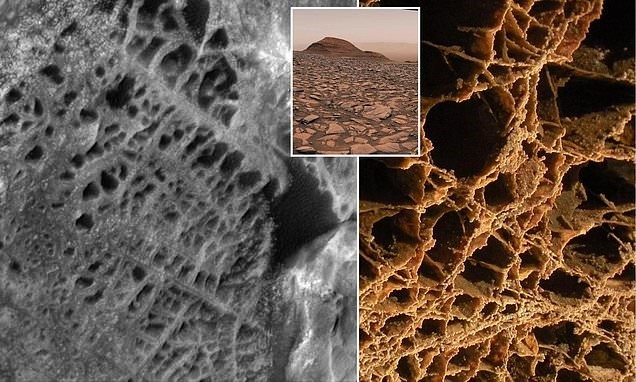
Martian "Spiderwebs" Unveiled in Curiosity's Striking 360° Panorama
NASA’s Curiosity rover has created a stunning 360° color-balanced...
-

Sky Spectacle Ahead: Mars Glows, Venus Shines, and an Eagle Soars
July’s night sky is packed with celestial highlights: Mars glows at twilight, Mercury makes a brief evening....