

Cosmic Feast: Massive Star Caught Rapidly Consuming Surrounding Gas
Astronomers have, for the first time, observed the massive gas inflow surrounding a forming high-mass star, revealing a key mechanism behind its rapid growth. Using the U.S. National Science Foundation's Very Large Array (NSF VLA), researchers tracked interstellar ammonia to uncover new insights into how massive stars take shape.
By observing HW2, a young protostar in the Cepheus A star-forming region about 2,300 light-years away, scientists mapped the structure and motion of the accretion disk feeding material to the developing star. The study, published in Astronomy & Astrophysics, was led by researchers from the Italian National Institute for Astrophysics (INAF) and the Max Planck Institute for Radio Astronomy, with contributions from the Institute of Space Sciences (ICE-CSIC).
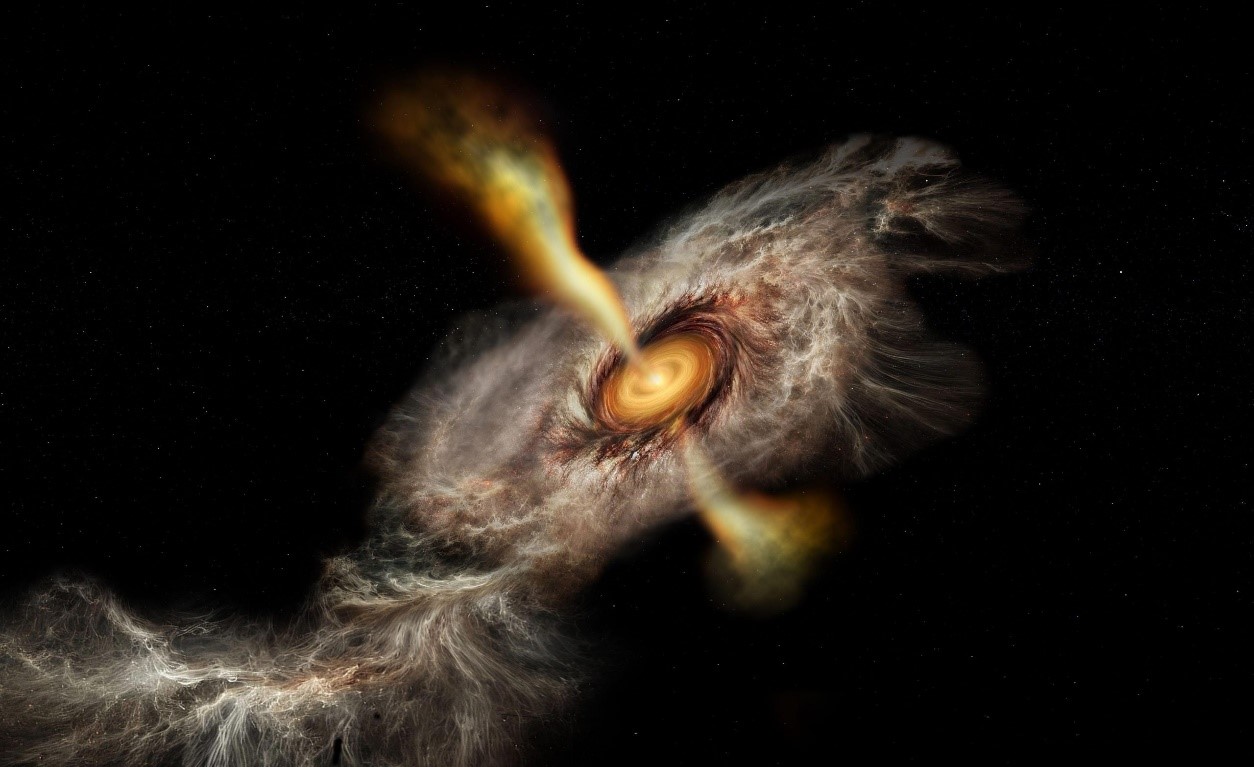
Figure 1. Ammonia Gas Flowing Into Accretion Disk Fueling Cepheus A HW2
A Deeper Look into How Stars Gain Mass
This discovery helps answer a core question in astrophysics: how do massive stars, which eventually explode as supernovae, accumulate such enormous mass? As one of the closest massive star-forming regions to Earth, Cepheus A provides a rare chance to observe these extreme processes up close. Figure 1 shows Ammonia Gas Flowing Into Accretion Disk Fueling Cepheus A HW2.
To study how material moves around the young star, researchers used ammonia (NH₃)—a molecule found in both interstellar clouds and everyday industrial applications—as a tracer. Their observations uncovered a hot, dense ammonia ring located between 200 and 700 astronomical units (AU) from the star, forming part of an accretion disk—a key structure in many star formation models.
Tracking Intense Gas Inflow
The researchers discovered that the gas within the disk around HW2 is both rotating and collapsing inward. Material is falling onto the protostar at a rate of about two-thousandths of a solar mass per year—one of the highest rates ever recorded for a massive protostar. This demonstrates that accretion disks can sustain intense gas flows even when the star has already grown to 16 times the Sun’s mass. “Our observations offer direct evidence that massive stars can form via disk-mediated accretion up to tens of solar masses,” said Dr. Alberto Sanna, lead author of the study. He noted that the NSF VLA’s exceptional radio sensitivity enabled them to resolve features as small as 100 astronomical units (AU), providing unprecedented detail.
The team also compared their findings with advanced computer simulations of massive star formation. “Our results closely match theoretical predictions, showing that ammonia gas near HW2 collapses almost at free-fall speed while rotating at sub-Keplerian velocities—a balance shaped by gravity and centrifugal force,” explained Prof. André Oliva, who led the simulation analysis.
Additionally, the researchers observed irregularities in the disk’s structure and movement, suggesting the presence of external gas flows, or “streamers,” feeding one side of the disk. Such streamers have been seen in other star-forming regions and are believed to play a vital role in supporting the ongoing growth of massive stars by channeling fresh material into their disks.
A Breakthrough That Resolves a Long-Standing Debate
This discovery puts to rest decades of scientific debate over whether HW2—and massive protostars in general—can host accretion disks capable of sustaining rapid growth. It also supports the idea that similar physical processes drive star formation across the full range of stellar masses.
“HW2 has been known for over 40 years and continues to inspire new generations of astronomers,” said José María Torrelles of ICE-CSIC and the Institute of Space Studies of Catalonia (IEEC), a co-author of the study who conducted key observations of HW2 in the late 1990s.
In the early 2000s, Torrelles and collaborators, using powerful tools like the NRAO’s VLA, the Smithsonian Astrophysical Observatory’s Submillimeter Array (SMA), and the ASIAA, presented early evidence that HW2 was surrounded by an accretion disk and a jet. The new study confirms this definitively, revealing a distinct pattern of rotation and inward gas flow—settling a debate that had persisted for 25 years.
Advanced Technology Uncovers Hidden Structures
These discoveries were made possible by high-sensitivity observations using the NSF’s Very Large Array (VLA) at centimeter wavelengths in 2019. Researchers focused on specific ammonia transitions excited at temperatures above 100 Kelvin, allowing them to trace the dense, warm gas surrounding HW2.
“These findings demonstrate the remarkable ability of radio interferometry to reveal the hidden processes behind the formation of some of the most influential objects in our galaxy,” said Dr. Todd Hunter of the NRAO. “In the next decade, the upgraded VLA will enable us to study circumstellar ammonia at scales comparable to our solar system,” he added.
Beyond advancing our understanding of massive star formation, this research has broader implications for galaxy evolution and chemical enrichment. Massive stars act as cosmic engines, driving powerful winds and explosive events that enrich galaxies with heavy elements.
Reference:
- https://scitechdaily.com/cosmic-feast-massive-star-spotted-devouring-gas-at-an-astounding-rate/
Cite this article:
Janani R (2025), Cosmic Feast: Massive Star Caught Rapidly Consuming Surrounding Gas, AnaTechMaz, pp.444
Recent Post
-
Scientists Uncover Strange Earth-Like Patterns in Mars Soil
Wave-like formations on Mars offer insights into the planet’s icy past, its potential to support life...
-
Webb Snaps First Direct Image of Exoplanet Shaping Cosmic Rings
This newly discovered planet marks Webb’s first direct image of an exoplanet. With nearly 6,000...
-
Astronomers Detect the Universe’s Long-Hidden Matter
Astronomers have discovered a massive filament of hot gas linking four galaxy clusters...
-
Hubble Captures Triple Suns and Hidden Planet Factory in Blue Nebula
Illuminated by scattered starlight, this vibrant blue nebula...
-
Star-Shredding Blast: NASA Unveils Brightest Black Hole Eruption Since the Big Bang
Supermassive black holes usually remain hidden, but when a star....
-
Space Emerging from Time? New Theory Challenges Einstein
A daring new theory proposes that time isn’t just a single linear flow but a three-dimensional fabric from which space....
-
Astronomers Find Hidden Earth-Like Planets Around Nearby Dwarf Stars
Research on 15 M-type stars has uncovered fresh insights into the...
-
Researchers Reveal Galactic Map Unlocking New Insights into the Extreme Universe
A groundbreaking survey from China’s Large High Altitude Air Shower...
-
Cosmic Feast: Massive Star Caught Rapidly Consuming Surrounding Gas
Astronomers have, for the first time, observed the massive gas inflow...
Lasers, Gas Bursts, and Hidden Water: How Perseverance Broke Through Mars’ Tough Rocks
NASA’s Perseverance rover recently tackled a tough Martian rock known...
-
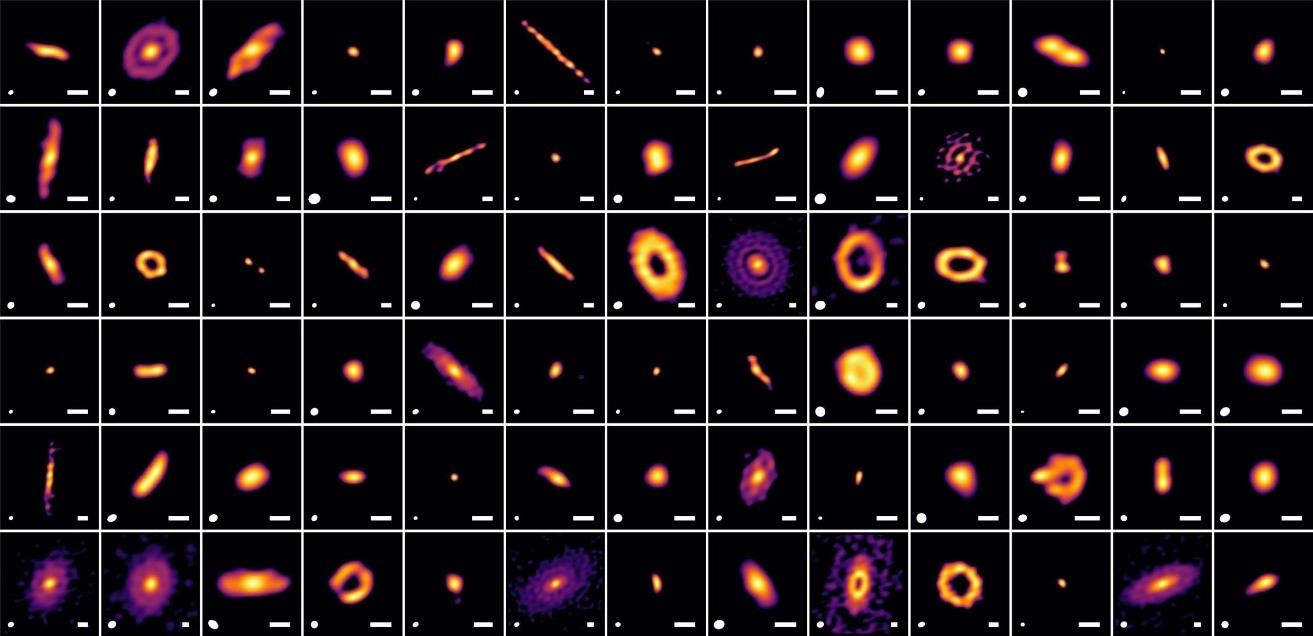
Hidden Rings Around Young Stars Offer Earliest Clues to Planet Formation
High-resolution views of 78 young star disks in the Ophiuchus cloud have...
-
Harnessing Bolide Sonic Booms to Enhance Planetary Defense
Faint sonic booms from space help scientists track incoming debris—but an object's path is more important than it...
-
Earth’s Weather Satellites Reveal Venus’s Fiery Secrets
The future looks bright for long-term planetary monitoring across various wavelengths. Researchers at the...
-
Martian "Spiderwebs" Unveiled in Curiosity's Striking 360° Panorama
NASA’s Curiosity rover has created a stunning 360° color-balanced...
-

Sky Spectacle Ahead: Mars Glows, Venus Shines, and an Eagle Soars
July’s night sky is packed with celestial highlights: Mars glows at twilight, Mercury makes a brief evening....