

Webb Snaps First Direct Image of Exoplanet Shaping Cosmic Rings
This newly discovered planet marks Webb’s first direct image of an exoplanet.
With nearly 6,000 worlds identified beyond our solar system, NASA’s James Webb Space Telescope may have just found another—detecting the faint glow of TWA 7 b, a Saturn-sized planet orbiting the young star TWA 7.
To spot the planet, astronomers used Webb’s coronagraph to block the star’s intense light and reveal what lay hidden nearby. TWA 7 b is located within a gap in one of three dusty rings encircling its star—precisely where models suggest a ring-carving planet would reside. Its brightness, color, and position match expectations for a young planet shaping its surrounding debris, making this one of the most thrilling discoveries yet from the James Webb Space Telescope.
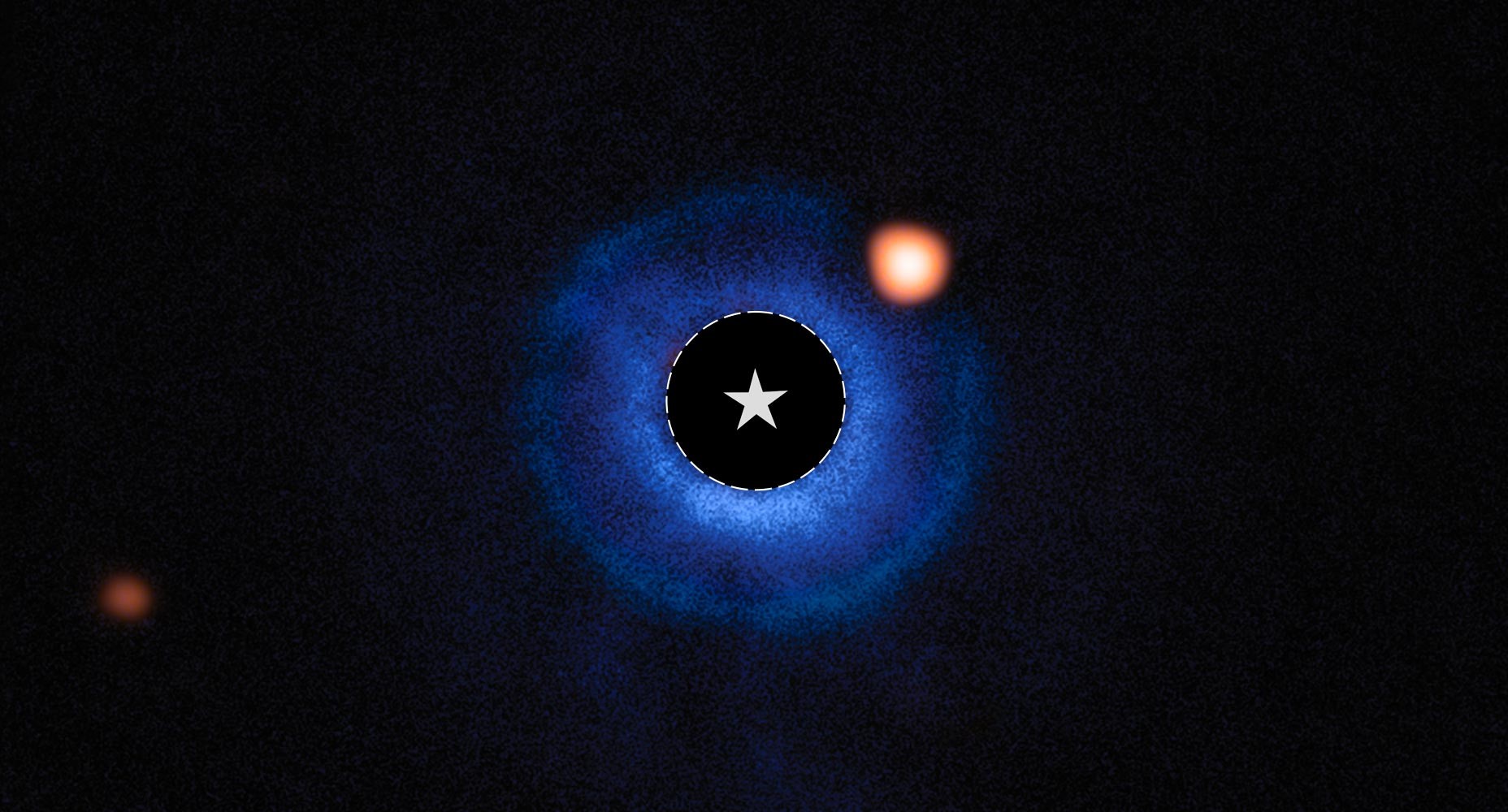
Figure 1. Webb Spots Possible Lightest Exoplanet Sculpting Dust Rings
NASA’s Webb Images Lightest Saturn-Mass Planet Ever Detected
Astronomers using NASA’s James Webb Space Telescope have detected a faint signal that likely belongs to a Saturn-mass planet orbiting the young star TWA 7. If confirmed, this would be Webb’s first direct imaging discovery of a planet—and the lightest exoplanet ever captured with this method. Figure 1 shows Webb Spots Possible Lightest Exoplanet Sculpting Dust Rings.
The planet’s soft glow, detected by Webb’s Mid-Infrared Instrument, appears within the star’s dusty debris disk, about 50 times farther from the star than Earth is from the Sun. Its location aligns precisely with models predicting where a ring-shaping planet would reside. The findings were published on June 25 in Nature.
To uncover the hidden planet, scientists used the MIRI coronagraph to block out the star’s glare, followed by advanced image processing to remove residual light. The resulting image revealed a tiny infrared point of light, which almost certainly indicates a new planet. Tests ruled out the possibility of it being a solar system object, and while a distant galaxy can’t be completely ruled out, the evidence strongly supports the presence of an undiscovered planet sculpting the dust around TWA 7.
Saturn-Mass Planet Found Hidden in Dust Ring Gap
The detected object lies within a gap in one of three dust rings previously observed around TWA 7 through ground-based telescopes. Its brightness, color, distance from the star, and precise location within the ring align with predictions for a young, cold, Saturn-mass planet shaping the surrounding debris.
“Our observations reveal a strong candidate for a planet sculpting the TWA 7 debris disk, positioned exactly where models suggest a planet of this mass should be,” said lead author Anne-Marie Lagrange of CNRS at the Observatoire de Paris-PSL and Université Grenoble Alpes.
“This discovery marks a major step forward, allowing us to image planets with masses similar to those in our own solar system,” added co-author Mathilde Malin of Johns Hopkins University and the Space Telescope Science Institute.
TWA 7 b: A Young Architect of Cosmic Rings
Preliminary analysis indicates that the object—named TWA 7 b—is likely a young, cold planet with a mass around 0.3 times that of Jupiter (roughly equivalent to Saturn, or about 100 Earth masses) and a temperature of approximately 120°F (47°C). Its position within a gap in the surrounding disk suggests a dynamic interaction with the surrounding material.
Debris disks—composed of dust and rocky debris—are common around stars of various ages, but are more easily observed around younger stars due to their brightness. These disks often show rings or gaps, believed to be shaped by orbiting planets. However, a planet has never been directly observed within one—until now. If confirmed, TWA 7 b would be the first planet directly linked to sculpting a debris disk and may also offer the first observational evidence of a “trojan disk,” a concentration of dust trapped in the planet’s orbit.
TWA 7, also known as CE Antliae, is a young red dwarf star about 6.4 million years old and located 34 light-years away in the TW Hydrae association. Its nearly face-on disk made it a prime candidate for Webb’s highly sensitive mid-infrared imaging.
Webb Pushes the Boundaries of Exoplanet Discovery
The discovery showcases Webb’s powerful capability to detect faint, low-mass planets orbiting nearby stars—targets previously beyond our reach [1]. Future observations will focus on confirming the object’s planetary nature, refining its characteristics, and advancing our understanding of how planets form and how debris disks evolve in young stellar systems.
Reference:
- https://scitechdaily.com/webb-captures-first-direct-image-of-alien-planet-carving-cosmic-rings/
Cite this article:
Janani R (2025), Webb Snaps First Direct Image of Exoplanet Shaping Cosmic Rings, AnaTechMaz, pp.437
Recent Post
-
Scientists Uncover Strange Earth-Like Patterns in Mars Soil
Wave-like formations on Mars offer insights into the planet’s icy past, its potential to support life...
-
Webb Snaps First Direct Image of Exoplanet Shaping Cosmic Rings
This newly discovered planet marks Webb’s first direct image of an exoplanet. With nearly 6,000...
-
Astronomers Detect the Universe’s Long-Hidden Matter
Astronomers have discovered a massive filament of hot gas linking four galaxy clusters...
-
Hubble Captures Triple Suns and Hidden Planet Factory in Blue Nebula
Illuminated by scattered starlight, this vibrant blue nebula...
-
Star-Shredding Blast: NASA Unveils Brightest Black Hole Eruption Since the Big Bang
Supermassive black holes usually remain hidden, but when a star....
-
Space Emerging from Time? New Theory Challenges Einstein
A daring new theory proposes that time isn’t just a single linear flow but a three-dimensional fabric from which space....
-
Astronomers Find Hidden Earth-Like Planets Around Nearby Dwarf Stars
Research on 15 M-type stars has uncovered fresh insights into the...
-
Researchers Reveal Galactic Map Unlocking New Insights into the Extreme Universe
A groundbreaking survey from China’s Large High Altitude Air Shower...
-
Cosmic Feast: Massive Star Caught Rapidly Consuming Surrounding Gas
Astronomers have, for the first time, observed the massive gas inflow...
Lasers, Gas Bursts, and Hidden Water: How Perseverance Broke Through Mars’ Tough Rocks
NASA’s Perseverance rover recently tackled a tough Martian rock known...
-
Hidden Rings Around Young Stars Offer Earliest Clues to Planet Formation
High-resolution views of 78 young star disks in the Ophiuchus cloud have...
-

Harnessing Bolide Sonic Booms to Enhance Planetary Defense
Faint sonic booms from space help scientists track incoming debris—but an object's path is more important than it...
-
Earth’s Weather Satellites Reveal Venus’s Fiery Secrets
The future looks bright for long-term planetary monitoring across various wavelengths. Researchers at the...
-
Martian "Spiderwebs" Unveiled in Curiosity's Striking 360° Panorama
NASA’s Curiosity rover has created a stunning 360° color-balanced...
-
Sky Spectacle Ahead: Mars Glows, Venus Shines, and an Eagle Soars
July’s night sky is packed with celestial highlights: Mars glows at twilight, Mercury makes a brief evening....