

Astronomers Detect the Universe’s Long-Hidden Matter
Astronomers have discovered a massive filament of hot gas linking four galaxy clusters, potentially shedding light on the mystery of the Universe’s missing matter. Weighing around ten times more than the Milky Way, this vast structure may account for part of the elusive ordinary matter that has remained undetected for decades.
The discovery was achieved using data from the European Space Agency’s XMM-Newton and Japan’s Suzaku X-ray space telescopes.
Over one-third of the ordinary matter in the nearby Universe—the matter that makes up stars, planets, galaxies, and life—has not been directly observed. Although vital to our understanding of the cosmos, this missing matter has remained elusive until now.
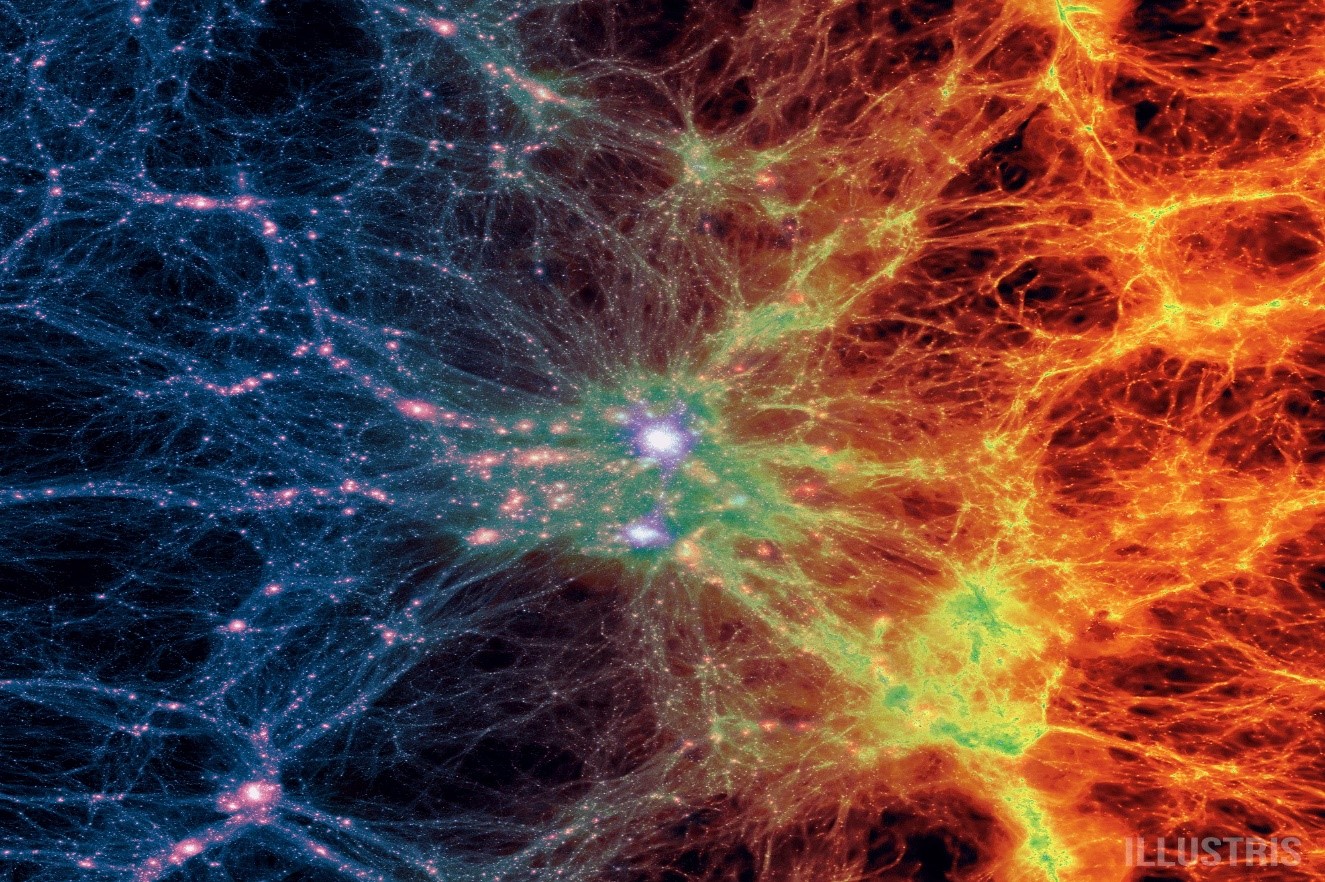
Figure 1. Simulating the Invisible Threads of the Cosmic Web
The most widely accepted theory is that the missing matter exists within diffuse, thread-like gas structures known as filaments, which stretch across the densest regions of the Universe. While filaments have been detected previously, their faint emissions are hard to distinguish from the surrounding light of galaxies and black holes, making them challenging to study. Figure 1 shows Simulating the Invisible Threads of the Cosmic Web.
In a breakthrough study, researchers have successfully detected and precisely characterized a single filament of hot gas connecting four galaxy clusters in the nearby Universe—one of the first times this has been achieved despite previous challenges.
“For the first time, our findings closely align with predictions from the leading cosmological model—something we've never observed before,” says lead researcher Konstantinos Migkas of Leiden Observatory in the Netherlands. “It appears the simulations were accurate all along.”
XMM-Newton Cracks the Case
The filament, with a scorching temperature of over 10 million degrees, contains about ten times the mass of the Milky Way and connects four galaxy clusters—two on each end. These clusters are part of the Shapley Supercluster, one of the largest known cosmic structures, containing over 8,000 galaxies.
Stretching 23 million light-years across the supercluster—equivalent to spanning the Milky Way roughly 230 times—the filament was carefully studied using X-ray data from XMM-Newton and Suzaku, along with optical data from multiple other observatories, allowing Konstantinos Migkas and his team to accurately characterize its structure and properties.
The two X-ray telescopes complemented each other perfectly in this study. Suzaku mapped the filament’s faint X-ray emissions across a broad area, while XMM-Newton provided precise identification of contaminating X-ray sources—mainly supermassive black holes—located within the filament.
“XMM-Newton allowed us to pinpoint and eliminate these cosmic contaminants, ensuring we were observing only the filament’s gas,” explains co-author Florian Pacaud from the University of Bonn, Germany. “Our strategy worked exceptionally well and confirmed that the filament matches exactly what our best large-scale Universe simulations predicted.”
Not Really Missing After All
In addition to uncovering a massive, previously undetected strand of matter in the nearby Universe, the discovery highlights how galaxy clusters—some of the densest and most extreme structures known—are interconnected across immense distances. It also offers new insights into the cosmic web, the vast, invisible network of filaments that forms the backbone of the Universe's large-scale structure.
“This work showcases the power of collaboration between telescopes and sets a new standard for detecting the faint glow of the cosmic web’s filaments,” says Norbert Schartel, ESA XMM-Newton Project Scientist.
“More importantly, this discovery strengthens our standard model of the Universe and supports decades of simulations—it suggests that the so-called ‘missing’ matter may indeed be hiding within faint, hard-to-detect filaments spread across the cosmos.”
Unraveling the structure of this cosmic web is a key focus of ESA’s Euclid mission, launched in 2023. Euclid is mapping the web’s structure and evolution while also probing the elusive nature of dark matter and dark energy—which together make up about 95% of the Universe yet remain unobserved [1]. Working alongside other efforts to study the dark Universe, the mission aims to help solve some of the most profound and long-standing mysteries in cosmology.
Reference:
- https://scitechdaily.com/astronomers-find-universes-missing-matter/
Cite this article:
Janani R (2025), Astronomers Detect the Universe’s Long-Hidden Matter, AnaTechMaz, pp.438
Recent Post
-

Scientists Uncover Strange Earth-Like Patterns in Mars Soil
Wave-like formations on Mars offer insights into the planet’s icy past, its potential to support life...
-
Webb Snaps First Direct Image of Exoplanet Shaping Cosmic Rings
This newly discovered planet marks Webb’s first direct image of an exoplanet. With nearly 6,000...
-
Astronomers Detect the Universe’s Long-Hidden Matter
Astronomers have discovered a massive filament of hot gas linking four galaxy clusters...
-
Hubble Captures Triple Suns and Hidden Planet Factory in Blue Nebula
Illuminated by scattered starlight, this vibrant blue nebula...
-
Star-Shredding Blast: NASA Unveils Brightest Black Hole Eruption Since the Big Bang
Supermassive black holes usually remain hidden, but when a star....
-
Space Emerging from Time? New Theory Challenges Einstein
A daring new theory proposes that time isn’t just a single linear flow but a three-dimensional fabric from which space....
-
Astronomers Find Hidden Earth-Like Planets Around Nearby Dwarf Stars
Research on 15 M-type stars has uncovered fresh insights into the...
-
Researchers Reveal Galactic Map Unlocking New Insights into the Extreme Universe
A groundbreaking survey from China’s Large High Altitude Air Shower...
-
Cosmic Feast: Massive Star Caught Rapidly Consuming Surrounding Gas
Astronomers have, for the first time, observed the massive gas inflow...
Lasers, Gas Bursts, and Hidden Water: How Perseverance Broke Through Mars’ Tough Rocks
NASA’s Perseverance rover recently tackled a tough Martian rock known...
-
Hidden Rings Around Young Stars Offer Earliest Clues to Planet Formation
High-resolution views of 78 young star disks in the Ophiuchus cloud have...
-

Harnessing Bolide Sonic Booms to Enhance Planetary Defense
Faint sonic booms from space help scientists track incoming debris—but an object's path is more important than it...
-
Earth’s Weather Satellites Reveal Venus’s Fiery Secrets
The future looks bright for long-term planetary monitoring across various wavelengths. Researchers at the...
-

Martian "Spiderwebs" Unveiled in Curiosity's Striking 360° Panorama
NASA’s Curiosity rover has created a stunning 360° color-balanced...
-

Sky Spectacle Ahead: Mars Glows, Venus Shines, and an Eagle Soars
July’s night sky is packed with celestial highlights: Mars glows at twilight, Mercury makes a brief evening....