

Star-Shredding Blast: NASA Unveils Brightest Black Hole Eruption Since the Big Bang
Supermassive black holes usually remain hidden, but when a star ventures too close, they unleash colossal eruptions—brighter than 100 supernovae.
Using data from NASA, ESA, and ground-based telescopes, astronomers observed three of these rare “extreme nuclear transients,” including a striking event nicknamed “Barbie.” These flares occurred as dormant galactic cores devoured stars three to ten times the mass of our Sun over several months. The intense ultraviolet, X-ray, and infrared emissions reveal otherwise invisible black holes and dramatically influence their host galaxies. These discoveries also pave the way for future observatories, like the Roman Space Telescope, to detect similar events dating back to the early Universe.
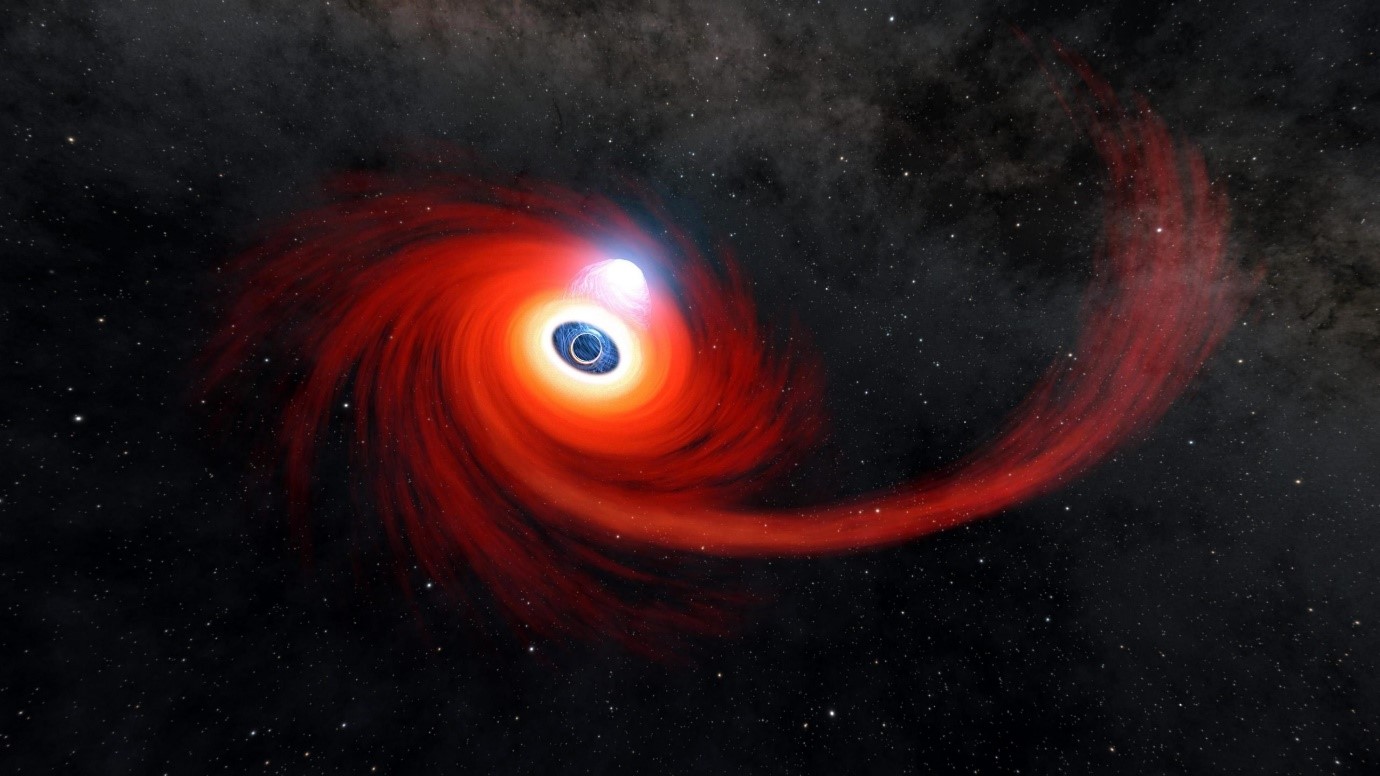
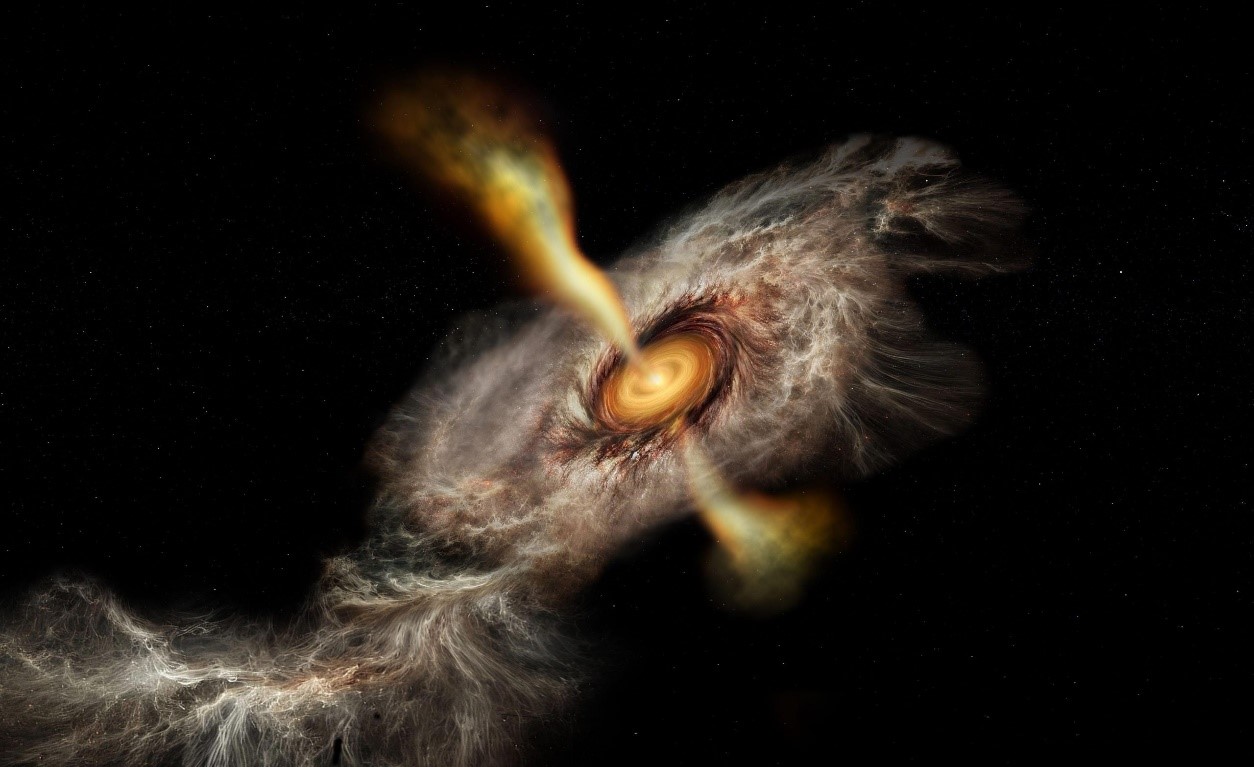
Figure 1. Black Hole Feeding on Star’s Gas Stream
Secret Black Hole Feeding Frenzies
Black holes typically remain hidden in the darkness of space, only becoming visible under special circumstances. Some steadily consume gas and dust, glowing as they feed, while others stay dormant for years—until an unfortunate star strays too close and is ripped apart. Figure 1 shows Black Hole Feeding on Star’s Gas Stream.
A new study, drawing on data from NASA, the European Space Agency (ESA), and multiple ground-based observatories, has uncovered three remarkable instances where supermassive black holes devoured massive stars. Each event unleashed energy surpassing that of 100 supernovae, making them among the most powerful cosmic explosions seen since the Big Bang.
Located in distant galaxies, these supermassive black holes suddenly flared to life as they tore apart stars weighing three to ten times the mass of our Sun. The resulting bursts of light, which lasted for several months, offered scientists a rare glimpse into these otherwise invisible cosmic events.
Extreme Galactic Core Eruptions
Astronomers refer to these rare, powerful outbursts as “extreme nuclear transients.” This newly recognized class of cosmic event could help reveal some of the Universe’s most massive—but normally hidden—supermassive black holes.
“These events act like spotlights, briefly illuminating black holes that would otherwise remain invisible,” explained Jason Hinkle, a graduate student at the University of Hawaii and lead author of a new study published in Science Advances.
These violent flares release intense high-energy radiation into the core regions of their host galaxies, significantly impacting their surroundings. “If galaxies experience these events, they likely play an important role in shaping galactic environments,” Hinkle added.
As the black holes tear apart massive stars, the resulting high-energy light takes more than 100 days to reach its peak brightness and over 150 days to fade to half that intensity. This radiation also triggers lower-energy emissions, which telescopes can detect, offering further clues about these dramatic cosmic episodes.
Case Studies: “Barbie” and Gaia Discoveries
One of the dramatic star-destroying events, nicknamed “Barbie” (based on its catalog ID ZTF20abrbeie), was first spotted in 2020 by the Zwicky Transient Facility at Caltech’s Palomar Observatory and documented in two studies published in 2023. The other two events were detected by ESA’s Gaia mission in 2016 and 2018 and are analyzed in depth in the latest research.
NASA’s Neil Gehrels Swift Observatory played a key role in confirming these outbursts were caused by black holes rather than supernovae or other stellar phenomena. The timing and behavior of the X-ray, ultraviolet, and optical light emissions closely matched the signature pattern of a black hole tearing a star apart.
Researchers also relied on data from NASA’s WISE spacecraft, which originally operated from 2009 to 2011 and was later reactivated as NEOWISE until its retirement in 2024. WISE’s infrared sky maps were instrumental in characterizing the dust environments surrounding the black holes. Numerous ground-based observatories also contributed to the findings, including the W. M. Keck Observatory through its NASA-supported archive, and data from NASA-backed Near-Earth Object surveys like ATLAS, Pan-STARRS, and Catalina.
Expanding the Boundaries of Cosmic Energy
“What excites me most about this research is that we're pushing the boundaries of what we know about the Universe's most energetic environments,” said Anna Payne, staff scientist at the Space Telescope Science Institute and study co-author. She helped analyze the chemical signatures of these events using the University of Hawaii’s 2.2-meter Telescope.
The project was supported by a FINESST (Future Investigators in NASA Earth and Space Science and Technology) grant, which enabled lead author Jason Hinkle to pursue the search for these black hole events [1]. “The FINESST grant gave Jason the freedom to investigate and identify what these unusual phenomena really were,” noted Ben Shappee, associate professor at the University of Hawaii’s Institute for Astronomy and Hinkle’s advisor.
Hinkle will continue this research as a NASA Hubble Fellow at the University of Illinois Urbana-Champaign. “One of the biggest open questions in astronomy is how black holes grow across cosmic time,” Hinkle said.
These findings also complement recent results from NASA’s James Webb Space Telescope, which has been observing how supermassive black holes feed and grow in the early Universe. Since only about 10% of early black holes are actively consuming gas and dust, capturing rare events like extreme nuclear transients—where a black hole devours a massive star—offers a new and powerful method to detect and study black holes from the distant past.
Cosmic Fireworks Yet to Come
These incredibly bright events could be visible even in the early universe. While they emit mostly ultraviolet light, cosmic expansion shifts this light into the infrared—perfect for NASA’s upcoming Nancy Grace Roman Space Telescope.
With its powerful infrared capabilities and wide field of view, Roman will detect such rare explosions from over 12 billion years ago, shedding new light on the formation and evolution of stars, galaxies, and black holes.
“We can use these three events as a blueprint for future discoveries,” said Anna Payne.
Reference:
- https://scitechdaily.com/star-shredding-spectacle-nasa-reveals-brightest-black-hole-blasts-since-the-big-bang/
Cite this article:
Janani R (2025), Star-Shredding Blast: NASA Unveils Brightest Black Hole Eruption Since the Big Bang, AnaTechMaz, pp.440
Recent Post
-
Scientists Uncover Strange Earth-Like Patterns in Mars Soil
Wave-like formations on Mars offer insights into the planet’s icy past, its potential to support life...
-
Webb Snaps First Direct Image of Exoplanet Shaping Cosmic Rings
This newly discovered planet marks Webb’s first direct image of an exoplanet. With nearly 6,000...
-
Astronomers Detect the Universe’s Long-Hidden Matter
Astronomers have discovered a massive filament of hot gas linking four galaxy clusters...
-
Hubble Captures Triple Suns and Hidden Planet Factory in Blue Nebula
Illuminated by scattered starlight, this vibrant blue nebula...
-
Star-Shredding Blast: NASA Unveils Brightest Black Hole Eruption Since the Big Bang
Supermassive black holes usually remain hidden, but when a star....
-
Space Emerging from Time? New Theory Challenges Einstein
A daring new theory proposes that time isn’t just a single linear flow but a three-dimensional fabric from which space....
-
Astronomers Find Hidden Earth-Like Planets Around Nearby Dwarf Stars
Research on 15 M-type stars has uncovered fresh insights into the...
-
Researchers Reveal Galactic Map Unlocking New Insights into the Extreme Universe
A groundbreaking survey from China’s Large High Altitude Air Shower...
-
Cosmic Feast: Massive Star Caught Rapidly Consuming Surrounding Gas
Astronomers have, for the first time, observed the massive gas inflow...
Lasers, Gas Bursts, and Hidden Water: How Perseverance Broke Through Mars’ Tough Rocks
NASA’s Perseverance rover recently tackled a tough Martian rock known...
-
Hidden Rings Around Young Stars Offer Earliest Clues to Planet Formation
High-resolution views of 78 young star disks in the Ophiuchus cloud have...
-
Harnessing Bolide Sonic Booms to Enhance Planetary Defense
Faint sonic booms from space help scientists track incoming debris—but an object's path is more important than it...
-
Earth’s Weather Satellites Reveal Venus’s Fiery Secrets
The future looks bright for long-term planetary monitoring across various wavelengths. Researchers at the...
-
Martian "Spiderwebs" Unveiled in Curiosity's Striking 360° Panorama
NASA’s Curiosity rover has created a stunning 360° color-balanced...
-
Sky Spectacle Ahead: Mars Glows, Venus Shines, and an Eagle Soars
July’s night sky is packed with celestial highlights: Mars glows at twilight, Mercury makes a brief evening....