

Hidden Rings Around Young Stars Offer Earliest Clues to Planet Formation
High-resolution views of 78 young star disks in the Ophiuchus cloud have revealed sharp rings and spirals—gravitational traces left by forming planets—just a few hundred thousand years after star formation begins.
By reprocessing ALMA archival data at three times its original resolution, astronomers identified these structures in 27 disks, including 15 never seen before. The findings suggest that planet formation begins much earlier than previously believed, with newborn planets emerging while their stars are still surrounded by abundant gas and dust.
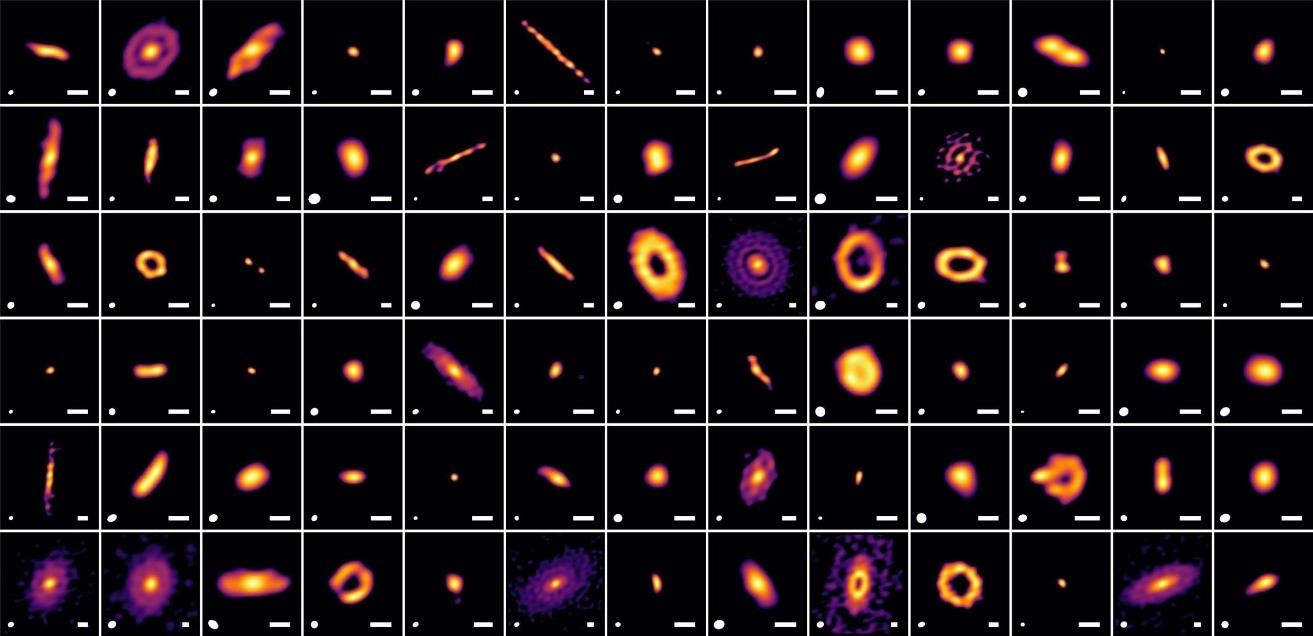
Figure 1. High-Resolution Images of Ophiuchus Protoplanetary Disks Showing Evolution and Scale
First Clues of Planet Formation
Astronomers have found surprising evidence that planets may begin forming much earlier than once thought—while their stars are still taking shape. By reanalyzing archival radio telescope data with advanced imaging techniques, researchers uncovered clear signs of planet formation in the swirling material around very young stars. These discoveries provide new insight into when and how planets like Earth begin to form. Figure 1 shows High-Resolution Images of Ophiuchus Protoplanetary Disks Showing Evolution and Scale.
Planets emerge within protoplanetary disks—large rings of cold gas and dust surrounding newborn stars, or protostars. Though the planets themselves are too small and faint to observe directly, their gravitational pull can carve visible rings and spirals into the surrounding material. Until now, scientists were uncertain how early these features formed, largely due to the limited number of nearby disks that could be studied in detail.
Uncovering Hidden Clues in ALMA’s Archival Data
To dig deeper, a team led by Ayumu Shoshi of Kyushu University and the Academia Sinica Institute of Astronomy and Astrophysics (ASIAA) revisited existing data from the ALMA (Atacama Large Millimeter/submillimeter Array) radio telescope. Using advanced image processing methods, they reanalyzed 78 protoplanetary disks in the Ophiuchus star-forming region, located about 460 light-years from Earth. These improvements boosted the image resolution, with over half of the images achieving more than three times the clarity of the original data.
Rings and Spirals Reveal Rapid Planet Formation
The new high-resolution images reveal ring or spiral patterns in 27 protoplanetary disks, including 15 newly identified structures [1]. When combined with earlier studies of a different star-forming region, the researchers found that these characteristic disk features appear in disks larger than 30 astronomical units (au)—about the distance from the Earth to the Sun—around stars in the earliest stages of formation, just a few hundred thousand years after their birth.
This indicates that planet formation begins much earlier than previously thought, occurring while the disk still contains abundant gas and dust. In other words, planets start growing alongside their very young host stars.
Reference:
- https://scitechdaily.com/hidden-rings-around-baby-stars-reveal-earliest-clues-of-planet-birth/
Cite this article:
Janani R (2025), Hidden Rings Around Young Stars Offer Earliest Clues to Planet Formation, AnaTechMaz, pp.446
Recent Post
-
Scientists Uncover Strange Earth-Like Patterns in Mars Soil
Wave-like formations on Mars offer insights into the planet’s icy past, its potential to support life...
-
Webb Snaps First Direct Image of Exoplanet Shaping Cosmic Rings
This newly discovered planet marks Webb’s first direct image of an exoplanet. With nearly 6,000...
-
Astronomers Detect the Universe’s Long-Hidden Matter
Astronomers have discovered a massive filament of hot gas linking four galaxy clusters...
-
Hubble Captures Triple Suns and Hidden Planet Factory in Blue Nebula
Illuminated by scattered starlight, this vibrant blue nebula...
-
Star-Shredding Blast: NASA Unveils Brightest Black Hole Eruption Since the Big Bang
Supermassive black holes usually remain hidden, but when a star....
-
Space Emerging from Time? New Theory Challenges Einstein
A daring new theory proposes that time isn’t just a single linear flow but a three-dimensional fabric from which space....
-

Astronomers Find Hidden Earth-Like Planets Around Nearby Dwarf Stars
Research on 15 M-type stars has uncovered fresh insights into the...
-
Researchers Reveal Galactic Map Unlocking New Insights into the Extreme Universe
A groundbreaking survey from China’s Large High Altitude Air Shower...
-
Cosmic Feast: Massive Star Caught Rapidly Consuming Surrounding Gas
Astronomers have, for the first time, observed the massive gas inflow...
Lasers, Gas Bursts, and Hidden Water: How Perseverance Broke Through Mars’ Tough Rocks
NASA’s Perseverance rover recently tackled a tough Martian rock known...
-
Hidden Rings Around Young Stars Offer Earliest Clues to Planet Formation
High-resolution views of 78 young star disks in the Ophiuchus cloud have...
-

Harnessing Bolide Sonic Booms to Enhance Planetary Defense
Faint sonic booms from space help scientists track incoming debris—but an object's path is more important than it...
-
Earth’s Weather Satellites Reveal Venus’s Fiery Secrets
The future looks bright for long-term planetary monitoring across various wavelengths. Researchers at the...
-
Martian "Spiderwebs" Unveiled in Curiosity's Striking 360° Panorama
NASA’s Curiosity rover has created a stunning 360° color-balanced...
-

Sky Spectacle Ahead: Mars Glows, Venus Shines, and an Eagle Soars
July’s night sky is packed with celestial highlights: Mars glows at twilight, Mercury makes a brief evening....