

Astronomers Snap Stunning Photo of a Real-Life “Tatooine” with Two Suns
Directly capturing an image of a planet outside our solar system is rare—but finding one orbiting two suns is even more extraordinary. This newly discovered planet is exceptional among these rare cases: it orbits closer to its twin stars than any other directly imaged planet in a binary system, sitting six times nearer to its suns than similar exoplanets identified to date.
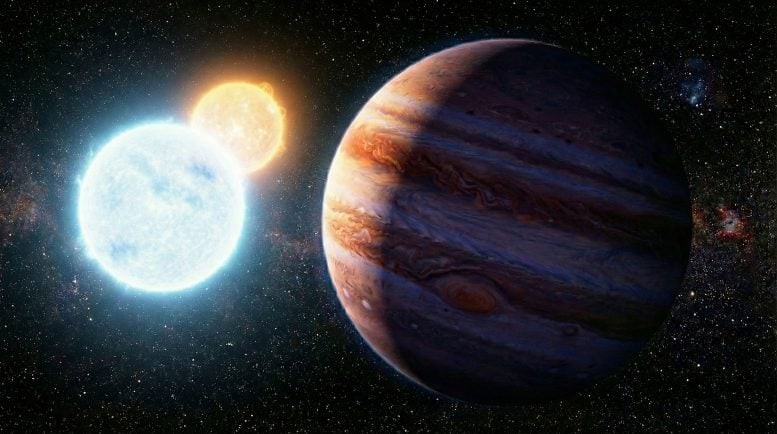
Figure 1. Astronomers Capture Rare Image of a “Tatooine” Exoplanet Orbiting Two Suns.
This discovery provides scientists with a unique opportunity to study planetary formation and dynamics in multi-star systems. Observing the interactions between the planet and its stars allows researchers to test and refine models of how planets form and evolve under complex gravitational forces. Figure 1 shows Astronomers Capture Rare Image of a “Tatooine” Exoplanet Orbiting Two Suns.
Experts Behind the Discovery
Wang, an assistant professor of physics and astronomy at Northwestern’s Weinberg College of Arts and Sciences and a member of the Center for Interdisciplinary Exploration and Research in Astrophysics (CIERA), is a specialist in exoplanet imaging. The study’s lead author, Nathalie Jones, is the CIERA Board of Visitors Graduate Fellow at Weinberg and a member of Wang’s research group.
Time-Lapse Captures a Planet Orbiting Two Stars
Astronomers released time-lapse footage of a newly discovered exoplanet slowly orbiting a pair of stars. To obtain the image, they had to remove the glare of the stars. Two-star icons mark their locations relative to the planet.
Nearly a decade later, Wang asked Nathalie Jones to revisit the data. GPI, the Gemini Planet Imager, is being upgraded and will move to Hawaii next year. As GPI concluded its first chapter in Chile, Wang decided to finalize his original search. “I didn’t think we’d find any new planets,” he said, “but we needed to check carefully anyway.”
Tracking a Suspicious Object
Jones analyzed GPI data from 2016–2019, cross-referencing it with observations from the W.M. Keck Observatory. This past summer, she noticed a faint object consistently following the motion of a star across the sky.
“Stars move in a galaxy, so we track objects to see if they move with a star,” Wang explained. “If they do, it’s likely an orbiting planet. Otherwise, it could just be a passing star.”
Jones added, “We also compare the light emitted by an object. The faint object matched what we’d expect from a planet.” To the team’s surprise, it was indeed a planet—captured by GPI in 2016 but overlooked in earlier analyses. Around the same time, a European team led by University of Exeter astronomers independently confirmed the discovery.
A Planet Born After the Dinosaurs
The confirmed planet is massive—six times the size of Jupiter—and relatively cool compared to other directly imaged exoplanets. Located about 446 light-years from Earth, it is young, forming roughly 13 million years ago. “That’s 50 million years after dinosaurs went extinct,” Wang said. “So, it still retains heat from its formation.”
The planet orbits its tightly bound binary stars, which revolve around each other every 18 Earth days. In contrast, the planet takes 300 years to complete its orbit—slightly longer than Pluto’s journey around our sun. “You have a fast-dancing binary pair with a slow, distant planet,” Wang said.
Looking Ahead
Despite being farther out than the stars, this planet is much closer to its hosts than other directly imaged planets in binary systems. While the exact formation of the system is still uncertain, the team suspects the stars formed first, followed by the planet.
The researchers plan to continue studying the system. Jones is preparing telescope proposals to monitor the planet’s orbit and the binary stars’ interactions.
“This discovery highlights the scientific value of archival data,” Wang said. “There are still a few suspicious objects in the data that we are checking. Who knows what else we might find?”
Source: SciTECHDaily
Cite this article:
Priyadharshini S (2025), Astronomers Snap Stunning Photo of a Real-Life “Tatooine” with Two Suns, AnaTechMaz, pp.643
Recent Post
-
Scientists Crack the Milky Way’s Long-Standing Chemical Mystery
Scientists at the Institute of Cosmos Sciences of the University of Barcelona (ICCUB) and the French National...
-
Astronomers Discover Giant Exoplanet 18 Times the Mass of Jupiter in Distant Star System
OASIS plays a key role in identifying the most promising candidates....
-
Most Detailed Black Hole Accretion Model Ever Revealed by Scientists
“This marks the first time we can observe what happens when the key physical processes governing...
-
Possible Building Block of Life Spotted on Distant Exoplanet, but Scientists Advise Caution
The key question for TRAPPIST-1e is simple: if it has an atmosphere...
-
Astronomers Spot One of the Universe’s Biggest Rotating Cosmic Structures
Researchers have discovered a remarkably thin chain of 14...
-

Hidden Dark Matter Around Black Holes Revealed by Gravitational Waves
The study focuses on extreme mass-ratio inspirals (EMRIs), which occur....
-
Unveiling the Universe’s Fiercest Explosions: Fresh Insights into X-Ray Bursts
The rp-process relies on numerous nuclei located near the proton...
-

Universe’s Expansion Gets a New Twist Through Gravitational Lensing
The universe is vast and continues to grow, even though its.....
-
Black Hole Launches Near-Light-Speed Winds in Just Hours
Using XMM-Newton and the JAXA-led XRISM mission, scientists studied the supermassive black hole at...

Ancient Asteroids Could Reveal the Blueprint for Space Mining
Researchers at ICE-CSIC selected and characterized meteorite samples that were later analyzed using...
-

Scientists Chart the Invisible Universe, Uncovering Fresh Insights into Dark Matter and Dark Energy
Between 2013 and 2019, the...
-
Surprising Discoveries Suggest Uranus and Neptune are Very Different Than Expected
To explore these ideas, the researchers created a new technique to simulate...
-
Astronomers Snap Stunning Photo of a Real-Life “Tatooine” with Two Suns
Directly capturing an image of a planet outside our solar system is rare—but...
-
James Webb Finds its Strongest Evidence Yet of an Atmosphere Around a Rocky Exoplanet
Gases such as water vapor can absorb specific wavelengths of near...
-
Secrets of Hot Jupiters Revealed Through their Unusual Orbits
To address this challenge, a research team led by PhD student Yugo Kawai and Assistant Professor...