

Astronomers Spot One of the Universe’s Biggest Rotating Cosmic Structures
Researchers have discovered a remarkably thin chain of 14 hydrogen-rich galaxies, stretched out in a long, narrow line about 5.5 million light-years long and only 117,000 light-years wide. This slender structure sits within a much larger cosmic filament spanning nearly 50 million light-years and containing over 280 galaxies.
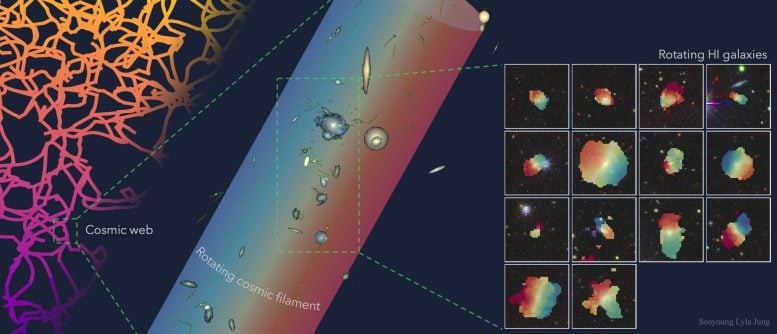
Figure 1. Astronomers Reveal Gigantic Rotating Cosmic Filament.
In this region, many galaxies appear to spin in the same direction as the filament itself—far more often than random chance would predict. This unexpected alignment challenges current theories, suggesting that massive cosmic structures may influence galaxy rotation more strongly, or for longer durations, than previously thought. Figure 1 shows Astronomers Reveal Gigantic Rotating Cosmic Filament.
The team also observed that galaxies on opposite sides of the filament’s core move in opposite directions, indicating that the entire filament is rotating. By applying models of filament dynamics, they estimated a rotation speed of about 110 km/s and calculated the radius of the filament’s dense central zone to be roughly 50 kiloparsecs, or around 163,000 light-years.
Insights Into Galactic Spin and Cosmic Dynamics
Co-lead author Dr. Lyla Jung (Department of Physics, University of Oxford) explained, “This structure is remarkable not just for its size, but for the combination of spin alignment and overall rotation. Imagine a teacups ride at a theme park: each galaxy is like a spinning teacup, while the entire platform—the cosmic filament—is rotating too. This dual motion offers a rare glimpse into how galaxies acquire their spin from the larger structures they inhabit.”
The filament appears to be relatively young and largely undisturbed. Its abundance of gas-rich galaxies and low internal motion—a so-called “dynamically cold” state—suggest it is still in an early stage of formation.
Hydrogen, the primary fuel for star formation, is plentiful in these galaxies, indicating they are actively gathering or retaining the material needed to form stars. Studying them provides a window into both early and ongoing stages of galaxy evolution.
Tracing Gas Flows Through the Cosmic Web
Hydrogen-rich galaxies are also excellent tracers of gas flows along cosmic filaments. Because atomic hydrogen is easily affected by motion, its distribution reveals how gas is funneled through filaments into galaxies. This helps scientists understand how angular momentum moves through the cosmic web, shaping galaxy morphology, spin, and star formation.
The findings may also improve models of intrinsic galaxy alignments, which are a potential source of contamination in upcoming weak lensing cosmology surveys, such as those by the European Space Agency’s Euclid mission and the Vera C. Rubin Observatory in Chile.
Multi-Observatory Effort and International Collaboration
The discovery was made by an international team using data from South Africa’s MeerKAT radio telescope, one of the world’s most powerful, consisting of 64 interlinked satellite dishes. The rotating filament was detected through the deep sky survey MIGHTEE, led by Professor Matt Jarvis (Department of Physics, University of Oxford), and supplemented with optical observations from the Dark Energy Spectroscopic Instrument (DESI) and the Sloan Digital Sky Survey (SDSS). Together, these observations revealed a cosmic filament showing both coherent galaxy spin alignment and large-scale rotation.
Source: SciTECHDaily
Cite this article:
Priyadharshini S (2025), Astronomers Spot One of the Universe’s Biggest Rotating Cosmic Structures, AnaTechMaz, pp.635
Recent Post
-
Scientists Crack the Milky Way’s Long-Standing Chemical Mystery
Scientists at the Institute of Cosmos Sciences of the University of Barcelona (ICCUB) and the French National...
-
Astronomers Discover Giant Exoplanet 18 Times the Mass of Jupiter in Distant Star System
OASIS plays a key role in identifying the most promising candidates....
-
Most Detailed Black Hole Accretion Model Ever Revealed by Scientists
“This marks the first time we can observe what happens when the key physical processes governing...
-
Possible Building Block of Life Spotted on Distant Exoplanet, but Scientists Advise Caution
The key question for TRAPPIST-1e is simple: if it has an atmosphere...
-
Astronomers Spot One of the Universe’s Biggest Rotating Cosmic Structures
Researchers have discovered a remarkably thin chain of 14...
-
Hidden Dark Matter Around Black Holes Revealed by Gravitational Waves
The study focuses on extreme mass-ratio inspirals (EMRIs), which occur....
-
Unveiling the Universe’s Fiercest Explosions: Fresh Insights into X-Ray Bursts
The rp-process relies on numerous nuclei located near the proton...
-

Universe’s Expansion Gets a New Twist Through Gravitational Lensing
The universe is vast and continues to grow, even though its.....
-
Black Hole Launches Near-Light-Speed Winds in Just Hours
Using XMM-Newton and the JAXA-led XRISM mission, scientists studied the supermassive black hole at...

Ancient Asteroids Could Reveal the Blueprint for Space Mining
Researchers at ICE-CSIC selected and characterized meteorite samples that were later analyzed using...
-

Scientists Chart the Invisible Universe, Uncovering Fresh Insights into Dark Matter and Dark Energy
Between 2013 and 2019, the...
-
Surprising Discoveries Suggest Uranus and Neptune are Very Different Than Expected
To explore these ideas, the researchers created a new technique to simulate...
-

Astronomers Snap Stunning Photo of a Real-Life “Tatooine” with Two Suns
Directly capturing an image of a planet outside our solar system is rare—but...
-
James Webb Finds its Strongest Evidence Yet of an Atmosphere Around a Rocky Exoplanet
Gases such as water vapor can absorb specific wavelengths of near...
-
Secrets of Hot Jupiters Revealed Through their Unusual Orbits
To address this challenge, a research team led by PhD student Yugo Kawai and Assistant Professor...