

Surprising Discoveries Suggest Uranus and Neptune are Very Different Than Expected
A New Way to Model Planetary Interiors
To explore these ideas, the researchers created a new technique to simulate the internal makeup of Uranus and Neptune. Luca Morf, a PhD student at the University of Zurich and lead author of the study, explains that labeling them simply as “ice giants” is misleading because much about their interiors remains unknown. Physics-based models often rely on too many assumptions, while purely empirical models tend to oversimplify the problem. By merging the two approaches, the team produced interior models that are largely unbiased yet remain firmly grounded in physical principles.
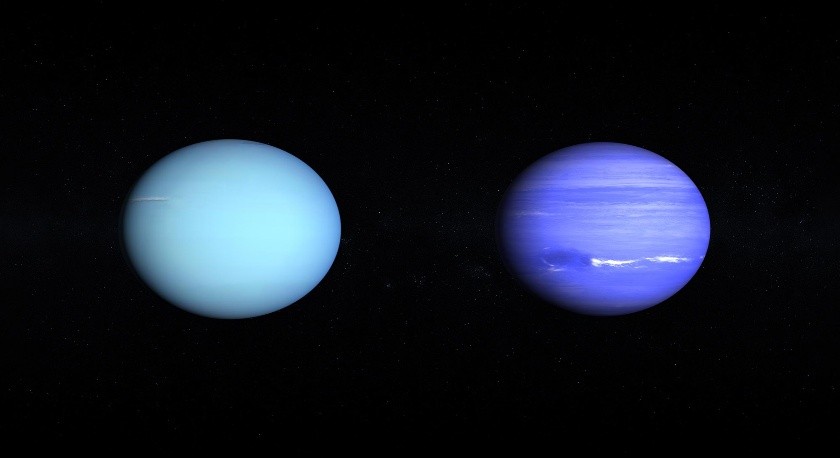
Figure 1. Unexpected Discoveries Show Uranus and Neptune Differ from Expectations.
The team’s approach starts by generating random density profiles for each planet. From these, they calculate gravitational fields that match existing observations and use the results to infer possible internal compositions. This process is repeated thousands of times, allowing the researchers to identify the models that best align with available data. Figure 1 shows Unexpected Discoveries Show Uranus and Neptune Differ from Expectations.
A Broader View of Ice Giant Interiors
Applying this unbiased modeling technique, the University of Zurich researchers discovered that the interiors of Uranus and Neptune do not necessarily need to be dominated by ice—typically assumed to be water. Instead, a much wider range of internal structures is possible.
“This is something we proposed nearly 15 years ago, but we now finally have the numerical framework to demonstrate it,” says Ravit Helled, professor at the University of Zurich and initiator of the project. The findings suggest that, depending on which models best fit the observations, either planet could be rich in water or dominated by rocky material.
New Insights into Unusual Magnetic Fields
The study also offers fresh explanations for the planets’ strange magnetic fields. Unlike Earth’s relatively simple dipolar field, Uranus and Neptune exhibit complex, multi-polar magnetic structures. According to Helled, the models include layers of so-called “ionic water” that generate magnetic dynamos in regions consistent with these unusual field geometries. The team also found that Uranus’ magnetic field likely originates deeper within the planet than Neptune’s.
Why Future Missions Matter
Despite these advances, significant uncertainties remain. “One of the major challenges is that we still have a limited understanding of how materials behave under the extreme pressures and temperatures found inside planets, which could affect our results,” explains Morf, who plans to further refine the models.
Even so, the research opens the door to new interpretations of Uranus and Neptune’s interiors and challenges long-standing assumptions. It may also help steer future studies of material behavior under extreme planetary conditions. As Helled concludes, “Uranus and Neptune could be either rock giants or ice giants depending on the model assumptions. Current data are not sufficient to clearly distinguish between these possibilities, highlighting the need for dedicated missions to uncover their true nature.”
Source: SciTECHDaily
Cite this article:
Priyadharshini S (2025), Surprising Discoveries Suggest Uranus and Neptune are Very Different Than Expected, AnaTechMaz, pp.642
Recent Post
-
Scientists Crack the Milky Way’s Long-Standing Chemical Mystery
Scientists at the Institute of Cosmos Sciences of the University of Barcelona (ICCUB) and the French National...
-
Astronomers Discover Giant Exoplanet 18 Times the Mass of Jupiter in Distant Star System
OASIS plays a key role in identifying the most promising candidates....
-
Most Detailed Black Hole Accretion Model Ever Revealed by Scientists
“This marks the first time we can observe what happens when the key physical processes governing...
-
Possible Building Block of Life Spotted on Distant Exoplanet, but Scientists Advise Caution
The key question for TRAPPIST-1e is simple: if it has an atmosphere...
-
Astronomers Spot One of the Universe’s Biggest Rotating Cosmic Structures
Researchers have discovered a remarkably thin chain of 14...
-
Hidden Dark Matter Around Black Holes Revealed by Gravitational Waves
The study focuses on extreme mass-ratio inspirals (EMRIs), which occur....
-
Unveiling the Universe’s Fiercest Explosions: Fresh Insights into X-Ray Bursts
The rp-process relies on numerous nuclei located near the proton...
-
Universe’s Expansion Gets a New Twist Through Gravitational Lensing
The universe is vast and continues to grow, even though its.....
-
Black Hole Launches Near-Light-Speed Winds in Just Hours
Using XMM-Newton and the JAXA-led XRISM mission, scientists studied the supermassive black hole at...
Ancient Asteroids Could Reveal the Blueprint for Space Mining
Researchers at ICE-CSIC selected and characterized meteorite samples that were later analyzed using...
-
Scientists Chart the Invisible Universe, Uncovering Fresh Insights into Dark Matter and Dark Energy
Between 2013 and 2019, the...
-
Surprising Discoveries Suggest Uranus and Neptune are Very Different Than Expected
To explore these ideas, the researchers created a new technique to simulate...
-
Astronomers Snap Stunning Photo of a Real-Life “Tatooine” with Two Suns
Directly capturing an image of a planet outside our solar system is rare—but...
-
James Webb Finds its Strongest Evidence Yet of an Atmosphere Around a Rocky Exoplanet
Gases such as water vapor can absorb specific wavelengths of near...
-
Secrets of Hot Jupiters Revealed Through their Unusual Orbits
To address this challenge, a research team led by PhD student Yugo Kawai and Assistant Professor...