

Hidden Dark Matter Around Black Holes Revealed by Gravitational Waves
Extreme Mass-Ratio Inspirals
The study focuses on extreme mass-ratio inspirals (EMRIs), which occur when a relatively small compact object—such as a black hole formed from the collapse of a single star—orbits a much larger black hole, typically found at the center of a galaxy. As the smaller object slowly spirals inward, it emits a continuous signal of gravitational waves.
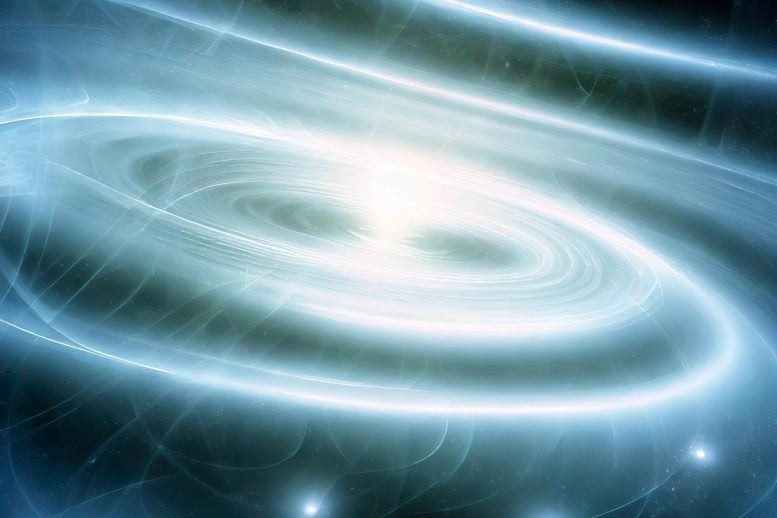
Figure 1. Gravitational Waves Unveil Hidden Dark Matter Near Black Holes.
Future space missions, such as the European Space Agency’s LISA space antenna set to launch in 2035, are expected to monitor these gravitational-wave signals for months or even years, tracking hundreds of thousands to millions of orbital cycles. When modeled accurately, these “cosmic fingerprints” can reveal how matter—particularly the elusive dark matter, which is believed to constitute most of the Universe’s matter—is distributed near massive black holes. Figure 1 shows Gravitational Waves Unveil Hidden Dark Matter Near Black Holes.
A Relativistic Perspective
Before missions like LISA begin collecting data, it is essential to predict in detail the types of signals they might detect and determine how to extract maximum information from them. Until now, most studies have relied on simplified approximations of how the surrounding environment influences EMRIs. The new paper by physicists from IoP/GRAPPA addresses this gap by providing the first fully relativistic framework—based on Einstein’s theory of gravity rather than Newtonian approximations—to describe how a massive black hole’s surroundings affect an EMRI’s orbit and its emitted gravitational waves.
The study specifically examines dense concentrations of dark matter, often referred to as “spikes” or “mounds,” that can form around massive black holes. By integrating this relativistic description into advanced waveform models, the researchers demonstrate how such structures would leave detectable signatures in the signals recorded by future detectors. This work marks a crucial step toward a long-term goal: using gravitational waves to map dark matter in the Universe and gain deeper insights into its fundamental nature.
The Future Space Antenna
- Introduce ESA’s LISA mission, planned for launch in 2035, designed to detect low-frequency gravitational waves.
- Explain how LISA will observe EMRIs for months or years, capturing the intricate details of their orbital cycles.
- Describe how this data can be used to map the distribution of matter around massive black holes.
Extreme Mass-Ratio Inspirals – Cosmic Beacons of Gravity
- Introduce EMRIs (extreme mass-ratio inspirals) – systems where a small compact object (like a stellar-mass black hole) orbits a supermassive black hole.
- Explain how the smaller object’s spiral motion emits continuous gravitational waves, acting as a “cosmic fingerprint” of the surrounding environment.
- Highlight why these signals are important: they carry detailed information about the dynamics near the black hole, including hints of otherwise invisible matter.
Source: SciTECHDaily
Cite this article:
Priyadharshini S (2025), Hidden Dark Matter Around Black Holes Revealed by Gravitational Waves, AnaTechMaz, pp.636
Recent Post
-
Scientists Crack the Milky Way’s Long-Standing Chemical Mystery
Scientists at the Institute of Cosmos Sciences of the University of Barcelona (ICCUB) and the French National...
-
Astronomers Discover Giant Exoplanet 18 Times the Mass of Jupiter in Distant Star System
OASIS plays a key role in identifying the most promising candidates....
-
Most Detailed Black Hole Accretion Model Ever Revealed by Scientists
“This marks the first time we can observe what happens when the key physical processes governing...
-
Possible Building Block of Life Spotted on Distant Exoplanet, but Scientists Advise Caution
The key question for TRAPPIST-1e is simple: if it has an atmosphere...
-
Astronomers Spot One of the Universe’s Biggest Rotating Cosmic Structures
Researchers have discovered a remarkably thin chain of 14...
-
Hidden Dark Matter Around Black Holes Revealed by Gravitational Waves
The study focuses on extreme mass-ratio inspirals (EMRIs), which occur....
-
Unveiling the Universe’s Fiercest Explosions: Fresh Insights into X-Ray Bursts
The rp-process relies on numerous nuclei located near the proton...
-

Universe’s Expansion Gets a New Twist Through Gravitational Lensing
The universe is vast and continues to grow, even though its.....
-
Black Hole Launches Near-Light-Speed Winds in Just Hours
Using XMM-Newton and the JAXA-led XRISM mission, scientists studied the supermassive black hole at...

Ancient Asteroids Could Reveal the Blueprint for Space Mining
Researchers at ICE-CSIC selected and characterized meteorite samples that were later analyzed using...
-
Scientists Chart the Invisible Universe, Uncovering Fresh Insights into Dark Matter and Dark Energy
Between 2013 and 2019, the...
-
Surprising Discoveries Suggest Uranus and Neptune are Very Different Than Expected
To explore these ideas, the researchers created a new technique to simulate...
-
Astronomers Snap Stunning Photo of a Real-Life “Tatooine” with Two Suns
Directly capturing an image of a planet outside our solar system is rare—but...
-
James Webb Finds its Strongest Evidence Yet of an Atmosphere Around a Rocky Exoplanet
Gases such as water vapor can absorb specific wavelengths of near...
-
Secrets of Hot Jupiters Revealed Through their Unusual Orbits
To address this challenge, a research team led by PhD student Yugo Kawai and Assistant Professor...