

Mystery at the Milky Way’s Core: Unusual Star-Forming Regions Baffle Scientists
“Previous research suggested that star formation near the Galactic Center is likely suppressed, with some even proposing that no new stars are forming there at all,” explained De Buizer, the study’s lead author. “Because massive stars in the process of forming shine brightest in long infrared wavelengths, we captured the highest-resolution infrared images of the Galaxy’s central star-forming regions. Our observations reveal that, contrary to earlier beliefs, massive stars are indeed forming there, albeit at a relatively slow pace.”
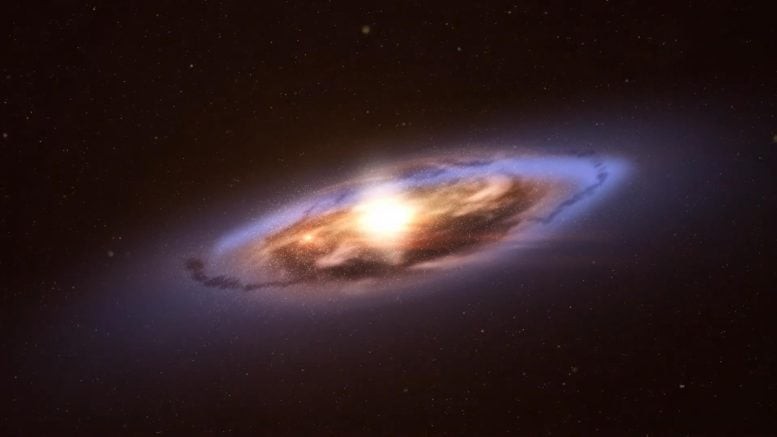
Figure 1. Unusual Star-Forming Regions at the Milky Way’s Center Puzzle Astronomers.
The study indicates that the slowdown in star formation is likely due to the extreme conditions at the Galactic Center. Gas clouds in these regions orbit rapidly around the central black hole, interacting with older stars and potentially with infalling material. Such turbulent and harsh conditions may prevent gas clouds from remaining intact long enough to form stars, and even those that do manage to form may not survive long enough to sustain further star formation.
Sgr B2, however, appears to be an exception. While its current rate of massive star formation is unusually low—similar to other regions studied in the Galactic Center—it has retained a substantial reservoir of dense gas and dust, offering the potential for a future emergent star cluster.
Rethinking Giant H II Regions
Giant H II regions, such as Sgr B1 and Sgr C, have traditionally been seen as hosts of massive star clusters still embedded within their birth clouds. This study challenges that view. The researchers suggest that these regions may not fit the classical definition of H II regions, or they could represent a new, previously unrecognized type of stellar nursery.
Obscured by thick clouds of gas and dust, these star-forming regions are visible only at the longest infrared wavelengths. Using SOFIA’s high-resolution infrared imaging, the team identified more than sixty massive stars currently forming within the Galactic Center. Despite this, these regions formed fewer stars overall and reached lower maximum stellar masses than typical regions elsewhere in the Galaxy.
“These star-forming regions in the Galactic Center resemble massive star-forming areas in the quieter parts of the Galaxy in many ways,” said Lim. “However, the most massive stars here, although still very large, are smaller and less numerous than their counterparts elsewhere. Moreover, while star-forming regions usually retain large reservoirs of material and produce multiple generations of stars, this does not seem to be the case for these Galactic Center regions.”
Slow but Steady — Massive Stars Still Forming
Despite earlier beliefs that star formation near the Galactic Center was nearly halted, new high-resolution infrared observations reveal that massive stars are indeed forming there, just at a slower pace than elsewhere in the Galaxy. Harsh conditions near the central black hole—rapid orbital motion and interactions with older stars—appear to slow the process.
Sgr B2 — A Rare Exception
While most Galactic Center regions struggle to sustain star formation, Sgr B2 stands out. This region has retained dense gas and dust, giving it the potential to form a new cluster of massive stars in the future. It offers a glimpse of how star formation might persist even under extreme conditions.
Rethinking Galactic Star Nurseries
Giant H II regions like Sgr B1 and Sgr C may not match traditional expectations of star-forming clouds. Though they host dozens of massive stars, these regions produce fewer stars overall and at lower masses than similar regions elsewhere. This challenges astronomers’ understanding of star formation in the Galaxy’s most extreme environments.
Source: SciTECHDaily
Cite this article:
Priyadharshini S (2025), Mystery at the Milky Way’s Core: Unusual Star-Forming Regions Baffle Scientists, AnaTechMaz, pp.605
Recent Post
-
Colliding Black Hole Twins Provide Einstein’s Theory Its Sharpest Test Yet
Gravitational waves are subtle ripples in space-time, generated...
-
The Universe Just Flashed a Creepy Cosmic Bat Signal
Just in time for Halloween, astronomers have spotted a haunting, bat-shaped cloud gliding through...
-
Webb Telescope Uncovers the Turbulent Youth of the Universe
“This isn’t just about a few remarkable exceptions — for the first time, we can observe an entire...
-
Geomagnetic Superstorm Overwhelms Earth’s Protective Plasma Shield
Launched by the Japan Aerospace Exploration Agency (JAXA) in 2016...
-
Mystery at the Milky Way’s Core: Unusual Star-Forming Regions Baffle Scientists
Previous research suggested that star formation near the Galactic Center is...
-
Ancient 13-Billion-Year Signal May Uncover the Universe’s First Stars
Fialkov leads the theoretical team behind REACH (the Radio Experiment for the Analysis of Cosmic Hydrogen...
-
Astronomers Puzzled by Exoplanet with an Extremely Tilted Orbit
The James Webb Space Telescope (JWST) can detect incredibly small variations in transit depth...
-
New Evidence Proves Hawking’s Prediction: Black Holes Don’t Shrink
In 1971, Stephen Hawking proposed that a black hole’s event horizon..
-
Revolutionary AI Maps our Galaxy’s 100 billion Stars Faster than Ever
A research team led by Keiya Hirashima at the RIKEN Center for Interdisciplinary Theoretical...
Supermassive Black Hole Unleashes Its Brightest Flare After Destroying a Massive Star
The universe’s biggest stars usually end their lives in dramatic......
-
Moss Endures 283 Days in Space, Astonishing Biologists
Though it may seem unassuming, Earth’s moss is remarkably resilient. It thrives in extreme conditions—from...
-
Voyager 1 Approaches Distance of Nearly One Light-Day from Earth
Voyager 1 stands as one of humanity’s most extraordinary technological achievements. Over its nearly fifty...
-
Astronomers Spot a Rule-Breaking Star Circling a Silent Black Hole
The most surprising aspect of this star lies in its composition. Classified as “alpha-rich,” it contains an abundance...
-
Why Dark Matter Remains One of Science’s Greatest Unsolved Mysteries
Right now, is a surreal moment for anyone studying dark matter...
-
Blue Origin Unveils Super-Heavy New Glenn Rocket Taller Than Saturn V
Fresh off a fully successful second flight of its latest mega rocket.....