

The Universe Just Flashed a Creepy Cosmic Bat Signal
Just in time for Halloween, astronomers have spotted a haunting, bat-shaped cloud gliding through the night sky above the European Southern Observatory’s Paranal site in Chile. Captured by the VLT Survey Telescope (VST) with its exceptionally wide field of view, the image reveals a vast expanse of interstellar gas and dust eerily resembling a ghostly, winged creature in flight.
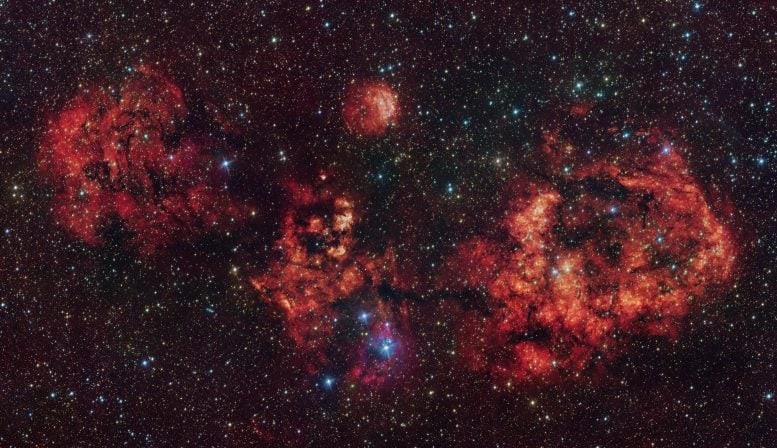
Figure 1. The Universe Unveils a Haunting Cosmic Bat Signal.
Located about 10,000 light-years from Earth, this so-called “cosmic bat” hovers between the southern constellations of Circinus and Norma. Spanning an area of the sky nearly four times the size of the full Moon, the nebula appears to swoop toward a bright patch of light above it—evoking the image of a celestial predator in mid-hunt. Figure 1 shows The Universe Unveils a Haunting Cosmic Bat Signal.
This eerie formation is, in fact, a stellar nursery—a sprawling region of gas and dust where new stars are being born. The young, energetic stars within emit intense radiation that excites the surrounding hydrogen gas, making it glow in rich crimson hues. The darker, web-like structures outlining the bat’s “wings” are cooler, denser filaments of dust that block and scatter the light from the stars behind them, adding to the nebula’s haunting appearance.
The nebula’s distinct features align with several well-known star-forming regions mapped in the southern sky. The right “wing” corresponds to RCW 94, while RCW 95 forms the central “body.” The remaining sections remain unnamed, enhancing the nebula’s haunting, otherworldly mystique.
This breathtaking view was captured by the VLT Survey Telescope (VST), operated by the Italian National Institute for Astrophysics (INAF) at ESO’s Paranal Observatory in Chile’s Atacama Desert. Designed for wide-field imaging, the VST excels at revealing vast cosmic structures like this celestial “bat.” At its heart is OmegaCAM, a 268-megapixel camera capable of producing exceptionally detailed, panoramic views of the night sky.
To produce the final image, astronomers combined data from multiple filters, each sensitive to different wavelengths of light. The red glow tracing the bat’s outline was captured in visible light as part of the VST Photometric Hα Survey of the Southern Galactic Plane and Bulge (VPHAS+). Complementary infrared data from ESO’s Visible and Infrared Survey Telescope for Astronomy (VISTA), collected through the VISTA Variables in the Vía Láctea (VVV) survey, uncovered hidden details buried within the nebula’s densest regions.
Both surveys are open to the public, allowing anyone to venture into these awe-inspiring cosmic landscapes. So go ahead—peer a little closer, if you dare—and lose yourself in the eerie, enchanting beauty of the universe. Happy Halloween!
The Cosmic Encounter
Just in time for Halloween, astronomers spotted a bat-shaped nebula soaring through the night sky above ESO’s Paranal site in Chile. Captured by the VLT Survey Telescope (VST), the eerie formation—nicknamed the “cosmic bat”—is a massive cloud of interstellar gas and dust about 10,000 light-years away, gliding between the constellations Circinus and Norma. Stretching across an area nearly four times the size of the full Moon, the nebula appears to swoop toward a glowing patch of light, resembling a celestial creature in mid-flight.
Anatomy of a Stellar Bat
Despite its spooky silhouette, the “bat” is actually a stellar nursery—a vast region where new stars are born. The young, radiant stars within energize the surrounding hydrogen gas, making it glow in deep crimson shades. The darker filaments that trace the bat’s “wings” are denser, cooler regions of dust that block the starlight behind them, creating the illusion of skeletal wings stretching through space. The nebula’s key structures correspond to known regions RCW 94 and RCW 95, though parts of its body remain unnamed—adding to its mysterious allure.
Capturing the Celestial Specter
This haunting image was made possible by the VLT Survey Telescope, operated by Italy’s National Institute for Astrophysics (INAF) at ESO’s Paranal Observatory. Equipped with the 268-megapixel OmegaCAM, the VST can capture vast, high-resolution views of the cosmos. To reveal the “cosmic bat,” astronomers combined visible light data from the VPHAS+ survey with infrared data from the VISTA Variables in the Vía Láctea (VVV) survey. Both datasets are publicly available—inviting anyone to explore this ghostly masterpiece and witness the universe’s own Halloween display.
Source: SciTECHDaily
Cite this article:
Priyadharshini S (2025), The Universe Just Flashed a Creepy Cosmic Bat Signal, AnaTechMaz, pp.602
Recent Post
-
Colliding Black Hole Twins Provide Einstein’s Theory Its Sharpest Test Yet
Gravitational waves are subtle ripples in space-time, generated...
-
The Universe Just Flashed a Creepy Cosmic Bat Signal
Just in time for Halloween, astronomers have spotted a haunting, bat-shaped cloud gliding through...
-
Webb Telescope Uncovers the Turbulent Youth of the Universe
“This isn’t just about a few remarkable exceptions — for the first time, we can observe an entire...
-
Geomagnetic Superstorm Overwhelms Earth’s Protective Plasma Shield
Launched by the Japan Aerospace Exploration Agency (JAXA) in 2016...
-
Mystery at the Milky Way’s Core: Unusual Star-Forming Regions Baffle Scientists
Previous research suggested that star formation near the Galactic Center is...
-
Ancient 13-Billion-Year Signal May Uncover the Universe’s First Stars
Fialkov leads the theoretical team behind REACH (the Radio Experiment for the Analysis of Cosmic Hydrogen...
-
Astronomers Puzzled by Exoplanet with an Extremely Tilted Orbit
The James Webb Space Telescope (JWST) can detect incredibly small variations in transit depth...
-
New Evidence Proves Hawking’s Prediction: Black Holes Don’t Shrink
In 1971, Stephen Hawking proposed that a black hole’s event horizon..
-
Revolutionary AI Maps our Galaxy’s 100 billion Stars Faster than Ever
A research team led by Keiya Hirashima at the RIKEN Center for Interdisciplinary Theoretical...
Supermassive Black Hole Unleashes Its Brightest Flare After Destroying a Massive Star
The universe’s biggest stars usually end their lives in dramatic......
-
Moss Endures 283 Days in Space, Astonishing Biologists
Though it may seem unassuming, Earth’s moss is remarkably resilient. It thrives in extreme conditions—from...
-
Voyager 1 Approaches Distance of Nearly One Light-Day from Earth
Voyager 1 stands as one of humanity’s most extraordinary technological achievements. Over its nearly fifty...
-
Astronomers Spot a Rule-Breaking Star Circling a Silent Black Hole
The most surprising aspect of this star lies in its composition. Classified as “alpha-rich,” it contains an abundance...
-
Why Dark Matter Remains One of Science’s Greatest Unsolved Mysteries
Right now, is a surreal moment for anyone studying dark matter...
-

Blue Origin Unveils Super-Heavy New Glenn Rocket Taller Than Saturn V
Fresh off a fully successful second flight of its latest mega rocket.....