

Webb Telescope Uncovers the Turbulent Youth of the Universe
A Universe Evolving Toward Harmony
“This isn’t just about a few remarkable exceptions — for the first time, we can observe an entire population at once,” explained lead author Lola Danhaive of Cambridge’s Kavli Institute for Cosmology. “We discovered striking diversity: while some galaxies are starting to rotate in an ordered way, most remain turbulent, with gas swirling chaotically in every direction.”
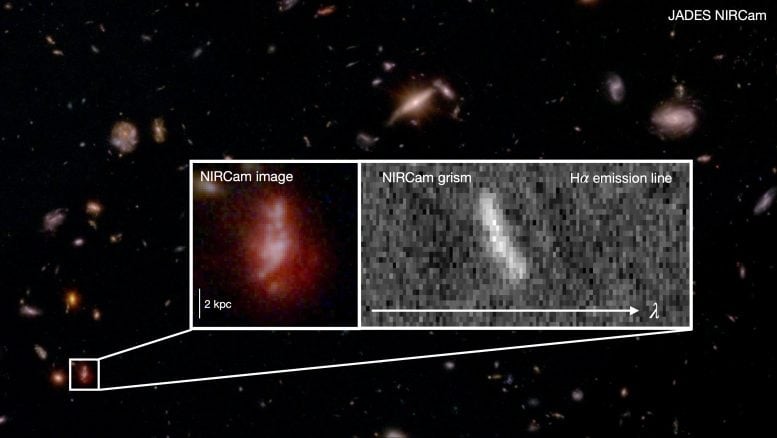
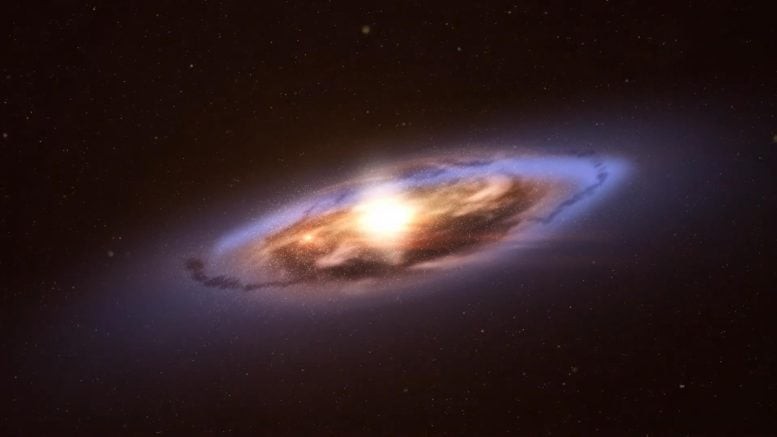
Figure 1. Webb Telescope Reveals the Universe’s Chaotic Early Years.
Decoding Galactic Motion with JWST’s Grism Mode
To uncover these details, researchers employed JWST’s NIRCam instrument in its specialized “grism mode,” capable of detecting faint emissions from ionized hydrogen in distant galaxies. Danhaive developed custom analytical software to decode this complex data, combining it with imagery from other JWST programs to chart the movement of gas within each galaxy. Figure 1 shows Webb Telescope Reveals the Universe’s Chaotic Early Years.
“Earlier studies hinted that large, well-structured disks formed surprisingly early — a mismatch with our models,” noted co-author Dr. Sandro Tacchella from the Kavli Institute and the Cavendish Laboratory. “By analyzing hundreds of smaller galaxies rather than just a handful of massive ones, we’re seeing the full picture — early galaxies were turbulent, unstable, and grew through frequent mergers and starburst activity.”
From Cosmic Turbulence to Galactic Structure
“This study bridges the gap between the epoch of reionization and the ‘cosmic noon,’ when star formation reached its peak,” said Danhaive. “It reveals how early galactic fragments evolved into more structured, stable systems, paving the way for galaxies like our Milky Way.”
Thanks to JWST’s precision, scientists can now study galaxy dynamics in unprecedented detail. Future research aims to integrate these insights with observations of cold gas and dust to form a more complete understanding of how the first galaxies emerged.
Looking Ahead to New Cosmic Frontiers
“This is only the beginning,” said Tacchella. “As more data arrives, we’ll be able to trace how these chaotic, energetic systems matured into the elegant spiral galaxies we see today.”
Cosmic Chaos in the Early Universe
The James Webb Space Telescope (JWST) reveals that in its earliest stages, the universe was far from orderly. Galaxies were turbulent, with intense bursts of star formation and chaotic gas motions driven by gravity. Most early galaxies lacked the structured disks and rotations seen in the present-day universe, highlighting a violent, dynamic youth.
How JWST Traces Galactic Motion
Using its NIRCam instrument in “grism mode,” JWST can detect faint emissions from ionized hydrogen in distant galaxies. Scientists, including Lola Danhaive, developed advanced software to interpret this complex data, mapping how gas moved within hundreds of galaxies. This approach gives a more complete view of galactic evolution than earlier studies that only looked at a few massive galaxies.
From Turbulence to Order
The research shows how galaxies gradually transitioned from chaotic clumps to ordered structures over billions of years. This process eventually gave rise to well-organized galaxies like the Milky Way. The findings bridge gaps between the early universe’s reionization epoch and the peak of star formation, offering a detailed glimpse into how cosmic order emerged from primordial chaos.
Source: SciTECHDaily
Cite this article:
Priyadharshini S (2025), Webb Telescope Uncovers the Turbulent Youth of the Universe, AnaTechMaz, pp.603
Recent Post
-
Colliding Black Hole Twins Provide Einstein’s Theory Its Sharpest Test Yet
Gravitational waves are subtle ripples in space-time, generated...
-
The Universe Just Flashed a Creepy Cosmic Bat Signal
Just in time for Halloween, astronomers have spotted a haunting, bat-shaped cloud gliding through...
-
Webb Telescope Uncovers the Turbulent Youth of the Universe
“This isn’t just about a few remarkable exceptions — for the first time, we can observe an entire...
-
Geomagnetic Superstorm Overwhelms Earth’s Protective Plasma Shield
Launched by the Japan Aerospace Exploration Agency (JAXA) in 2016...
-
Mystery at the Milky Way’s Core: Unusual Star-Forming Regions Baffle Scientists
Previous research suggested that star formation near the Galactic Center is...
-
Ancient 13-Billion-Year Signal May Uncover the Universe’s First Stars
Fialkov leads the theoretical team behind REACH (the Radio Experiment for the Analysis of Cosmic Hydrogen...
-
Astronomers Puzzled by Exoplanet with an Extremely Tilted Orbit
The James Webb Space Telescope (JWST) can detect incredibly small variations in transit depth...
-
New Evidence Proves Hawking’s Prediction: Black Holes Don’t Shrink
In 1971, Stephen Hawking proposed that a black hole’s event horizon..
-
Revolutionary AI Maps our Galaxy’s 100 billion Stars Faster than Ever
A research team led by Keiya Hirashima at the RIKEN Center for Interdisciplinary Theoretical...
Supermassive Black Hole Unleashes Its Brightest Flare After Destroying a Massive Star
The universe’s biggest stars usually end their lives in dramatic......
-
Moss Endures 283 Days in Space, Astonishing Biologists
Though it may seem unassuming, Earth’s moss is remarkably resilient. It thrives in extreme conditions—from...
-
Voyager 1 Approaches Distance of Nearly One Light-Day from Earth
Voyager 1 stands as one of humanity’s most extraordinary technological achievements. Over its nearly fifty...
-
Astronomers Spot a Rule-Breaking Star Circling a Silent Black Hole
The most surprising aspect of this star lies in its composition. Classified as “alpha-rich,” it contains an abundance...
-
Why Dark Matter Remains One of Science’s Greatest Unsolved Mysteries
Right now, is a surreal moment for anyone studying dark matter...
-

Blue Origin Unveils Super-Heavy New Glenn Rocket Taller Than Saturn V
Fresh off a fully successful second flight of its latest mega rocket.....