

Colliding Black Hole Twins Provide Einstein’s Theory Its Sharpest Test Yet
Gravitational Waves Confirm Einstein and Reveal the Universe’s Power
Gravitational waves are subtle ripples in space-time, generated when massive celestial bodies like black holes collide. These waves carry clues about some of the Universe’s most violent events.
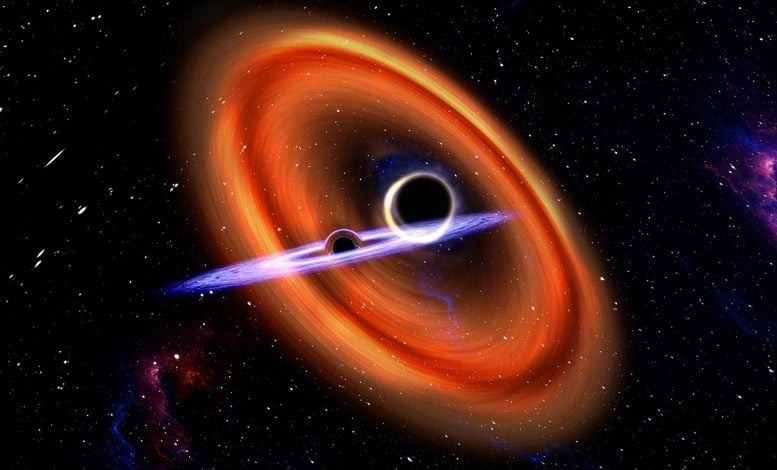
Figure 1. Twin Black Hole Collisions Put Einstein’s Theory to Its Ultimate Test.
The first event highlighted in the study, GW241011 (October 11, 2024), occurred roughly 700 million light-years from Earth. It resulted from the merger of two black holes, with masses about 20 and 6 times that of the Sun. Remarkably, the larger black hole was spinning at an extraordinary rate, ranking among the fastest-rotating black holes ever observed. Figure 1 shows Twin Black Hole Collisions Put Einstein’s Theory to Its Ultimate Test.
Nearly a month later, GW241110 (November 10, 2024) was detected around 2.4 billion light-years away. This merger involved black holes weighing approximately 17 and 8 solar masses. What made this event truly unprecedented was that the larger black hole’s spin was opposite to its orbital direction, a phenomenon never seen before.
“Each new detection provides crucial insights into the universe,” says Carl-Johan Haster, assistant professor of astrophysics at UNLV and co-author of the study. “Every observed merger is not just an astrophysical discovery—it’s also an invaluable laboratory for probing the fundamental laws of physics. While binaries like these had been predicted, this is the first direct evidence for their existence.”
Uncovering Hidden Properties of Black Hole Mergers
Albert Einstein first predicted gravitational waves in 1916 as part of his general theory of relativity. Although indirect evidence emerged in the 1970s, it wasn’t until 2015 that the LIGO observatory made the first direct detection, capturing waves from a black hole collision.
Today, the LIGO-Virgo-KAGRA Collaboration operates a global network of highly sensitive detectors that track these faint ripples from across the cosmos. Their current fourth observation phase, O4, began in late May 2023 and will continue through mid-November 2025. So far, astronomers have identified around 300 black hole mergers, including several promising candidates from this ongoing run.
Signs of “Second-Generation” Black Holes
The recent detections of GW241011 and GW241110 showcase the power of gravitational-wave astronomy to reveal the inner lives of black holes. Both events hint at the presence of “second-generation” black holes.
“GW241011 and GW241110 stand out among the hundreds of mergers observed by LIGO-Virgo-KAGRA,” says Stephen Fairhurst, professor at Cardiff University and spokesperson for the LIGO Scientific Collaboration. “In both cases, one black hole was significantly more massive and rapidly spinning, providing tantalizing evidence that these black holes formed from previous mergers.”
Source: SciTECHDaily
Cite this article:
Priyadharshini S (2025), Colliding Black Hole Twins Provide Einstein’s Theory Its Sharpest Test Yet, AnaTechMaz, pp.601
Recent Post
-
Colliding Black Hole Twins Provide Einstein’s Theory Its Sharpest Test Yet
Gravitational waves are subtle ripples in space-time, generated...
-
The Universe Just Flashed a Creepy Cosmic Bat Signal
Just in time for Halloween, astronomers have spotted a haunting, bat-shaped cloud gliding through...
-
Webb Telescope Uncovers the Turbulent Youth of the Universe
“This isn’t just about a few remarkable exceptions — for the first time, we can observe an entire...
-
Geomagnetic Superstorm Overwhelms Earth’s Protective Plasma Shield
Launched by the Japan Aerospace Exploration Agency (JAXA) in 2016...
-
Mystery at the Milky Way’s Core: Unusual Star-Forming Regions Baffle Scientists
Previous research suggested that star formation near the Galactic Center is...
-
Ancient 13-Billion-Year Signal May Uncover the Universe’s First Stars
Fialkov leads the theoretical team behind REACH (the Radio Experiment for the Analysis of Cosmic Hydrogen...
-
Astronomers Puzzled by Exoplanet with an Extremely Tilted Orbit
The James Webb Space Telescope (JWST) can detect incredibly small variations in transit depth...
-
New Evidence Proves Hawking’s Prediction: Black Holes Don’t Shrink
In 1971, Stephen Hawking proposed that a black hole’s event horizon..
-
Revolutionary AI Maps our Galaxy’s 100 billion Stars Faster than Ever
A research team led by Keiya Hirashima at the RIKEN Center for Interdisciplinary Theoretical...
Supermassive Black Hole Unleashes Its Brightest Flare After Destroying a Massive Star
The universe’s biggest stars usually end their lives in dramatic......
-
Moss Endures 283 Days in Space, Astonishing Biologists
Though it may seem unassuming, Earth’s moss is remarkably resilient. It thrives in extreme conditions—from...
-
Voyager 1 Approaches Distance of Nearly One Light-Day from Earth
Voyager 1 stands as one of humanity’s most extraordinary technological achievements. Over its nearly fifty...
-
Astronomers Spot a Rule-Breaking Star Circling a Silent Black Hole
The most surprising aspect of this star lies in its composition. Classified as “alpha-rich,” it contains an abundance...
-
Why Dark Matter Remains One of Science’s Greatest Unsolved Mysteries
Right now, is a surreal moment for anyone studying dark matter...
-
Blue Origin Unveils Super-Heavy New Glenn Rocket Taller Than Saturn V
Fresh off a fully successful second flight of its latest mega rocket.....