

Two Spacecraft Synchronize to Simulate a Solar Eclipse in Space
Meet Proba-3
Proba-3 is a groundbreaking mission designed to recreate the effect of a solar eclipse in space. The system uses two spacecraft: one, appearing almost perfectly circular from the front, positions itself closer to the Sun to block its blinding central light—acting much like the Moon during a natural eclipse. This creates a shadow that falls onto the second spacecraft, which carries a camera to capture detailed images of the artificial eclipse.
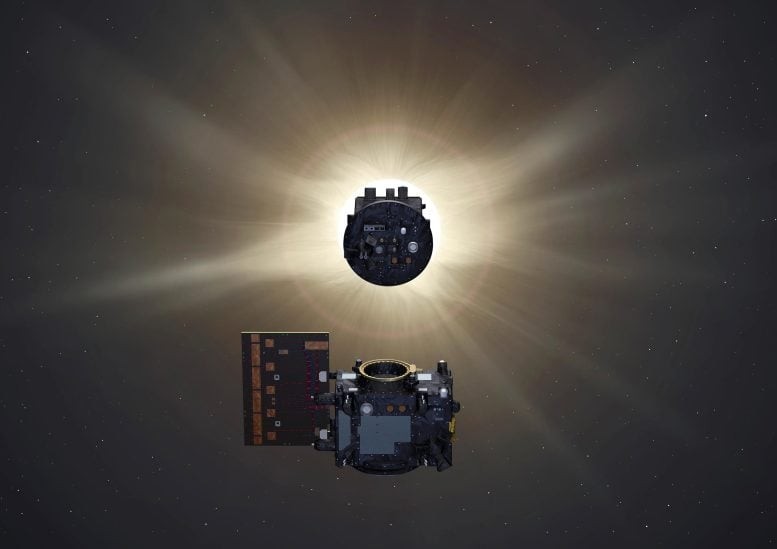
Figure 1. Two Spacecraft Align to Create an Artificial Solar Eclipse in Space.
Maintaining such alignment is no simple task. Ensuring one spacecraft consistently casts its shadow onto the other requires extraordinary precision in formation flying. Proba-3 is therefore not only about simulating eclipses, but also about proving the advanced coordination technology that will be vital for future space missions. Figure 1 shows Two Spacecraft Align to Create an Artificial Solar Eclipse in Space.
An Immense Challenge
The techniques being tested with Proba-3 could pave the way for future missions—such as spacecraft capable of docking with and removing inactive satellites, or next-generation telescopes that keep their delicate instruments far from the glare of their main mirrors.
Beyond its technological goals, the mission also provides scientists with a unique bonus: the chance to capture detailed images of the Sun’s corona, offering fresh insights into its structure and behavior.
Launched in 2024, the two satellites travel in orbits that swing as close as 372 miles (600 kilometers) to Earth—about 50% higher than the International Space Station—and as far as 37,282 miles (60,000 kilometers), roughly one-sixth of the distance to the Moon.
Precision at Extreme Speeds
As the two-spacecraft orbit Earth, their speeds range from 5,400 miles per hour (8,690 kph) to a staggering 79,200 mph (127,460 kph). Even at their slowest, they travel fast enough to cover the distance from New York City to Philadelphia in just one minute.
What makes Proba-3 extraordinary is not just this velocity, but the precision it achieves while flying autonomously. The satellites maintain a separation of 492 feet (150 meters)—longer than a football stadium—yet keep their alignment accurate to within a single millimeter. This delicate formation had to be held steady for hours in order to capture images of the Sun’s corona, a milestone the mission accomplished in June 2025.
Beyond imaging, Proba-3 is also a tool for studying space weather. By tracking high-energy particles ejected from the Sun—sometimes directed toward Earth—the mission provides insights into both the beauty and risks of solar activity. While these particles create dazzling auroras in Earth’s skies, they can also damage satellites. Researchers hope that Proba-3’s observations will lead to more accurate predictions of dangerous solar storms, giving humanity a better chance to safeguard vital space infrastructure.
Source: SciTECHDaily
Cite this article:
Priyadharshini S (2025), Two Spacecraft Synchronize to Simulate a Solar Eclipse in Space, AnaTechMaz, pp.510
Recent Post
-
Solar Power from Space Could Transform Energy by 2050
A new cost-benefit analysis based on NASA’s current designs for space-based solar...
-
Nearby Galaxy Illuminated by the Brightest Radio Flash Ever Recorded
A fast radio burst (FRB) is a powerful surge of radio energy that lasts...
-
What Lies Beneath Jupiter’s Surface?
NASA’s Juno spacecraft has revealed that Jupiter’s core doesn’t have a sharp boundary, as...
-
Hidden Power Source of Massive Stars Finally Discovered
The universe is so vast that even our sun—over 330,000 times the mass of Earth—seems small...
-
NASA’s Parker Solar Probe Cracks a 70-Year-Old Solar Mystery
A research team led by the Southwest Research Institute (SwRI) has achieved the first...
-
Webb Telescope Uncovers 300 Cosmic Objects That Defy Expectations
The Mizzou research team began their investigation using two of JWST’s...
-
What if the Big Bang Wasn’t the Start? Supercomputers Hunt for Answers
For years, the question of what came before the Big Bang has been...
-
Astronomers Believe this Star May Soon Explode as a Supernova
A team from Chalmers University of Technology, Sweden, has discovered the largest ...
-
The Star That Nearly Disappeared: Astronomers Uncover a Cosmic Secret
ASASSN-24fw is an F-type star — slightly more massive than our Sun and...
Unusual Space Dust Uncovers Surprising Connection Between Distant Asteroids
About 4.6 billion years ago, the solar system emerged from a swirling...
-
The Cosmic "Hand of God" Reveals an Even Stranger Mystery
In 2009, NASA’s Chandra X-ray Observatory captured a remarkable image of a...
-
These Stars Don’t Shine by Fusion – They Consume Dark Matter
Scientists may have uncovered evidence for an entirely new class of star-like object that...
-
Unveiling the Sun’s Secret Threads in Spectacular Solar Flare Images
The most detailed images of a solar flare ever captured in the H-alpha wavelength (656.28...
-
Two Spacecraft Align to Create an Artificial Solar Eclipse in Space
The building blocks of a galaxy—stars, gas, and dust—emit light in a wide range of colors....
-
Two Spacecraft Synchronize to Simulate a Solar Eclipse in Space
Proba-3 is a groundbreaking mission designed to recreate the effect of a solar eclipse...