

Nearby Galaxy Illuminated by the Brightest Radio Flash Ever Recorded
A Flash Across the Universe
A fast radio burst (FRB) is a powerful surge of radio energy that lasts only a few thousandths of a second. In that fleeting instant, it can outshine every other radio source in its host galaxy. These extraordinary flashes are so intense that their signals can be detected from billions of light-years away, spanning half the observable universe.
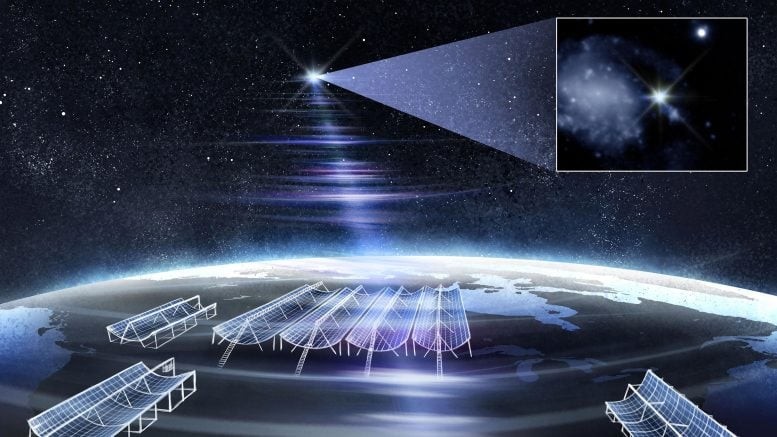
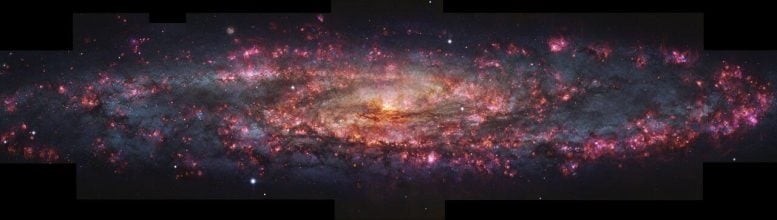
Figure 1. Brightest Ever Radio Flash Lights Up a Nearby Galaxy.
The exact cause of these bursts remains a mystery. Now, researchers have a rare chance to examine one in far greater detail than ever before. An international team of scientists, including physicists at MIT, has identified an exceptionally bright FRB located about 130 million light-years from Earth in the constellation Ursa Major. This event ranks among the nearest FRBs ever discovered and is also the brightest on record, earning it the informal nickname RBFLOAT, short for “radio brightest flash of all time.” Figure 1 shows Brightest Ever Radio Flash Lights Up a Nearby Galaxy.
Because this burst is both unusually close and extraordinarily luminous, it offers scientists an unprecedented opportunity to study FRBs and the environments where they form.
“Cosmically speaking, this fast radio burst is just in our neighborhood,” says Kiyoshi Masui, associate professor of physics and affiliate of MIT’s Kavli Institute for Astrophysics and Space Research. “This gives us the chance to study a fairly typical FRB in exquisite detail.”
CHIME Telescope Upgrades Sharpen the View
The ability to capture this event so clearly comes from recent upgrades to the Canadian Hydrogen Intensity Mapping Experiment (CHIME), a large radio telescope made of long, curved antennae in British Columbia. Originally built to map hydrogen across the universe, CHIME is also highly sensitive to fast, powerful radio signals. Since beginning operations in 2018, it has detected around 4,000 FRBs from all directions in the sky. Until recently, however, CHIME could not pinpoint the exact origin of these bursts.
That changed with the addition of CHIME Outriggers, three smaller companion arrays spread across North America. Together, CHIME and its Outriggers act like a continent-sized telescope, able to zero in on bright bursts and determine their precise locations.
“Imagine we are in New York and there’s a firefly in Florida that’s bright for a thousandth of a second, which is usually how quick FRBs are,” says MIT Kavli graduate student Shion Andrew. “Localizing an FRB to a specific part of its host galaxy is like figuring out not just what tree the firefly came from, but which branch it’s sitting on.”
Pinpointing a Burst on the Edge of a Galaxy
This new FRB is the first detection made using the combination of CHIME and the completed Outriggers. The telescope array not only identified the host galaxy but also located the precise region from which the burst originated. It appears to have come from the edge of the galaxy, just outside a star-forming region. This precise localization allows scientists to study the surrounding environment for clues about what produces such bursts.
“As we get much more precise looks at FRBs, we can better understand the diversity of environments they originate from,” says MIT physics postdoc Adam Lanman.
Lanman, Andrew, and Kiyoshi Masui are members of the CHIME Collaboration, which includes scientists from multiple institutions worldwide, and are authors of the new paper detailing the discovery.
Each Outrigger station continuously monitors the same swath of sky as the parent CHIME array. Both CHIME and the Outriggers “listen” for radio flashes on millisecond timescales. Even a few minutes of monitoring generates massive amounts of data. If CHIME detects no FRB signal, the Outriggers automatically delete the last 40 seconds of data to make room for the next measurement.
A Surprising Source: Older Magnetar?
On March 16, 2025, CHIME detected an ultrabright flash of radio emissions, triggering the Outriggers to record the data. The flash was initially so bright that astronomers debated whether it was an FRB or a terrestrial event, such as a burst from cellular communications.
Follow-up observations confirmed the source: NGC4141, a spiral galaxy in Ursa Major about 130 million light-years away—surprisingly close in cosmic terms. The burst came from the edge of an active star-forming region. While the source of FRBs remains uncertain, scientists suspect magnetars—young neutron stars with extremely powerful magnetic fields capable of emitting high-energy flares across the electromagnetic spectrum, including radio waves.
“Most hints point toward magnetars,” says Masui. “The precise localization of this burst allows us to explore how old an FRB source might be. If it were in the middle of a star-forming region, it would be very young. This one, being on the edge, may have had a little more time to evolve.”
One-Off or Repeating Mystery?
The team also searched CHIME’s six years of archival data to see if similar flares occurred in the same region. While some FRBs are known to repeat, most are one-offs. This new FRB appears to be a one-off at least in the last six years.
“Right now, we’re in the middle of figuring out whether repeating and non-repeating FRBs are fundamentally different,” Masui says. “These observations are helping us piece the puzzle together.”
“There’s evidence that not all FRB progenitors are the same,” adds Andrew. “We aim to localize hundreds of FRBs every year. By studying a larger sample, we hope to reveal the full diversity of these mysterious cosmic flashes.”
Source: SciTECHDaily
Cite this article:
Priyadharshini S (2025), Nearby Galaxy Illuminated by the Brightest Radio Flash Ever Recorded, AnaTechMaz, pp.497
Recent Post
-
Solar Power from Space Could Transform Energy by 2050
A new cost-benefit analysis based on NASA’s current designs for space-based solar...
-
Nearby Galaxy Illuminated by the Brightest Radio Flash Ever Recorded
A fast radio burst (FRB) is a powerful surge of radio energy that lasts...
-
What Lies Beneath Jupiter’s Surface?
NASA’s Juno spacecraft has revealed that Jupiter’s core doesn’t have a sharp boundary, as...
-
Hidden Power Source of Massive Stars Finally Discovered
The universe is so vast that even our sun—over 330,000 times the mass of Earth—seems small...
-
NASA’s Parker Solar Probe Cracks a 70-Year-Old Solar Mystery
A research team led by the Southwest Research Institute (SwRI) has achieved the first...
-
Webb Telescope Uncovers 300 Cosmic Objects That Defy Expectations
The Mizzou research team began their investigation using two of JWST’s...
-
What if the Big Bang Wasn’t the Start? Supercomputers Hunt for Answers
For years, the question of what came before the Big Bang has been...
-
Astronomers Believe this Star May Soon Explode as a Supernova
A team from Chalmers University of Technology, Sweden, has discovered the largest ...
-
The Star That Nearly Disappeared: Astronomers Uncover a Cosmic Secret
ASASSN-24fw is an F-type star — slightly more massive than our Sun and...

Unusual Space Dust Uncovers Surprising Connection Between Distant Asteroids
About 4.6 billion years ago, the solar system emerged from a swirling...
-
The Cosmic "Hand of God" Reveals an Even Stranger Mystery
In 2009, NASA’s Chandra X-ray Observatory captured a remarkable image of a...
-
These Stars Don’t Shine by Fusion – They Consume Dark Matter
Scientists may have uncovered evidence for an entirely new class of star-like object that...
-
Unveiling the Sun’s Secret Threads in Spectacular Solar Flare Images
The most detailed images of a solar flare ever captured in the H-alpha wavelength (656.28...
-
Two Spacecraft Align to Create an Artificial Solar Eclipse in Space
The building blocks of a galaxy—stars, gas, and dust—emit light in a wide range of colors....
-
Two Spacecraft Synchronize to Simulate a Solar Eclipse in Space
Proba-3 is a groundbreaking mission designed to recreate the effect of a solar eclipse...