

Two Spacecraft Align to Create an Artificial Solar Eclipse in Space
A Map of Sculptor Like Never Before
The building blocks of a galaxy—stars, gas, and dust—emit light in a wide range of colors. Each color carries unique clues, and the more colors astronomers capture, the deeper their understanding of a galaxy’s inner workings becomes. Traditional images reveal only a handful of colors, but the new map of the Sculptor Galaxy contains thousands. With this unprecedented detail, researchers can probe the age, chemical makeup, and motion of its stars, gas, and dust.
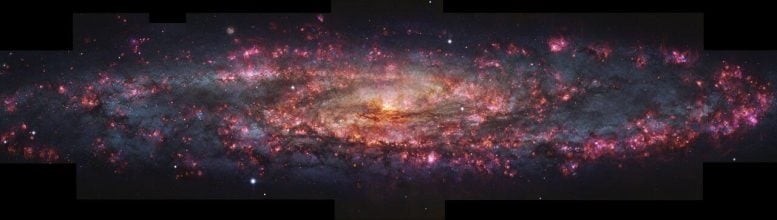
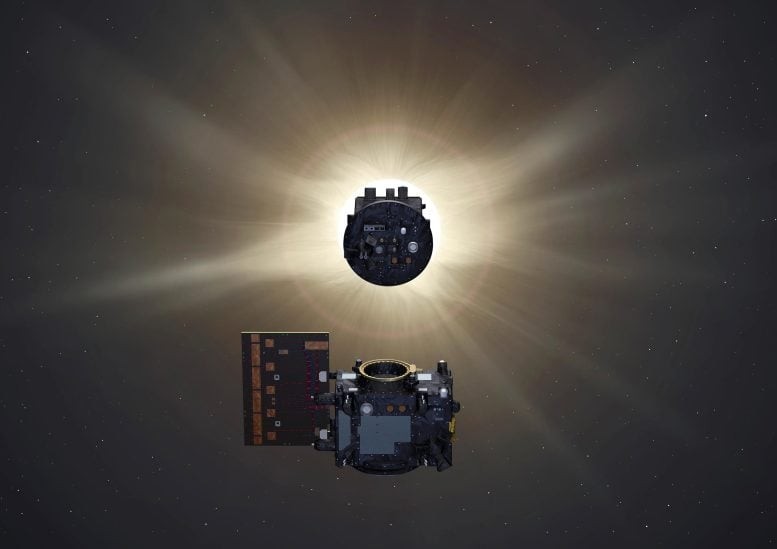
Figure 1. Twin Spacecraft Align to Reproduce a Solar Eclipse in Space
To construct the map of Sculptor, also known as NGC 253, astronomers observed the galaxy—located 11 million light-years away—for more than 50 hours using the MUSE instrument on ESO’s Very Large Telescope. The final result required stitching together over 100 exposures, covering an area about 65,000 light-years across. Figure 1 shows Twin Spacecraft Align to Reproduce a Solar Eclipse in Space.
A Tool for Zooming In and Out
As Heidelberg University’s Kathryn Kreckel explains, the dataset is uniquely versatile: “We can zoom in to study individual star-forming regions nearly at the scale of single stars, but we can also zoom out to see the galaxy as a whole.”
In their initial analysis, the team identified around 500 planetary nebulae—glowing shells of gas and dust expelled by dying stars similar to the Sun. Co-author Fabian Scheuermann, a doctoral student at Heidelberg University, highlights the significance: “Beyond our galactic neighborhood, we usually deal with fewer than 100 detections per galaxy.”
Planetary nebulae are more than cosmic landmarks—they serve as distance markers. “Finding them allows us to verify the distance to the galaxy, a critical piece of information on which the rest of the studies depend,” adds Adam Leroy of The Ohio State University.
Looking ahead, astronomers plan to use the Sculptor map to study how gas flows, evolves, and fuels star formation across the galaxy. As study co-author Congiu notes: “How such small processes can have such a big impact on a galaxy thousands of times larger is still a mystery.”
The Idea Behind Proba-3
Solar eclipses are rare and short-lived, but they reveal the Sun’s mysterious outer atmosphere, the corona. To study it more often and in greater detail, scientists designed Proba-3, a mission using two spacecraft that can mimic an eclipse in space on command.
How the Two Spacecraft Work Together
The first spacecraft, shaped like a circular disk, positions itself in front of the Sun to block its bright central light—just like the Moon during a natural eclipse. The second spacecraft, carrying a sensitive camera, sits about 150 meters (492 feet) behind it, in the perfect spot to capture clear images of the corona.
The Precision Challenge
Coordinating two satellites moving at up to 127,000 kph (79,000 mph) is no small feat. They must stay aligned within one millimeter of accuracy while keeping their separation stable for hours. Achieving this demonstrates advanced “formation flying” technology, which could be vital for future space missions.
Scientific Goals
By creating artificial eclipses, Proba-3 allows scientists to study the Sun’s corona, track high-energy particles, and better understand solar storms. These storms, while responsible for Earth’s auroras, can also damage satellites. Proba-3’s data will help improve predictions of such space weather events.
Beyond Solar Studies
The techniques tested in Proba-3 have far-reaching potential. Future missions could use similar precision flying to dock with and remove space junk, or to build giant space telescopes with mirrors and instruments spread across multiple spacecraft. Proba-3 is not just about eclipses—it’s a step toward the future of space exploration.
Source: SciTECHDaily
Cite this article:
Priyadharshini S (2025), Two Spacecraft Align to Create an Artificial Solar Eclipse in Space, AnaTechMaz, pp.509
Recent Post
-
Solar Power from Space Could Transform Energy by 2050
A new cost-benefit analysis based on NASA’s current designs for space-based solar...
-
Nearby Galaxy Illuminated by the Brightest Radio Flash Ever Recorded
A fast radio burst (FRB) is a powerful surge of radio energy that lasts...
-
What Lies Beneath Jupiter’s Surface?
NASA’s Juno spacecraft has revealed that Jupiter’s core doesn’t have a sharp boundary, as...
-
Hidden Power Source of Massive Stars Finally Discovered
The universe is so vast that even our sun—over 330,000 times the mass of Earth—seems small...
-
NASA’s Parker Solar Probe Cracks a 70-Year-Old Solar Mystery
A research team led by the Southwest Research Institute (SwRI) has achieved the first...
-
Webb Telescope Uncovers 300 Cosmic Objects That Defy Expectations
The Mizzou research team began their investigation using two of JWST’s...
-
What if the Big Bang Wasn’t the Start? Supercomputers Hunt for Answers
For years, the question of what came before the Big Bang has been...
-
Astronomers Believe this Star May Soon Explode as a Supernova
A team from Chalmers University of Technology, Sweden, has discovered the largest ...
-
The Star That Nearly Disappeared: Astronomers Uncover a Cosmic Secret
ASASSN-24fw is an F-type star — slightly more massive than our Sun and...
Unusual Space Dust Uncovers Surprising Connection Between Distant Asteroids
About 4.6 billion years ago, the solar system emerged from a swirling...
-
The Cosmic "Hand of God" Reveals an Even Stranger Mystery
In 2009, NASA’s Chandra X-ray Observatory captured a remarkable image of a...
-
These Stars Don’t Shine by Fusion – They Consume Dark Matter
Scientists may have uncovered evidence for an entirely new class of star-like object that...
-
Unveiling the Sun’s Secret Threads in Spectacular Solar Flare Images
The most detailed images of a solar flare ever captured in the H-alpha wavelength (656.28...
-
Two Spacecraft Align to Create an Artificial Solar Eclipse in Space
The building blocks of a galaxy—stars, gas, and dust—emit light in a wide range of colors....
-
Two Spacecraft Synchronize to Simulate a Solar Eclipse in Space
Proba-3 is a groundbreaking mission designed to recreate the effect of a solar eclipse...