

Unveiling the Sun’s Secret Threads in Spectacular Solar Flare Images
A Strange New Type of Star
The most detailed images of a solar flare ever captured in the H-alpha wavelength (656.28 nm) are offering scientists unprecedented insights into the Sun’s magnetic structures and could sharpen forecasts of space weather. Using the NSF’s Daniel K. Inouye Solar Telescope, researchers observed remarkably thin coronal loops during the fading stage of an X1.3-class flare on August 8, 2024. Measuring an average width of just 48.2 km—some as narrow as 21 km—these are the slimmest loops ever recorded, setting a new benchmark in solar physics.
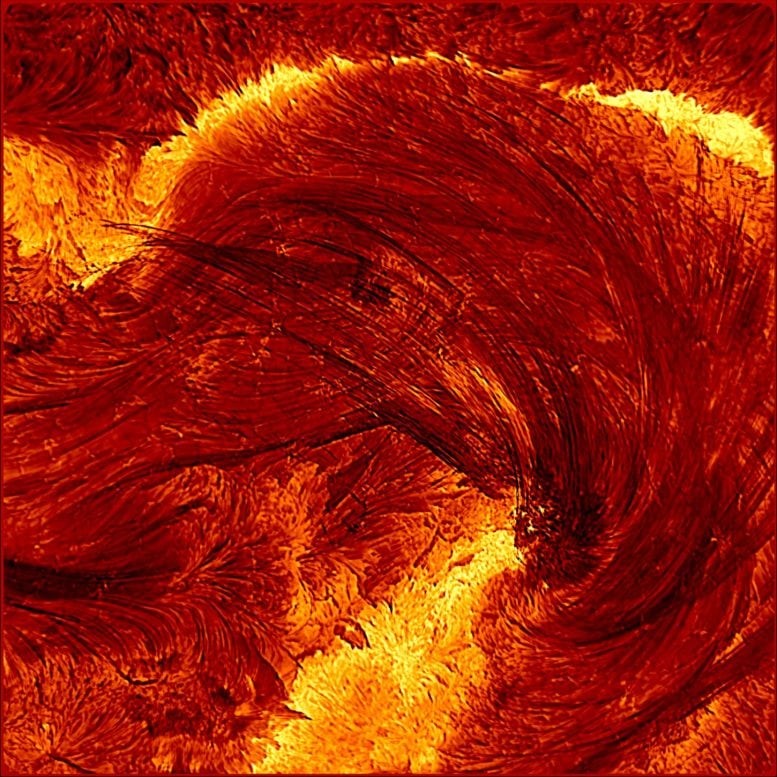
Figure 1. Revealing the Sun’s Hidden Threads Through Dazzling Solar Flare Images
Coronal loops, shaped by the Sun’s magnetic field, are critical precursors to solar flares—eruptions that can disrupt satellites, power grids, and communications on Earth. By imaging at the H-alpha wavelength, the Inouye telescope reveals solar features invisible to other instruments, pushing the boundaries of flare modeling and space weather prediction. Figure 1 shows Revealing the Sun’s Hidden Threads Through Dazzling Solar Flare Images.
First X-Class Flare Captured by Inouye Telescope
A high-cadence, high-resolution movie of the flare, sped up 100 times, reveals both bright ribbons and dark, overlying coronal loops. The view spans a region about four Earth diameters across.
“This is the first time the Inouye Solar Telescope has ever observed an X-class flare,” explains Cole Tamburri, lead author of the study and Ph.D. student at the University of Colorado Boulder. Tamburri is supported by the NSF’s Inouye Solar Telescope Ambassador Program, which trains graduate students to become part of a collaborative network of early-career researchers specializing in Inouye data analysis across the solar physics community. “These flares are among the most energetic events our star produces, and we were fortunate to capture this one under nearly perfect observing conditions.”
The research team—including scientists from the National Solar Observatory (NSO), CU Boulder’s Laboratory for Atmospheric and Space Physics (LASP), the Cooperative Institute for Research in Environmental Sciences (CIRES), and CU—focused on the delicate magnetic loops arching above the flare’s bright ribbons. In total, hundreds of these ultra-fine structures were observed, averaging about 48 km across, with some loops nearing the telescope’s resolution limit.
“Before Inouye, we could only imagine what this scale looked like,” Tamburri notes. “Now we can see it directly. These are the smallest coronal loops ever imaged on the Sun.”
Pushing the Limits of Solar Resolution
The Inouye Solar Telescope’s Visible Broadband Imager (VBI), tuned to the H-alpha filter, can resolve features as small as ~24 km across—more than two and a half times sharper than any other solar telescope. That leap in resolution is what made this discovery possible. “Knowing a telescope can theoretically do something is one thing,” says co-author and NSO scientist Maria Kazachenko. “Actually, watching it perform at that limit is exhilarating.”
Originally, the team had planned to study chromospheric spectral line dynamics using the telescope’s Visible Spectropolarimeter (ViSP). But the VBI data revealed unexpected treasures: ultra-fine coronal structures that can directly refine flare models built with complex radiative-hydrodynamic codes. “We went in looking for one thing and stumbled across something even more intriguing,” Kazachenko explains.
Confirming Long-Standing Theories
For decades, theory suggested coronal loops could range anywhere from 10 to 100 km in width. Yet confirming this range observationally had remained impossible—until now. “We’re finally peering into the spatial scales we’ve been speculating about for years,” says lead author Cole Tamburri. “This opens the door to studying not just their size, but their shapes, their evolution, and even the scales where magnetic reconnection—the engine behind flares—occurs.”
Perhaps most exciting is the possibility that these loops represent elementary structures—the fundamental building blocks of solar flares. “If that’s the case, we’re not just resolving bundles of loops; we’re resolving individual loops for the first time,” Tamburri adds. “It’s like going from seeing a forest to suddenly seeing every single tree.”
A Landmark Moment in Solar Science
The imagery itself is breathtaking: dark, threadlike loops suspended in a glowing arcade, with bright flare ribbons etched in astonishing detail—a compact triangular one at the center, and a sweeping arc-shaped one at the top. Even to the casual eye, the complexity is unmistakable.
“It’s a landmark moment in solar science,” Tamburri concludes. “We’re finally seeing the Sun at the scales it truly works on.” None of this, he emphasizes, would have been possible without the NSF’s Daniel K. Inouye Solar Telescope and its unprecedented observational power.
Source: SciTECHDaily
Cite this article:
Priyadharshini S (2025), Unveiling the Sun’s Secret Threads in Spectacular Solar Flare Images, AnaTechMaz, pp.508
Recent Post
-

Solar Power from Space Could Transform Energy by 2050
A new cost-benefit analysis based on NASA’s current designs for space-based solar...
-

Nearby Galaxy Illuminated by the Brightest Radio Flash Ever Recorded
A fast radio burst (FRB) is a powerful surge of radio energy that lasts...
-
What Lies Beneath Jupiter’s Surface?
NASA’s Juno spacecraft has revealed that Jupiter’s core doesn’t have a sharp boundary, as...
-
Hidden Power Source of Massive Stars Finally Discovered
The universe is so vast that even our sun—over 330,000 times the mass of Earth—seems small...
-
NASA’s Parker Solar Probe Cracks a 70-Year-Old Solar Mystery
A research team led by the Southwest Research Institute (SwRI) has achieved the first...
-
Webb Telescope Uncovers 300 Cosmic Objects That Defy Expectations
The Mizzou research team began their investigation using two of JWST’s...
-

What if the Big Bang Wasn’t the Start? Supercomputers Hunt for Answers
For years, the question of what came before the Big Bang has been...
-
Astronomers Believe this Star May Soon Explode as a Supernova
A team from Chalmers University of Technology, Sweden, has discovered the largest ...
-

The Star That Nearly Disappeared: Astronomers Uncover a Cosmic Secret
ASASSN-24fw is an F-type star — slightly more massive than our Sun and...

Unusual Space Dust Uncovers Surprising Connection Between Distant Asteroids
About 4.6 billion years ago, the solar system emerged from a swirling...
-
The Cosmic "Hand of God" Reveals an Even Stranger Mystery
In 2009, NASA’s Chandra X-ray Observatory captured a remarkable image of a...
-

These Stars Don’t Shine by Fusion – They Consume Dark Matter
Scientists may have uncovered evidence for an entirely new class of star-like object that...
-
Unveiling the Sun’s Secret Threads in Spectacular Solar Flare Images
The most detailed images of a solar flare ever captured in the H-alpha wavelength (656.28...
-
Two Spacecraft Align to Create an Artificial Solar Eclipse in Space
The building blocks of a galaxy—stars, gas, and dust—emit light in a wide range of colors....
-
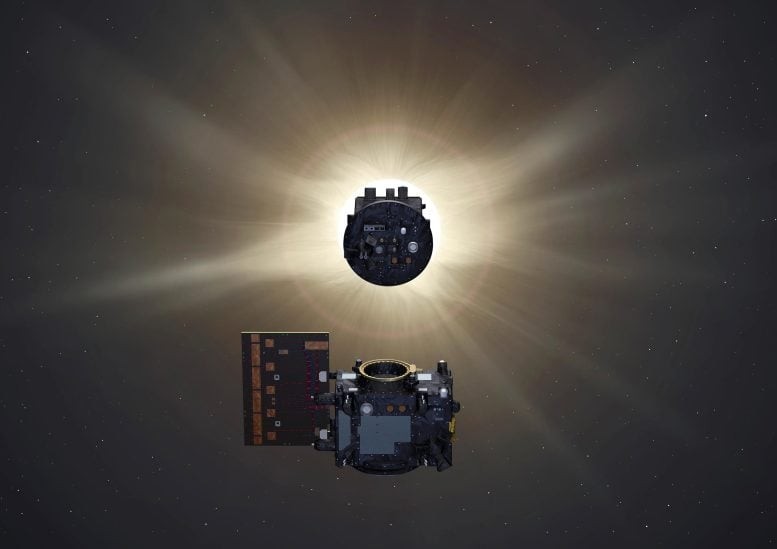
Two Spacecraft Synchronize to Simulate a Solar Eclipse in Space
Proba-3 is a groundbreaking mission designed to recreate the effect of a solar eclipse...