

The Cosmic "Hand of God" Reveals an Even Stranger Mystery
A Cosmic Hand in Space
In 2009, NASA’s Chandra X-ray Observatory captured a remarkable image of a pulsar surrounded by a nebula resembling a giant hand.
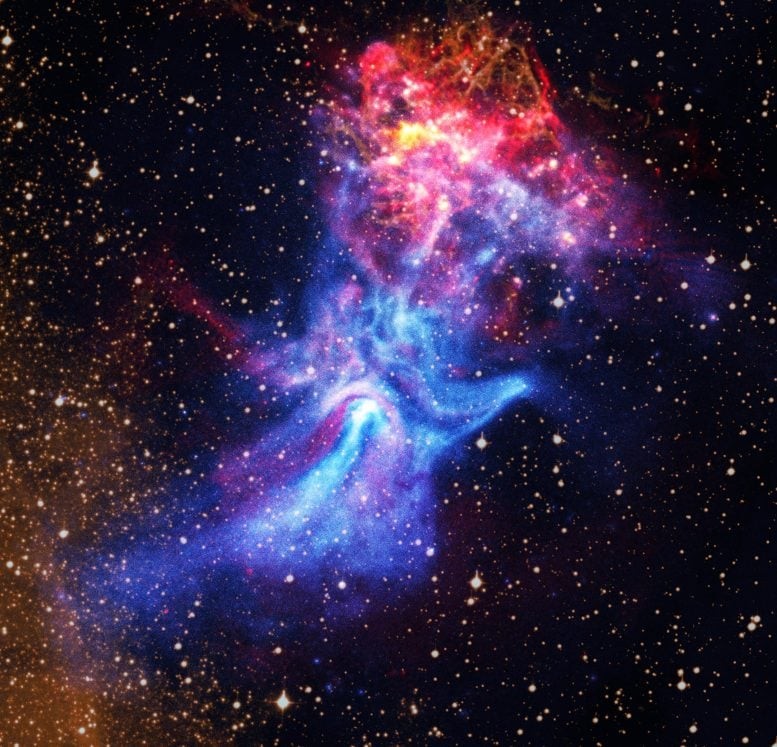
Figure 1. The Cosmic "Hand of God" Unveils a Deeper Mystery.
Since then, astronomers have continued monitoring the object with Chandra and other powerful telescopes. Most recently, they combined fresh radio data from the Australia Telescope Compact Array (ATCA) with Chandra’s X-ray observations, producing a more detailed portrait of the stellar explosion’s aftermath and shedding new light on its strange shape. Figure 1 shows The Cosmic "Hand of God" Unveils a Deeper Mystery.
Fresh Insights from Radio and X-Ray Data
At the center of this cosmic spectacle lies pulsar B1509-58, a rapidly spinning neutron star only about 12 miles wide. Despite its tiny size, it powers an enormous nebula—MSH 15-52—that stretches more than 150 light-years, or roughly 900 trillion miles. In X-ray light, this cloud of high-energy particles eerily resembles a giant hand, complete with a glowing palm and outstretched fingers reaching to the right.
The pulsar was forged in the violent collapse of a massive star that had burned through its nuclear fuel. The implosion triggered a supernova, blasting the star’s outer layers into space and leaving behind the dense stellar remnant.
Today, B1509-58 spins nearly seven times per second and generates a magnetic field about 15 trillion times stronger than Earth’s. This extraordinary engine drives torrents of electrons and other particles, fueling the vast, hand-shaped nebula we see today.
One of the Galaxy’s Most Powerful Generators
This new composite image blends data from multiple observatories: radio observations from ATCA (in red), X-rays from Chandra (in blue, orange, and yellow), and optical data of hydrogen gas (in gold). Where the X-ray and radio emissions overlap in MSH 15-52, they appear purple. The optical view also reveals background stars and parts of the supernova’s expanding debris, known as RCW 89. A labeled version highlights the key structures within the scene.
ATCA’s radio data uncovers intricate filaments that trace the nebula’s magnetic field, represented by short white lines in a companion image. These delicate structures may form where the pulsar’s high-speed particle wind collides with the supernova’s debris, shaping the nebula’s eerie, hand-like glow.
Mysterious Filaments and Magnetic Fields
By comparing radio and X-ray data, astronomers uncovered striking differences in the sources of each type of light. Some of the most prominent X-ray features — including the jet extending downward and the inner regions of the three “fingers” at the top — do not appear in radio waves. This suggests that extremely energetic particles are escaping from a shock wave, much like the sonic boom of a supersonic jet, and traveling along magnetic field lines to sculpt the finger-like shapes.
The radio observations also reveal that RCW 89 behaves differently from most young supernova remnants. Its radio emission appears patchy, closely mirroring clumps seen in X-ray and optical light, and stretches well beyond the region of X-ray emission. These patterns support the idea that RCW 89 is crashing into a dense cloud of nearby hydrogen gas.
Yet, some findings remain puzzling. One of the most perplexing features is the sharp boundary of X-ray emission in the upper right — likely the supernova’s blast wave. Normally, young remnants like RCW 89 shine brightly in radio waves along such boundaries, but here no radio signal is present.
Perplexing Boundaries and Missing Signals
MSH 15-52 and RCW 89 host a variety of unusual structures rarely seen in other young remnants. Despite years of study, many mysteries remain about how these shapes formed and evolved. Future observations will be key to unraveling the complex interplay between the pulsar’s powerful wind and the chaotic debris left behind by the supernova.
Source: SciTECHDaily
Cite this article:
Priyadharshini S (2025), The Cosmic "Hand of God" Reveals an Even Stranger Mystery, AnaTechMaz, pp.506
Recent Post
-
Solar Power from Space Could Transform Energy by 2050
A new cost-benefit analysis based on NASA’s current designs for space-based solar...
-
Nearby Galaxy Illuminated by the Brightest Radio Flash Ever Recorded
A fast radio burst (FRB) is a powerful surge of radio energy that lasts...
-
What Lies Beneath Jupiter’s Surface?
NASA’s Juno spacecraft has revealed that Jupiter’s core doesn’t have a sharp boundary, as...
-
Hidden Power Source of Massive Stars Finally Discovered
The universe is so vast that even our sun—over 330,000 times the mass of Earth—seems small...
-
NASA’s Parker Solar Probe Cracks a 70-Year-Old Solar Mystery
A research team led by the Southwest Research Institute (SwRI) has achieved the first...
-
Webb Telescope Uncovers 300 Cosmic Objects That Defy Expectations
The Mizzou research team began their investigation using two of JWST’s...
-
What if the Big Bang Wasn’t the Start? Supercomputers Hunt for Answers
For years, the question of what came before the Big Bang has been...
-
Astronomers Believe this Star May Soon Explode as a Supernova
A team from Chalmers University of Technology, Sweden, has discovered the largest ...
-
The Star That Nearly Disappeared: Astronomers Uncover a Cosmic Secret
ASASSN-24fw is an F-type star — slightly more massive than our Sun and...
Unusual Space Dust Uncovers Surprising Connection Between Distant Asteroids
About 4.6 billion years ago, the solar system emerged from a swirling...
-
The Cosmic "Hand of God" Reveals an Even Stranger Mystery
In 2009, NASA’s Chandra X-ray Observatory captured a remarkable image of a...
-
These Stars Don’t Shine by Fusion – They Consume Dark Matter
Scientists may have uncovered evidence for an entirely new class of star-like object that...
-
Unveiling the Sun’s Secret Threads in Spectacular Solar Flare Images
The most detailed images of a solar flare ever captured in the H-alpha wavelength (656.28...
-
Two Spacecraft Align to Create an Artificial Solar Eclipse in Space
The building blocks of a galaxy—stars, gas, and dust—emit light in a wide range of colors....
-
Two Spacecraft Synchronize to Simulate a Solar Eclipse in Space
Proba-3 is a groundbreaking mission designed to recreate the effect of a solar eclipse...