Did a Cosmic Impact Block the Grand Canyon? Unraveling A 56,000-Year-Old Enigma
Around 56,000 years ago, an extraordinary coincidence unfolded: the cosmic impact that formed Meteor Crater also set off events leading to a landslide-dammed lake and the creation of a paleolake within the Grand Canyon.
Earth’s deep history often resembles a detective story, and a recent study in Geology sheds light on one of its most fascinating episodes. Led by University of New Mexico Distinguished Professors Emeritus Karl Karlstrom and Laurie Crossey, together with an international research team, the study reveals an unexpected link between two of the American Southwest’s most iconic geological landmarks: Meteor Crater and the Grand Canyon.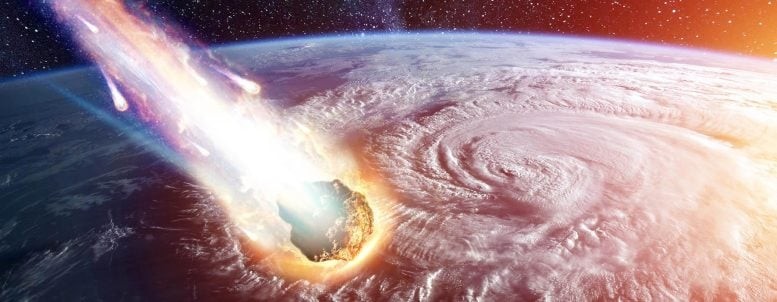
Figure 1. 56,000-Year-Old Mystery.
4The study focuses on an intriguing overlap in timing between two significant events. About 56,000 years ago, a meteor collided with Earth, and around the same period, a massive landslide created a natural dam in the Grand Canyon. This blockage temporarily stopped the Colorado River’s flow, resulting in the formation of an ancient lake. Beyond exploring these geological events, the research also highlights the work of successive generations of scientists and the recent advances in dating methods that helped clarify the timeline. Figure 1 shows 56,000-Year-Old Mystery.
“To explain these deposits, we’d have to imagine a flood ten times larger than any known flood in the past few thousand years—or consider that they might be ancient remnants left as the river cut deeper into the canyon,” explained Karlstrom. “Alternatively, they could have been carried in by a paleolake created by a downstream lava or landslide dam. Determining the age of the cave deposits was crucial for solving this puzzle.”
In the mid-1960s, Karl Karlstrom’s father, Thor, joined a joint geology and archaeology expedition that led him deep into one of the Grand Canyon’s caves. During this fieldwork, the team uncovered the remains of now-extinct animals that once roamed the area, such as the California condor and among the discoveries was a piece of driftwood that initially yielded an age of over 35,000 years—close to the limits of radiocarbon dating methods available back then. In 1984, that estimate was updated to 43,500 years. Thanks to improved dating techniques and data from labs in New Zealand and Australia, the new study now offers a more refined age of 56,000 years.
Piecing Together Clues from Labs to Caves
The research team included Chris Bastien, who happened to be studying Stanton’s driftwood collection stored at the University of Arizona Tree Ring Laboratory, and David Kring, the science coordinator for Meteor Crater, who had been revising the estimated age of the crater itself (ranging from 53,000 to 63,000 years based on various methods). During a road trip to the USA, co-author Jonathan Palmer from the Australian lab visited Meteor Crater and met Bastien at the UA lab, where he noticed the remarkable similarity in the ages—an observation that helped spark this research.
Harrington’s Mountain goat. They also found split twig figurines—delicately crafted artifacts dating back 3,000 to 4,000 years, created by the ancestors of Indigenous peoples who still live near the canyon today.
The researchers sent an additional driftwood sample to laboratories in Australia and New Zealand, while sediment samples went to Tammy Rittenour at Utah State University (USU). Using two different dating methods was crucial, and both returned remarkably similar results, dating the material to about 55,600 years ago.
Back in the 1980s, Richard Hereford from the USGS in Flagstaff had suggested that a rockslide near Nankoweap Canyon at river mile (RM) 52—about 22 miles downstream of Stanton’s Cave—could have formed a dam, creating a paleolake that allowed driftwood to float into Stanton’s Cave. This idea regained attention thanks to the new 56,000-year-old dates from caves located high above the current river level. Grand Canyon caver Jason Ballensky even reported spotting beaver tracks deep inside Vasey’s Paradise caves, in locations beavers wouldn’t normally reach.
Data Supporting a Temporary Lake and a Massive Dam
The study’s findings, including estimates of the paleolake’s depth and extent, are summarized in a Colorado River profile graph presented in the Geology paper:
Driftwood and sediment have been found in numerous caves at elevations up to 940 meters, indicating that water from the paleolake extended above Lees Ferry—the common starting point for rafting trips—adding weight to the paleolake hypothesis.
At Nankoweap Canyon, layers of chaotic reddish landslide debris are topped by rounded cobbles carried from upstream, suggesting a dam once stood there. Evidence points to this dam being overtopped and rapidly eroded—likely within less than 1,000 years—similar to how modern concrete dams accumulate sediment over time.
Could the Meteor Crater impact itself have triggered such a large landslide? Kring’s research into impact physics suggests the meteor strike could have generated a magnitude 5.4 earthquake—or possibly up to M6 under different assumptions. Even after traveling the roughly 100 miles to the Grand Canyon, the shock wave might have still registered around M3.5. This force could have been enough to destabilize the canyon’s already fractured cliffs, leading to the landslide—an area known for frequent rockfalls.
“The team assembled these arguments while acknowledging that absolute proof remains elusive,” explained Karlstrom. “There are other possible explanations, such as an unrelated rockslide or a local earthquake occurring within a thousand years of the meteor impact. Still, the meteorite collision, the large landslide, the paleolake deposits, and driftwood found high above the river are all rare and significant events. The average of the dates—around 55,600 ± 1,300 years ago—clusters in a narrow time window, lending weight to the idea that they might all be connected.”
Reference:
- https://scitechdaily.com/did-a-cosmic-collision-dam-the-grand-canyon-a-56000-year-old-mystery/
Cite this article:
Keerthana S (2025), Did A Cosmic Impact Block the Grand Canyon? Unraveling A 56,000-Year-Old Enigma, AnaTechMaz, pp.474
Recent Post
-
China Successfully Tests Domestically Developed Operating System In Space to Cut Reliance on Foreign Software
China Successfully Tests...
-
World’s Largest Space Camera Captures Stunning First Images of the Universe
The Vera C. Rubin Observatory has unveiled its first breathtaking...
-
Most Detailed Image of the Sun Yet Uncovers Hidden Magnetic Stripes
In a groundbreaking achievement, scientists from the U.S. National Science Foundation’s National Solar ...
-
European Space Agency Partners with Blue Origin to Secure Future Access to Low-Earth Orbit
For decades, the International Space Station (ISS) has served as...
-
NASA’s Lunar Rover to Search for Ice, Chart Minerals, and Explore the Subsurface
NASA is launching a new chapter in lunar exploration, equipping....
-
NASA Just Entered the Sun’s Atmosphere — and the Views Are Stunning
NASA’s Parker Solar Probe is transforming our understanding...
-
Shubhanshu Shukla Returns to Earth After Spending 20 Days in Space
Indian Air Force Group Captain Shubhanshu Shukla has returned...
-

US Company’s Maglev Launches Ramp Aims to Hurl Rockets into Orbit Using Minimal Fuel
Several companies are exploring ways to send spacecraft into orbit...
-
Did a Cosmic Impact Block the Grand Canyon? Unraveling A 56,000-Year-Old Enigma
Around 56,000 years ago, an extraordinary coincidence unfolded:...
NASA Finally Unveils the True Source of These Mysterious Cosmic X-Rays
Astronomers have finally unraveled a long-standing puzzle surrounding...
-
Strange Space Object Circles the Sun Once for Every Ten Neptune Orbits — What’s Behind It?
Astronomers have uncovered a mysterious object lurking far...
-
Astronomers Uncover Previously Unknown River of Gas Streaming Toward the Milky Way’s Core
Natalie Butterfield, NSF National Radio Astronomy Observatory scientist...
-
Interstellar Comet, Possibly as Ancient as the Galaxy, Pays a Visit to our Solar System
“This is exactly what we’re here for—finding objects like this, sharing...
-
NASA Discovers Potential Ingredients for Life on Saturn’s Moon Titan
An introduction to Titan’s unique environment — thick...