NASA Just Entered the Sun’s Atmosphere — and the Views Are Stunning
NASA’s Parker Solar Probe Has Flown Into the Sun’s Atmosphere — And What It Captured Is Stunning
NASA’s Parker Solar Probe is transforming our understanding of the Sun by venturing closer than any spacecraft before, capturing breathtaking images from within the solar atmosphere.
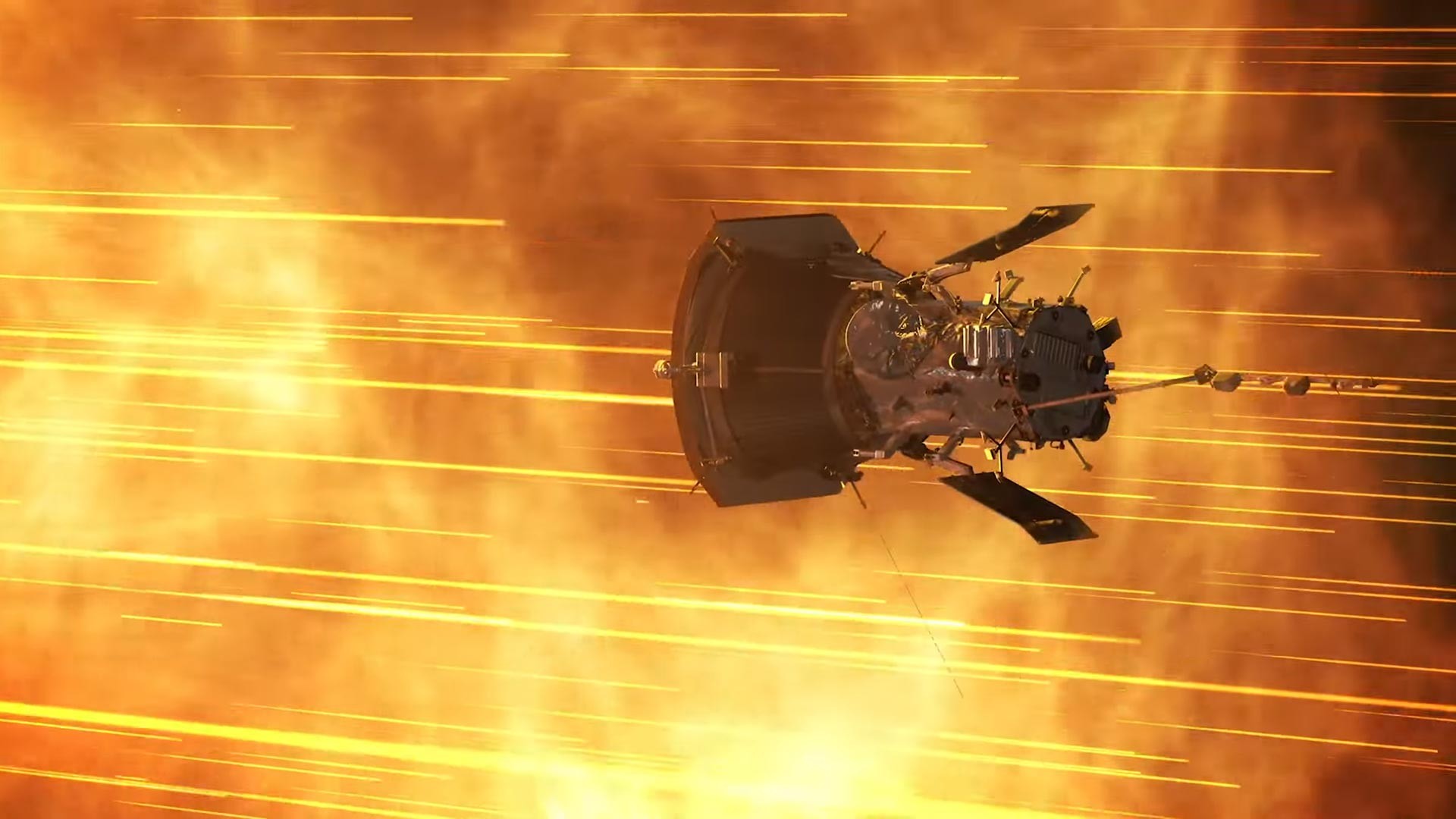
Figure 1. Sun’s Atmosphere.
A Historic Journey into the Sun’s Atmosphere
In late 2024, Parker Solar Probe achieved a historic flyby, capturing unprecedented views from deep inside the Sun’s corona, its outer atmosphere. These observations are helping scientists understand how solar activity shapes space weather that can impact Earth. Figure 1shows Sun’s Atmosphere.
“Parker Solar Probe has transported us directly into the Sun’s dynamic atmosphere,” said Nicky Fox, associate administrator of NASA’s Science Mission Directorate. “Seeing these processes firsthand helps us better predict space weather to protect our astronauts and technology both near Earth and across the solar system.”
During its closest approach on December 24, 2024, Parker Solar Probe collected data using instruments like the Wide-Field Imager for Solar Probe (WISPR). This flyby brought it closer to the Sun than any previous mission.
Revealing the Solar Wind’s Secrets
The WISPR images show the solar corona and the solar wind flowing outward into space. This steady stream of charged particles affects everything from Earth’s power grids and communication systems to auroras and planetary atmospheres.
Notably, Parker Solar Probe captured detailed views of the heliospheric current sheet — the boundary where the Sun’s magnetic field flips direction — and, for the first time, high-resolution images of multiple coronal mass ejections (CMEs) colliding.
“These images show CMEs stacking up on each other,” explained Angelos Vourlidas, WISPR instrument scientist at Johns Hopkins Applied Physics Laboratory. “Understanding how these CMEs merge is key to forecasting space weather events.”
Colliding CMEs and Space Weather Risks
When CMEs merge, their paths can shift unpredictably, complicating forecasts. Such mergers can also boost the energy of charged particles and mix magnetic fields, increasing potential risks to astronauts and satellites.
While the idea of the solar wind was first proposed by physicist Eugene Parker in 1958, past missions — like Mariner 2, Helios, and Ulysses — could only observe it from afar [1]. Parker Solar Probe, launched in 2018 and named in Parker’s honor, is now offering close-up data that fills long-standing gaps in our understanding.
Magnetic Switchbacks and Uneven Boundaries
As Parker Solar Probe approached within 14.7 million miles of the Sun, it discovered zig-zagging magnetic fields known as switchbacks. In 2021, it found that the corona’s boundary was far more irregular and complex than scientists had imagined.
Later, Parker’s data traced the origins of some switchbacks to areas on the Sun’s surface with magnetic funnels. In 2024, scientists concluded that these switchbacks partly power the fast-solar wind, solving a puzzle that had persisted for over half a century.
The Mystery of the Slow Solar Wind
Yet the slow solar wind, moving at about half the speed of the fast wind, remains harder to explain. “How the solar wind forms and escapes the Sun’s gravity is still a big question,” said Nour Rawafi, project scientist for Parker Solar Probe. “But thanks to Parker’s close-up data, we’re getting closer to answers.”
Scientists have long suspected two types of slow solar wind: Alfvénic, which shows switchbacks, and non-Alfvénic, which doesn’t. Parker Solar Probe’s close passes confirmed this theory and are helping identify where each type originates. Non-Alfvénic slow wind may emerge from helmet streamers — giant magnetic loops on the Sun — while Alfvénic slow wind could come from coronal holes, which are cooler, darker regions.
Looking Ahead
As Parker Solar Probe continues its orbit, it will keep gathering data during future passes, including its next closest approach on September 15, 2025. Each new flyby helps refine our understanding of the Sun’s atmosphere and the solar wind’s origins.
“We don’t have all the answers yet,” said Adam Szabo, mission scientist at NASA’s Goddard Space Flight Center, “but we now have an incredible wealth of new data to explore.”
Reference:
- https://scitechdaily.com/nasa-just-flew-through-the-suns-atmosphere-and-what-it-saw-is-jaw-dropping/
Cite this article:
Keerthana S (2025), NASA Just Entered the Sun’s Atmosphere — and the Views Are Stunning, AnaTechMaz, pp.471
Recent Post
-
China Successfully Tests Domestically Developed Operating System In Space to Cut Reliance on Foreign Software
China Successfully Tests...
-
World’s Largest Space Camera Captures Stunning First Images of the Universe
The Vera C. Rubin Observatory has unveiled its first breathtaking...
-
Most Detailed Image of the Sun Yet Uncovers Hidden Magnetic Stripes
In a groundbreaking achievement, scientists from the U.S. National Science Foundation’s National Solar ...
-
European Space Agency Partners with Blue Origin to Secure Future Access to Low-Earth Orbit
For decades, the International Space Station (ISS) has served as...
-

NASA’s Lunar Rover to Search for Ice, Chart Minerals, and Explore the Subsurface
NASA is launching a new chapter in lunar exploration, equipping....
-
NASA Just Entered the Sun’s Atmosphere — and the Views Are Stunning
NASA’s Parker Solar Probe is transforming our understanding...
-
Shubhanshu Shukla Returns to Earth After Spending 20 Days in Space
Indian Air Force Group Captain Shubhanshu Shukla has returned...
-
US Company’s Maglev Launches Ramp Aims to Hurl Rockets into Orbit Using Minimal Fuel
Several companies are exploring ways to send spacecraft into orbit...
-
Did a Cosmic Impact Block the Grand Canyon? Unraveling A 56,000-Year-Old Enigma
Around 56,000 years ago, an extraordinary coincidence unfolded:...
NASA Finally Unveils the True Source of These Mysterious Cosmic X-Rays
Astronomers have finally unraveled a long-standing puzzle surrounding...
-
Strange Space Object Circles the Sun Once for Every Ten Neptune Orbits — What’s Behind It?
Astronomers have uncovered a mysterious object lurking far...
-
Astronomers Uncover Previously Unknown River of Gas Streaming Toward the Milky Way’s Core
Natalie Butterfield, NSF National Radio Astronomy Observatory scientist...
-
Interstellar Comet, Possibly as Ancient as the Galaxy, Pays a Visit to our Solar System
“This is exactly what we’re here for—finding objects like this, sharing...
-
NASA Discovers Potential Ingredients for Life on Saturn’s Moon Titan
An introduction to Titan’s unique environment — thick...