World’s Largest Space Camera Captures Stunning First Images of the Universe
The Vera C. Rubin Observatory has unveiled its first breathtaking images, captured using the world’s largest digital camera, marking the start of a decade-long mission to study the evolving universe in unprecedented detail.
In just over 10 hours of test imaging, the observatory recorded millions of galaxies, thousands of asteroids, and previously unseen cosmic phenomena. Nestled high in the Chilean Andes, the Rubin Observatory will scan the entire Southern Hemisphere sky every few nights, playing a key role in unraveling the mysteries of dark matter, dark energy, and planetary defense. It’s a remarkable step forward in astronomical science, with its powerful camera at the heart of the mission.
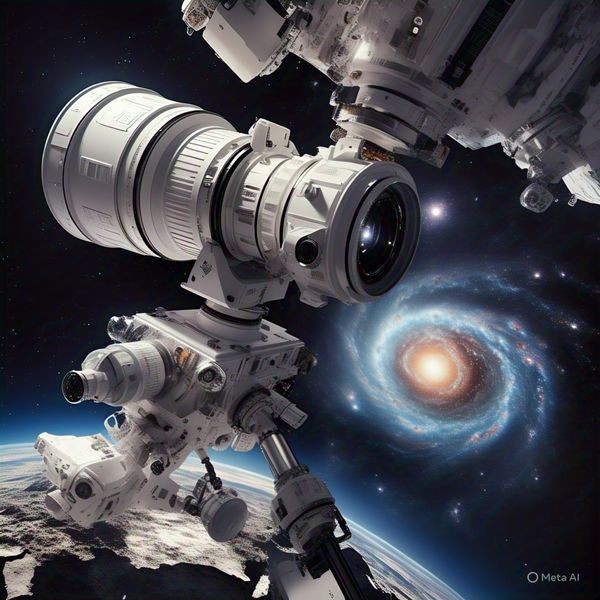
Figure 1. Largest Space Camera.
The first images were revealed during a special event in Washington, D.C., showcasing dazzling views of stars, galaxies, and asteroids on an extraordinary scale. These initial results are just a glimpse of the vast data the observatory is set to collect over the next decade. Figure 1 shows largest space camera.
“The NSF-DOE Vera C. Rubin Observatory proves that the U.S. continues to lead global scientific discovery and showcases what’s possible when our national research community collaborates,” said Michael Kratsios, Director of the White House Office of Science and Technology Policy. “This observatory is a forward-looking investment—laying the foundation of knowledge that future generations will build upon with pride.”
Peering into the Depths of the Cosmos: Rubin Observatory’s Visionary Mission Begins
A stunning new video, created from over 1,100 images captured by the NSF–DOE Vera C. Rubin Observatory, begins with a close-up of two galaxies before zooming out to reveal around 10 million more [1]. These galaxies represent just 0.05% of the estimated 20 billion the observatory is expected to document over its 10-year Legacy Survey of Space and Time—a sweeping effort that promises to revolutionize our understanding of the universe. Credit: NSF–DOE Vera C. Rubin Observatory
Unveiling the Universe’s Greatest Secrets
“The NSF–DOE Rubin Observatory will gather more data about our universe than all previous optical telescopes combined,” said Brian Stone, currently serving as the NSF director. “With this extraordinary scientific instrument, we’ll investigate profound cosmic questions, including the nature of dark matter and dark energy.”
“We’re witnessing a golden era for American science,” added Harriet Kung, acting director of the DOE’s Office of Science. “The Rubin Observatory is a shining example of what can be achieved when the federal government empowers top-tier engineers and scientists with the resources they need. This facility will spark groundbreaking discoveries, nurture the next generation of innovators, and elevate America’s scientific leadership on the world stage.”
Reference:
- https://scitechdaily.com/worlds-largest-space-camera-snaps-breathtaking-first-photos-of-the-universe/
Cite this article:
Keerthana S (2025), World’s Largest Space Camera Captures Stunning First Images of the Universe, AnaTechMaz, pp.467
Recent Post
-
China Successfully Tests Domestically Developed Operating System In Space to Cut Reliance on Foreign Software
China Successfully Tests...
-
World’s Largest Space Camera Captures Stunning First Images of the Universe
The Vera C. Rubin Observatory has unveiled its first breathtaking...
-
Most Detailed Image of the Sun Yet Uncovers Hidden Magnetic Stripes
In a groundbreaking achievement, scientists from the U.S. National Science Foundation’s National Solar ...
-
European Space Agency Partners with Blue Origin to Secure Future Access to Low-Earth Orbit
For decades, the International Space Station (ISS) has served as...
-

NASA’s Lunar Rover to Search for Ice, Chart Minerals, and Explore the Subsurface
NASA is launching a new chapter in lunar exploration, equipping....
-
NASA Just Entered the Sun’s Atmosphere — and the Views Are Stunning
NASA’s Parker Solar Probe is transforming our understanding...
-
Shubhanshu Shukla Returns to Earth After Spending 20 Days in Space
Indian Air Force Group Captain Shubhanshu Shukla has returned...
-

US Company’s Maglev Launches Ramp Aims to Hurl Rockets into Orbit Using Minimal Fuel
Several companies are exploring ways to send spacecraft into orbit...
-

Did a Cosmic Impact Block the Grand Canyon? Unraveling A 56,000-Year-Old Enigma
Around 56,000 years ago, an extraordinary coincidence unfolded:...
NASA Finally Unveils the True Source of These Mysterious Cosmic X-Rays
Astronomers have finally unraveled a long-standing puzzle surrounding...
-
Strange Space Object Circles the Sun Once for Every Ten Neptune Orbits — What’s Behind It?
Astronomers have uncovered a mysterious object lurking far...
-
Astronomers Uncover Previously Unknown River of Gas Streaming Toward the Milky Way’s Core
Natalie Butterfield, NSF National Radio Astronomy Observatory scientist...
-
Interstellar Comet, Possibly as Ancient as the Galaxy, Pays a Visit to our Solar System
“This is exactly what we’re here for—finding objects like this, sharing...
-
NASA Discovers Potential Ingredients for Life on Saturn’s Moon Titan
An introduction to Titan’s unique environment — thick...