NASA’s Lunar Rover to Search for Ice, Chart Minerals, and Explore the Subsurface
NASA is launching a new chapter in lunar exploration, equipping upcoming missions with three advanced scientific instruments designed to study the Moon’s surface and subsurface in unprecedented detail.
Two of these instruments will travel aboard the Lunar Terrain Vehicle (LTV)—a nimble, crew-ready rover—while the third will observe from lunar orbit. Together, they’ll help locate hidden water, map mineral resources, and monitor changes driven by human activity.
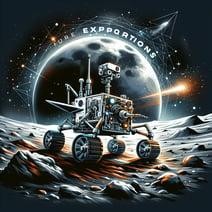
Figure 1. Lunar Rover.
Artemis LTV: Expanding Lunar Frontiers
Central to these plans is the Lunar Terrain Vehicle, part of NASA’s broader Artemis program. This marks the first return of a human-operated rover to the Moon in over 50 years. Designed to carry up to two astronauts or operate autonomously, the LTV can navigate varied lunar landscapes, supporting both exploration and science. Figure 1 shows Lunar Rover.
“The Artemis Lunar Terrain Vehicle will take humanity farther across the Moon than ever before,” said Nicky Fox, associate administrator of NASA’s Science Mission Directorate. “By combining human and robotic exploration, these instruments will make discoveries that teach us about the Moon and help keep astronauts and spacecraft safe.”
aires: Tracking Moon Minerals and Volatiles
One instrument, the Artemis Infrared Reflectance and Emission Spectrometer (AIRES), will detect and map minerals and volatile compounds like water and ammonia. AIRES, led by Phil Christensen at Arizona State University, will gather spectral data overlaid on visible images, focusing on areas like the Moon’s south pole.
l-maps: Revealing the Hidden Subsurface
The Lunar Microwave Active-Passive Spectrometer (L-MAPS), directed by Matthew Siegler at the University of Hawaii, will investigate what lies beneath the lunar surface. Combining spectrometry and ground-penetrating radar, L-MAPS can probe more than 131 feet (40 meters) deep, measuring temperature, density, and underground layers to identify potential ice deposits.
Together, AIRES and L-MAPS will give scientists a comprehensive view of the Moon’s composition and help pinpoint valuable resources while revealing clues about the history of rocky worlds.
ucis-moon: A View from Above
To complement these surface studies, NASA has also chosen the Ultra-Compact Imaging Spectrometer for the Moon (UCIS-Moon) for a future orbital mission [1]. Led by Abigail Fraeman at NASA’s Jet Propulsion Laboratory, UCIS-Moon will map geological features and volatiles from orbit. It will also track how human exploration affects the lunar environment and guide astronauts to the most scientifically interesting sites. UCIS-Moon promises the highest-resolution orbital data yet on lunar water, minerals, and thermal properties.
A Powerful Trio for Lunar Science
“These instruments will advance our understanding of minerals and volatiles both on and beneath the Moon’s surface,” said Joel Kearns, deputy associate administrator for Exploration at NASA. “With data from the LTV and orbital missions, we’ll study not only where astronauts travel but also across the Moon’s south polar region, opening new frontiers for discovery.”
Ahead of deploying these tools, NASA collaborated with commercial LTV developers—Intuitive Machines, Lunar Outpost, and Venturi Astrolab—to complete preliminary design reviews. These reviews confirm that each rover meets NASA’s requirements and outline the verification process. NASA plans to select the demonstration mission proposal from among these vendors by the end of 2025.
artemis: Laying the Groundwork for Mars
Through Artemis, NASA is tackling top science questions that require human presence on the Moon, supported by robotic systems on the surface and in orbit. These missions aim not only to explore and unlock lunar science and economic opportunities but also to pave the way for the first human missions to Mars.
Reference:
- https://scitechdaily.com/nasas-moon-rover-will-hunt-for-ice-map-minerals-and-reveal-what-lies-beneath/
Cite this article:
Keerthana S (2025), NASA’s Lunar Rover to Search for Ice, Chart Minerals, and Explore the Subsurface, AnaTechMaz, pp.470
Recent Post
-
China Successfully Tests Domestically Developed Operating System In Space to Cut Reliance on Foreign Software
China Successfully Tests...
-
World’s Largest Space Camera Captures Stunning First Images of the Universe
The Vera C. Rubin Observatory has unveiled its first breathtaking...
-
Most Detailed Image of the Sun Yet Uncovers Hidden Magnetic Stripes
In a groundbreaking achievement, scientists from the U.S. National Science Foundation’s National Solar ...
-
European Space Agency Partners with Blue Origin to Secure Future Access to Low-Earth Orbit
For decades, the International Space Station (ISS) has served as...
-
NASA’s Lunar Rover to Search for Ice, Chart Minerals, and Explore the Subsurface
NASA is launching a new chapter in lunar exploration, equipping....
-
NASA Just Entered the Sun’s Atmosphere — and the Views Are Stunning
NASA’s Parker Solar Probe is transforming our understanding...
-
Shubhanshu Shukla Returns to Earth After Spending 20 Days in Space
Indian Air Force Group Captain Shubhanshu Shukla has returned...
-

US Company’s Maglev Launches Ramp Aims to Hurl Rockets into Orbit Using Minimal Fuel
Several companies are exploring ways to send spacecraft into orbit...
-
Did a Cosmic Impact Block the Grand Canyon? Unraveling A 56,000-Year-Old Enigma
Around 56,000 years ago, an extraordinary coincidence unfolded:...
NASA Finally Unveils the True Source of These Mysterious Cosmic X-Rays
Astronomers have finally unraveled a long-standing puzzle surrounding...
-
Strange Space Object Circles the Sun Once for Every Ten Neptune Orbits — What’s Behind It?
Astronomers have uncovered a mysterious object lurking far...
-
Astronomers Uncover Previously Unknown River of Gas Streaming Toward the Milky Way’s Core
Natalie Butterfield, NSF National Radio Astronomy Observatory scientist...
-
Interstellar Comet, Possibly as Ancient as the Galaxy, Pays a Visit to our Solar System
“This is exactly what we’re here for—finding objects like this, sharing...
-
NASA Discovers Potential Ingredients for Life on Saturn’s Moon Titan
An introduction to Titan’s unique environment — thick...