NASA Finally Unveils the True Source of These Mysterious Cosmic X-Rays
Astronomers have finally unraveled a long-standing puzzle surrounding a rare, fast-spinning neutron star known as PSR J1023+0038.
By combining data from NASA’s IXPE telescope with observations from several other space observatories, scientists discovered that the system’s intense X-rays don’t actually come from its bright accretion disk, as was widely assumed. Instead, they originate from a chaotic, high-speed wind of particles blasted out by the pulsar itself. This discovery overturns earlier models and points to a single, powerful mechanism behind the pulsar’s radiation—a surprising revelation that deepens our understanding of how these “dead” stars continue to light up the cosmos.
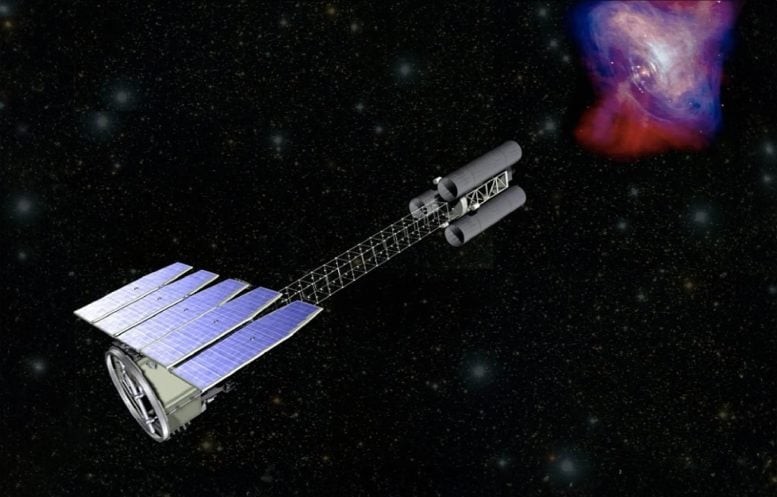
Figure 1. Mysterious Cosmic X-Rays.
Explosive Star Remnants and a Mysterious Pulsar System
An international team of astronomers has uncovered new details about how energetic remnants of exploded stars interact with their surroundings. Using NASA’s IXPE (Imaging X-ray Polarimetry Explorer) along with a suite of other observatories, the researchers gained fresh insights into these dynamic processes. Figure 1 shows Mysterious Cosmic X-Rays.
Their focus was on an enigmatic stellar system named PSR J1023+0038, often called J1023. At its center lies a rapidly rotating neutron star siphoning material from a smaller companion star, which has led to the formation of an accretion disk around it [1]. Acting as a pulsar, the neutron star also emits powerful beams of radiation from its magnetic poles, producing a sweeping lighthouse-like effect across space.
What makes J1023 particularly fascinating is its ability to switch between two very different states. In one state, the pulsar draws in large amounts of material from its companion. In the other, it quiets down, emitting detectable radio pulses instead. This unusual dual behavior has led astronomers to classify J1023 as a “transitional millisecond pulsar.”
Cosmic Laboratories for Neutron Star Evolution
“Transitional millisecond pulsars act like natural laboratories, offering valuable clues about how neutron stars evolve within binary systems,” explained Maria Cristina Baglio of Italy’s National Institute of Astrophysics (INAF) Brera Observatory in Merate, and lead author of a new paper in The Astrophysical Journal Letters presenting these findings.
One major question that had puzzled scientists was the true origin of the X-rays emitted by this pulsar system. Pinpointing their source could help refine theories about particle acceleration, accretion processes, and the complex environments around neutron stars throughout the cosmos.
The answer turned out to be unexpected: rather than coming from the glowing accretion disk, the X-rays arise from the pulsar wind itself—a turbulent mix of gas, shock waves, magnetic fields, and near-light-speed particles slamming into the disk.
Probing Polarized Light with IXPE and ESO
To uncover this, astronomers analyzed the polarization of both X-ray and optical light—essentially studying how aligned the light waves are. They used IXPE, NASA’s Imaging X-ray Polarimetry Explorer, which is uniquely equipped to measure X-ray polarization in space. These observations were paired with optical polarization data collected by the European Southern Observatory’s Very Large Telescope in Chile.
IXPE, launched in December 2021, has studied many pulsars before, but J1023 is the first transitional millisecond pulsar system it has examined. Additional high-energy data came from NASA’s NICER (Neutron star Interior Composition Explorer) and the Neil Gehrels Swift Observatory, with radio observations contributed by the Karl G. Jansky Very Large Array in New Mexico.
Matching Polarization Confirms a Theory
The team discovered that the polarization angle remained the same across multiple wavelengths.
“That result offers strong evidence that a single, unified physical process drives the radiation we’re seeing,” said Francesco Coti Zelati of the Institute of Space Sciences in Barcelona, Spain, who co-led the research.
These finding challenges previous models that attributed X-ray emissions mainly to the accretion disk, showing instead that the pulsar wind itself is the dominant source.
Pulsar Winds as Dominant Energy Engines
“IXPE has already shown that the pulsar wind powers X-ray emissions in isolated pulsars,” noted Philip Kaaret, principal investigator for IXPE at NASA’s Marshall Space Flight Center in Huntsville, Alabama. “Now, these new observations reveal that the same wind also drives most of the energy output in this binary system.”
Astronomers are continuing to study transitional millisecond pulsars to see how these physical processes compare with those seen in other pulsars and pulsar wind nebulae. Insights from this research could refine models of how pulsar winds produce radiation—and, as Baglio and Coti Zelati both emphasized, bring scientists closer to fully understanding the remarkable physics behind these extreme cosmic systems.
Reference:
- https://scitechdaily.com/nasa-just-discovered-where-these-mysterious-space-x-rays-really-come-from/
Cite this article:
Keerthana S (2025), NASA Finally Unveils the True Source of These Mysterious Cosmic X-Rays, AnaTechMaz, pp.475
Recent Post
-

China Successfully Tests Domestically Developed Operating System In Space to Cut Reliance on Foreign Software
China Successfully Tests...
-
World’s Largest Space Camera Captures Stunning First Images of the Universe
The Vera C. Rubin Observatory has unveiled its first breathtaking...
-
Most Detailed Image of the Sun Yet Uncovers Hidden Magnetic Stripes
In a groundbreaking achievement, scientists from the U.S. National Science Foundation’s National Solar ...
-
European Space Agency Partners with Blue Origin to Secure Future Access to Low-Earth Orbit
For decades, the International Space Station (ISS) has served as...
-

NASA’s Lunar Rover to Search for Ice, Chart Minerals, and Explore the Subsurface
NASA is launching a new chapter in lunar exploration, equipping....
-
NASA Just Entered the Sun’s Atmosphere — and the Views Are Stunning
NASA’s Parker Solar Probe is transforming our understanding...
-

Shubhanshu Shukla Returns to Earth After Spending 20 Days in Space
Indian Air Force Group Captain Shubhanshu Shukla has returned...
-

US Company’s Maglev Launches Ramp Aims to Hurl Rockets into Orbit Using Minimal Fuel
Several companies are exploring ways to send spacecraft into orbit...
-

Did a Cosmic Impact Block the Grand Canyon? Unraveling A 56,000-Year-Old Enigma
Around 56,000 years ago, an extraordinary coincidence unfolded:...
NASA Finally Unveils the True Source of These Mysterious Cosmic X-Rays
Astronomers have finally unraveled a long-standing puzzle surrounding...
-

Strange Space Object Circles the Sun Once for Every Ten Neptune Orbits — What’s Behind It?
Astronomers have uncovered a mysterious object lurking far...
-

Astronomers Uncover Previously Unknown River of Gas Streaming Toward the Milky Way’s Core
Natalie Butterfield, NSF National Radio Astronomy Observatory scientist...
-
Interstellar Comet, Possibly as Ancient as the Galaxy, Pays a Visit to our Solar System
“This is exactly what we’re here for—finding objects like this, sharing...
-

NASA Discovers Potential Ingredients for Life on Saturn’s Moon Titan
An introduction to Titan’s unique environment — thick...