Most Detailed Image of the Sun Yet Uncovers Hidden Magnetic Stripes
In a groundbreaking achievement, scientists from the U.S. National Science Foundation’s National Solar Observatory have captured the sharpest view of the Sun’s surface ever recorded. Using the cutting-edge Daniel K. Inouye Solar Telescope in Hawai ‘i, the team discovered ultra-fine magnetic “stripes” just 20 kilometers wide—roughly the length of Manhattan.
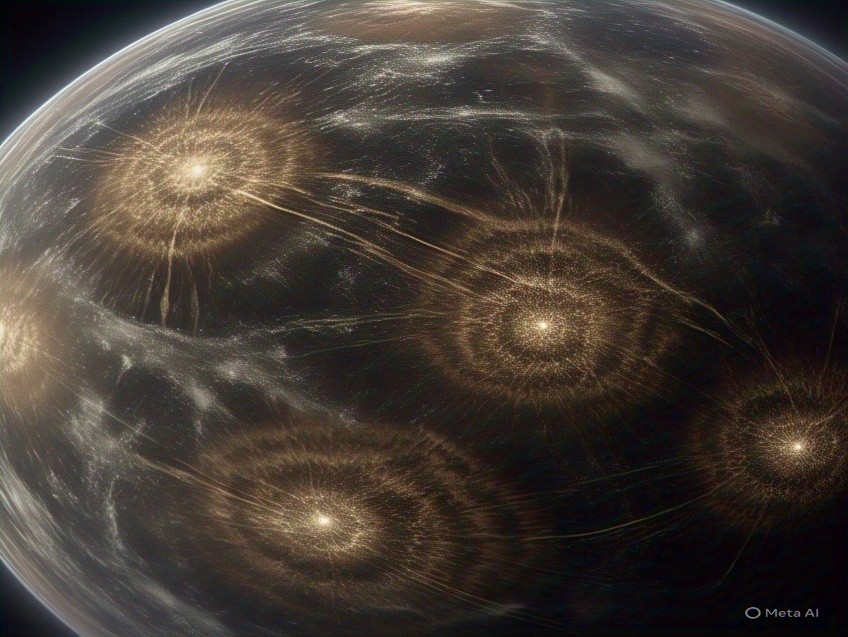
Figure 1. Hidden Magnetic Stripes.
These alternating light and dark bands, called striations, appear along the edges of solar granules and are shaped by delicate, sheet-like magnetic fields that ripple like flowing fabric. As sunlight passes through these magnetic structures, it varies in brightness—much like light filtering through a waving curtain. Figure 1 shows Hidden Magnetic Stripes.
This discovery uncovers a previously hidden layer of complexity within the Sun’s magnetic field and highlights the Inouye Telescope’s exceptional ability to reveal details once considered beyond reach. It also provides vital insight into how solar magnetism fuels energetic phenomena such as solar flares and space storms.
A team of solar physicists has made a groundbreaking discovery, uncovering intricate magnetic structures on the Sun’s surface with a level of detail never seen before [1]. Using the unparalleled resolution of the Daniel K. Inouye Solar Telescope in Hawai ‘i, the scientists captured the sharpest images ever of the solar photosphere. For the first time, they observed ultra-thin bright and dark magnetic “stripes” just 20 kilometers wide—roughly the size of Manhattan.
These fine bands, known as striations, appear along the edges of solar granules—convection cells on the Sun’s surface—and are formed by delicate, sheet-like magnetic fields that ripple like fabric in the wind. As light from the granule walls passes through these magnetic “curtains,” it creates subtle variations in brightness. Brighter areas mark stronger magnetic fields, while darker areas reveal weaker ones.
A Breakthrough in Solar Imaging
“We’re exploring the Sun’s fine-scale magnetic structure with a spatial resolution of about 20 kilometers—the length of Manhattan Island,” said Dr. David Kuridze, lead author of the study and a scientist at the National Solar Observatory. “These striations are clear indicators of small-scale magnetic field fluctuations.”
This unexpected discovery was made possible by the Inouye Telescope’s advanced imaging capabilities. Researchers used the Visible Broadband Imager (VBI), operating in the G-band of visible light, which is especially sensitive to magnetic activity. The setup allowed the team to image the Sun at a resolution of better than 0.03 arcseconds—equivalent to roughly 20 kilometers on the solar surface—making it the most detailed solar imagery ever achieved.
To interpret the data, the team compared Inouye’s observations with cutting-edge simulations of solar physics. The strong agreement between observed and simulated images helped confirm the origin of the fine-scale magnetic striations.
Subtle Twists, Profound Implications
The study reveals that these striations result from small but powerful magnetic fluctuations—only about 100 gausses in strength, comparable to a household magnet [1]. These variations change the plasma’s density and opacity, causing the visible surface of the Sun to shift by just a few kilometers, a phenomenon known as the Wilson depression. Only the exceptional resolution of the Inouye Telescope’s 4-meter mirror made this discovery possible.
“Magnetism is a universal force, and we've seen similar stripe patterns in distant cosmic environments, like molecular clouds,” said Dr. Han Uitenbroek, NSO scientist and study co-author. “Inouye’s precision, coupled with simulations, is helping us understand how magnetic fields behave across the universe.”
Revolutionizing Space Weather Forecasting
Understanding the Sun’s magnetic architecture is key to predicting its most violent outbursts—like flares and coronal mass ejections—which can disrupt satellites, communications, and power grids on Earth. This breakthrough provides new insight into small-scale magnetic activity, offering a path toward better space weather forecasting.
“This discovery is just the beginning of what Inouye can do,” said Dr. David Boboltz, NSO Associate Director for the telescope. “It highlights the telescope’s critical role in advancing solar physics and protecting our increasingly technology-reliant society from solar-driven space weather.”
Reference:
- https://scitechdaily.com/sharpest-ever-image-of-the-sun-reveals-hidden-magnetic-stripes/
Cite this article:
Keerthana S (2025), Most Detailed Image of the Sun Yet Uncovers Hidden Magnetic Stripes, AnaTechMaz, pp.468
Recent Post
-

China Successfully Tests Domestically Developed Operating System In Space to Cut Reliance on Foreign Software
China Successfully Tests...
-

World’s Largest Space Camera Captures Stunning First Images of the Universe
The Vera C. Rubin Observatory has unveiled its first breathtaking...
-
Most Detailed Image of the Sun Yet Uncovers Hidden Magnetic Stripes
In a groundbreaking achievement, scientists from the U.S. National Science Foundation’s National Solar ...
-

European Space Agency Partners with Blue Origin to Secure Future Access to Low-Earth Orbit
For decades, the International Space Station (ISS) has served as...
-

NASA’s Lunar Rover to Search for Ice, Chart Minerals, and Explore the Subsurface
NASA is launching a new chapter in lunar exploration, equipping....
-

NASA Just Entered the Sun’s Atmosphere — and the Views Are Stunning
NASA’s Parker Solar Probe is transforming our understanding...
-

Shubhanshu Shukla Returns to Earth After Spending 20 Days in Space
Indian Air Force Group Captain Shubhanshu Shukla has returned...
-

US Company’s Maglev Launches Ramp Aims to Hurl Rockets into Orbit Using Minimal Fuel
Several companies are exploring ways to send spacecraft into orbit...
-

Did a Cosmic Impact Block the Grand Canyon? Unraveling A 56,000-Year-Old Enigma
Around 56,000 years ago, an extraordinary coincidence unfolded:...

NASA Finally Unveils the True Source of These Mysterious Cosmic X-Rays
Astronomers have finally unraveled a long-standing puzzle surrounding...
-

Strange Space Object Circles the Sun Once for Every Ten Neptune Orbits — What’s Behind It?
Astronomers have uncovered a mysterious object lurking far...
-

Astronomers Uncover Previously Unknown River of Gas Streaming Toward the Milky Way’s Core
Natalie Butterfield, NSF National Radio Astronomy Observatory scientist...
-
Interstellar Comet, Possibly as Ancient as the Galaxy, Pays a Visit to our Solar System
“This is exactly what we’re here for—finding objects like this, sharing...
-

NASA Discovers Potential Ingredients for Life on Saturn’s Moon Titan
An introduction to Titan’s unique environment — thick...