Shubhanshu Shukla Returns to Earth After Spending 20 Days in Space
Indian Air Force Group Captain Shubhanshu Shukla has returned to Earth after an 18-day mission aboard the International Space Station (ISS) as part of the Axiom-4 mission. But while his journey concluded with a safe splashdown off the California coast, its significance marks a powerful liftoff for India’s human spaceflight ambitions.
Shukla’s flight was more than just a personal milestone—it was a historic moment, marking the first time an Indian astronaut lived and worked aboard the ISS. It also lays crucial groundwork for Gaganyaan, India’s homegrown mission to send humans into space using its own launch systems. His experience offers both technical lessons and symbolic momentum for a nation on the cusp of joining the world’s few spacefaring powers with independent crewed capabilities.
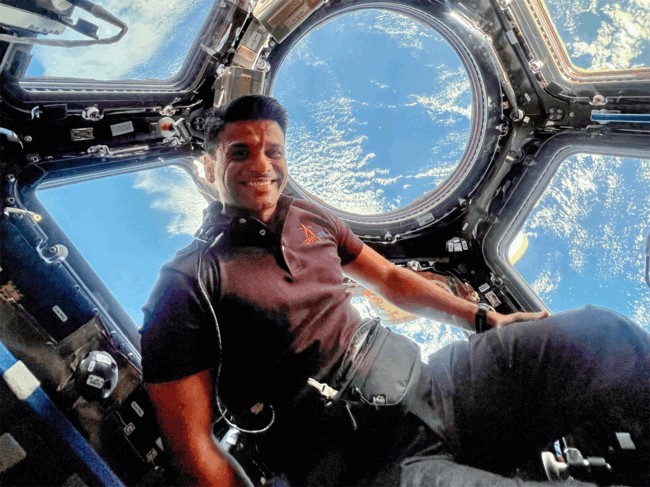
Figure 1. Shubhanshu Shukla.
A pioneering role on the Axiom-4 missions
As the pilot of Axiom-4, Shukla had a vital job: operating SpaceX’s Crew Dragon spacecraft during critical phases including launch, docking with the ISS, undocking, and re-entry. This made him the first Indian military pilot to handle real-time flight operations aboard a commercial spacecraft, working alongside space veteran Peggy Whitson. This exposure to the technical, operational, and psychological demands of spaceflight is invaluable as India prepares for its own crewed missions.
During his stay in orbit, Shukla participated in over 60 scientific experiments—many spearheaded by Indian scientists. These ranged from studying the growth of moong and methi (traditional Indian crops) in microgravity, to analyzing cyanobacteria and microalgae as potential life-support components, and observing tardigrades to explore biological resilience in space. Other projects examined muscle atrophy, techniques for diabetes monitoring, and the effects of prolonged screen exposure in microgravity. Far from being abstract science, these experiments deliver practical insights essential to designing life-support systems and healthcare protocols for long-duration missions—critical steps toward sustainable Indian human spaceflight.
Inspiring a new generation
Beyond science, Shukla’s time aboard the ISS served an equally important purpose: education and outreach. By interacting remotely with Indian students and researchers, he offered a firsthand look at daily life in space—from managing hygiene without showers to adapting everyday routines in microgravity. These lived experiences provide ISRO with real-world data on human adaptation beyond Earth’s atmosphere and help spark interest and curiosity among the next generation of Indian scientists and engineers.
Reference:
- https://economictimes.indiatimes.com/news/india/why-shubhanshu-shukla-matters-so-much-for-indias-space-tech/articleshow/122514839.cms?from=mdr
Cite this article:
Keerthana S (2025), Shubhanshu Shukla Returns to Earth After Spending 20 Days in Space, AnaTechMaz, pp.472
Recent Post
-
China Successfully Tests Domestically Developed Operating System In Space to Cut Reliance on Foreign Software
China Successfully Tests...
-
World’s Largest Space Camera Captures Stunning First Images of the Universe
The Vera C. Rubin Observatory has unveiled its first breathtaking...
-
Most Detailed Image of the Sun Yet Uncovers Hidden Magnetic Stripes
In a groundbreaking achievement, scientists from the U.S. National Science Foundation’s National Solar ...
-
European Space Agency Partners with Blue Origin to Secure Future Access to Low-Earth Orbit
For decades, the International Space Station (ISS) has served as...
-
NASA’s Lunar Rover to Search for Ice, Chart Minerals, and Explore the Subsurface
NASA is launching a new chapter in lunar exploration, equipping....
-
NASA Just Entered the Sun’s Atmosphere — and the Views Are Stunning
NASA’s Parker Solar Probe is transforming our understanding...
-
Shubhanshu Shukla Returns to Earth After Spending 20 Days in Space
Indian Air Force Group Captain Shubhanshu Shukla has returned...
-
US Company’s Maglev Launches Ramp Aims to Hurl Rockets into Orbit Using Minimal Fuel
Several companies are exploring ways to send spacecraft into orbit...
-
Did a Cosmic Impact Block the Grand Canyon? Unraveling A 56,000-Year-Old Enigma
Around 56,000 years ago, an extraordinary coincidence unfolded:...
NASA Finally Unveils the True Source of These Mysterious Cosmic X-Rays
Astronomers have finally unraveled a long-standing puzzle surrounding...
-
Strange Space Object Circles the Sun Once for Every Ten Neptune Orbits — What’s Behind It?
Astronomers have uncovered a mysterious object lurking far...
-
Astronomers Uncover Previously Unknown River of Gas Streaming Toward the Milky Way’s Core
Natalie Butterfield, NSF National Radio Astronomy Observatory scientist...
-
Interstellar Comet, Possibly as Ancient as the Galaxy, Pays a Visit to our Solar System
“This is exactly what we’re here for—finding objects like this, sharing...
-
NASA Discovers Potential Ingredients for Life on Saturn’s Moon Titan
An introduction to Titan’s unique environment — thick...