European Space Agency Partners with Blue Origin to Secure Future Access to Low-Earth Orbit
ESA Partners with Blue Origin to Secure Europe’s Future in Low Earth Orbit
For decades, the International Space Station (ISS) has served as humanity’s premier orbital laboratory. But with its planned retirement approaching by the end of the decade, the focus is now shifting toward the next phase of human presence in low Earth orbit (LEO). Rather than relying solely on government-led projects, the future lies increasingly in private and commercial space stations.
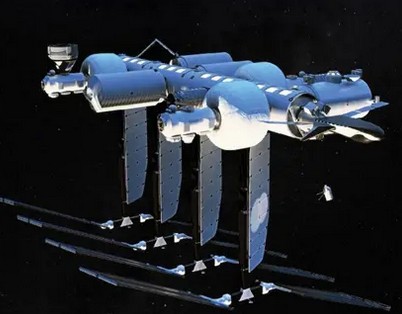
Figure 1. Depiction of Orbital Reef.
To secure a key role in this emerging era, the European Space Agency (ESA) is taking significant steps—most notably by teaming up with Jeff Bezos’ Blue Origin. Figure 1 shows Depiction of Orbital Reef.
ESA, Blue Origin, and Thales Alenia Sign Landmark MoU
At the Paris Air Show, ESA announced a major agreement: a Memorandum of Understanding (MoU) with Blue Origin and European aerospace leader Thales Alenia Space. The agreement focuses on the potential use of Orbital Reef, Blue Origin’s proposed commercial space station.
According to a joint statement, the collaboration aims to align Orbital Reef’s capabilities with Europe’s long-term research and commercial needs in space. “Through this MoU, ESA intends to develop a closer relationship with Blue Origin and Thales Alenia Space for the development of Orbital Reef,” the statement read.
Orbital Reef: A Mixed-Use Platform in Orbit
Orbital Reef is being designed as a flexible, multi-purpose platform in LEO. Initially planned to accommodate six occupants, it could eventually expand to host more than ten people. The station is expected to support a wide range of activities, from scientific research and film production in microgravity to the potential for space tourism and hospitality.
Under the agreement, ESA is exploring the deployment of European payloads and astronauts aboard Orbital Reef. Discussions also include possible European contributions to the station’s infrastructure, from key subsystems to entire modules [1]. Additionally, the partners are examining how European commercial services could play a role in transporting cargo and crew to and from the outpost—strengthening Europe’s industrial footprint in space.
Building Experience Through Private Missions
This partnership builds on ESA’s ongoing efforts to prepare for the post-ISS era. The agency has been actively participating in private astronaut missions to the ISS, gaining operational experience and maximizing scientific return.
Recent examples include Swedish ESA reserve astronaut Marcus Wandt, who flew on the Ax-3 mission in early 2024, and Polish astronaut Sławosz Uznański-Wiśniewski, scheduled to fly on the delayed Ax-4 mission now aiming for launch in June 2025.
These short-duration missions offer unique benefits, allowing astronauts to focus almost entirely on research, without the routine maintenance duties associated with longer stays.
A Changing Orbital Landscape
ESA’s collaboration with Blue Origin reflects the rapidly evolving dynamics of space exploration. While SpaceX currently dominates launch services and ISS crew transport, and has ambitious plans for the Moon and Mars, ESA is staking its claim in the future of LEO by investing in commercial partnerships.
With the ISS nearing the end of its life—and a controlled deorbit mission, likely led by SpaceX, planned for its retirement—new platforms like Orbital Reef represent the next generation of space infrastructure. And ESA is positioning itself to play a central role in that future.
Reference:
- https://interestingengineering.com/space/esa-forges-ties-with-blue-origin
Cite this article:
Keerthana S (2025), European Space Agency Partners with Blue Origin to Secure Future Access to Low-Earth Orbit, AnaTechMaz, pp.469
Recent Post
-
China Successfully Tests Domestically Developed Operating System In Space to Cut Reliance on Foreign Software
China Successfully Tests...
-
World’s Largest Space Camera Captures Stunning First Images of the Universe
The Vera C. Rubin Observatory has unveiled its first breathtaking...
-

Most Detailed Image of the Sun Yet Uncovers Hidden Magnetic Stripes
In a groundbreaking achievement, scientists from the U.S. National Science Foundation’s National Solar ...
-
European Space Agency Partners with Blue Origin to Secure Future Access to Low-Earth Orbit
For decades, the International Space Station (ISS) has served as...
-

NASA’s Lunar Rover to Search for Ice, Chart Minerals, and Explore the Subsurface
NASA is launching a new chapter in lunar exploration, equipping....
-
NASA Just Entered the Sun’s Atmosphere — and the Views Are Stunning
NASA’s Parker Solar Probe is transforming our understanding...
-

Shubhanshu Shukla Returns to Earth After Spending 20 Days in Space
Indian Air Force Group Captain Shubhanshu Shukla has returned...
-

US Company’s Maglev Launches Ramp Aims to Hurl Rockets into Orbit Using Minimal Fuel
Several companies are exploring ways to send spacecraft into orbit...
-

Did a Cosmic Impact Block the Grand Canyon? Unraveling A 56,000-Year-Old Enigma
Around 56,000 years ago, an extraordinary coincidence unfolded:...
NASA Finally Unveils the True Source of These Mysterious Cosmic X-Rays
Astronomers have finally unraveled a long-standing puzzle surrounding...
-

Strange Space Object Circles the Sun Once for Every Ten Neptune Orbits — What’s Behind It?
Astronomers have uncovered a mysterious object lurking far...
-

Astronomers Uncover Previously Unknown River of Gas Streaming Toward the Milky Way’s Core
Natalie Butterfield, NSF National Radio Astronomy Observatory scientist...
-
Interstellar Comet, Possibly as Ancient as the Galaxy, Pays a Visit to our Solar System
“This is exactly what we’re here for—finding objects like this, sharing...
-
NASA Discovers Potential Ingredients for Life on Saturn’s Moon Titan
An introduction to Titan’s unique environment — thick...