US Company’s Maglev Launches Ramp Aims to Hurl Rockets into Orbit Using Minimal Fuel
Several companies are exploring ways to send spacecraft into orbit without relying on traditional rocket boosters.] One example is Spin Launch, which hopes to eventually fling satellites into space using a giant centrifuge. Another is Green Launch, aiming to propel payloads directly into orbit with a space cannon.
Now, a new US-based player, Auriga Space, has joined this effort. The company is developing a magnetic launch track powered by electricity, where powerful magnets accelerate a vehicle to six times the speed of sound before launching it skyward.Auriga Space recently secured $6 million in funding to advance this magnetic launch system.
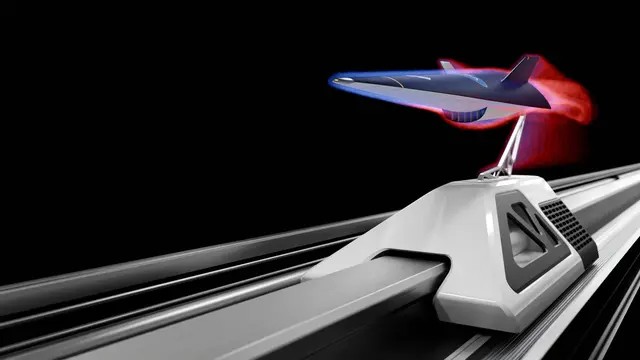
Figure 1. Space Ramp.
Auriga Space’s magnetic ramp
A large part of a rocket’s weight comes from the propellant it carries to reach orbit. Auriga Space wants to reduce this dependency dramatically. Their concept uses a steep ramp at the end of the magnetic track to propel rockets upward, so the vehicle only needs to ignite its engine briefly to complete the journey into orbit. Figure 1 shows Space Ramp.
The track itself is designed to be rapidly reusable. According to the company, modern advances in power electronics have made this system more achievable [1]. Although earlier maglev launches concepts—sometimes referred to as “space elevators”—have been proposed before, they never moved beyond early stages.
In an interview with TechCrunch, Auriga’s founder and CEO Winnie Lai highlighted that “less than 2% of the rocket’s mass actually reaches space. Our ultimate goal is to make launches more efficient. By doing that, we can lower costs and enable more frequent missions.”
Auriga plans to first target hypersonic test customers. Next year, it will introduce two systems: Prometheus, a small indoor lab-scale track, and Thor, a larger outdoor accelerator for full-scale hypersonic testing. The fully orbital system, Zeus, is planned for a later stage.
Focusing on responsive launch and hypersonic testing
Investors appear confident in Auriga Space’s vision. As reported by TechCrunch, the company quietly closed a $4.6 million seed round earlier this year, led by European investor OTB Ventures. Additionally, Auriga received $1.4 million in new contracts from AFWERX and SpaceWERX.
Auriga is still refining its vehicle design. Similar to SpinLaunch—which faced challenges managing the extreme G-forces on payloads—Auriga Space will also need to balance launch speeds carefully to protect its payloads.
If successful, Auriga’s magnetic launch track could open the door to faster, cheaper, and more frequent access to space.
Reference:
- https://interestingengineering.com/space/maglev-ramp-fire-rockets-to-orbit-with-no-fuel/li>
Cite this article:
Keerthana S (2025), US Company’s Maglev Launches Ramp Aims to Hurl Rockets into Orbit Using Minimal Fuel, AnaTechMaz, pp.473
Recent Post
-
China Successfully Tests Domestically Developed Operating System In Space to Cut Reliance on Foreign Software
China Successfully Tests...
-
World’s Largest Space Camera Captures Stunning First Images of the Universe
The Vera C. Rubin Observatory has unveiled its first breathtaking...
-
Most Detailed Image of the Sun Yet Uncovers Hidden Magnetic Stripes
In a groundbreaking achievement, scientists from the U.S. National Science Foundation’s National Solar ...
-
European Space Agency Partners with Blue Origin to Secure Future Access to Low-Earth Orbit
For decades, the International Space Station (ISS) has served as...
-

NASA’s Lunar Rover to Search for Ice, Chart Minerals, and Explore the Subsurface
NASA is launching a new chapter in lunar exploration, equipping....
-
NASA Just Entered the Sun’s Atmosphere — and the Views Are Stunning
NASA’s Parker Solar Probe is transforming our understanding...
-
Shubhanshu Shukla Returns to Earth After Spending 20 Days in Space
Indian Air Force Group Captain Shubhanshu Shukla has returned...
-
US Company’s Maglev Launches Ramp Aims to Hurl Rockets into Orbit Using Minimal Fuel
Several companies are exploring ways to send spacecraft into orbit...
-

Did a Cosmic Impact Block the Grand Canyon? Unraveling A 56,000-Year-Old Enigma
Around 56,000 years ago, an extraordinary coincidence unfolded:...
NASA Finally Unveils the True Source of These Mysterious Cosmic X-Rays
Astronomers have finally unraveled a long-standing puzzle surrounding...
-
Strange Space Object Circles the Sun Once for Every Ten Neptune Orbits — What’s Behind It?
Astronomers have uncovered a mysterious object lurking far...
-
Astronomers Uncover Previously Unknown River of Gas Streaming Toward the Milky Way’s Core
Natalie Butterfield, NSF National Radio Astronomy Observatory scientist...
-
Interstellar Comet, Possibly as Ancient as the Galaxy, Pays a Visit to our Solar System
“This is exactly what we’re here for—finding objects like this, sharing...
-
NASA Discovers Potential Ingredients for Life on Saturn’s Moon Titan
An introduction to Titan’s unique environment — thick...