

Rare Supernova Challenges Expectations, Unveiling the Hidden Layers of a Dying Star
A New Kind of Supernova
Astrophysicists at Northwestern University, working with an international team, have discovered an entirely new type of supernova—an exploding star with unusually high amounts of silicon, sulfur, and argon.
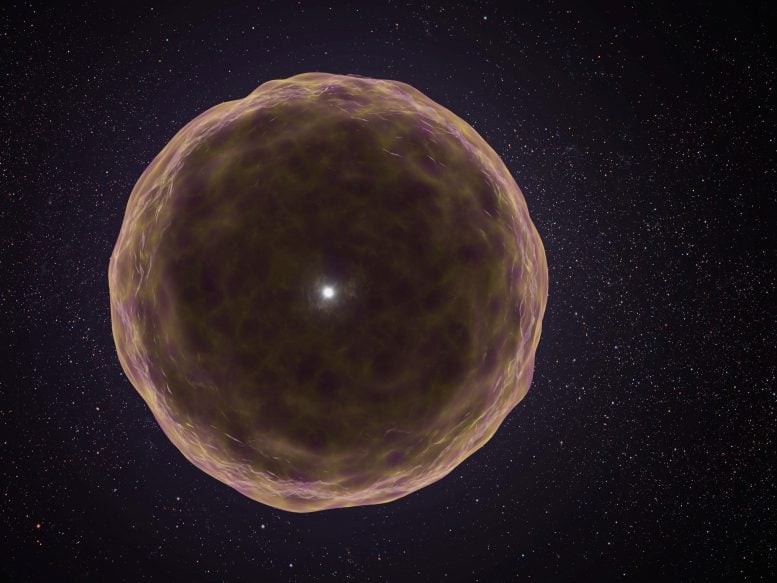
Figure 1. Rare Supernova Reveals the Deep Interior of a Dying Star.
Typically, when massive stars explode, astronomers detect strong signals from lighter elements like hydrogen and helium. But the recently observed event, designated SN 2021yfj, was strikingly different, exhibiting a chemical composition that defied expectations. Figure 1 shows Rare Supernova Reveals the Deep Interior of a Dying Star.
For decades, scientists have theorized that giant stars are layered like an onion: lighter elements in the outer shells, heavier elements deeper inside, culminating in an iron core at the center. This new supernova challenges that traditional view.
Stripped to the Core
“This is the first time we’ve seen a star essentially stripped to the bone,” said Steve Schulze of Northwestern, who led the research. “It demonstrates how stars are structured and shows that they can lose enormous amounts of material before exploding. They can shed not just their outermost layers but be completely stripped down and still produce a brilliant explosion visible from immense distances.”
Challenging Old Theories
“This event literally looks unlike anything anyone has seen before,” added Adam Miller, a senior author on the study. “It was almost so strange that we wondered if we had observed the right object. This star is telling us that our current theories of stellar evolution are too narrow. Our textbooks aren’t wrong, but they don’t capture all the pathways that nature can produce. There are clearly more exotic ways for massive stars to end their lives that we haven’t considered.”
Schulze and Miller: Chasing Cosmic Extremes
Steve Schulze, a specialist in the universe’s most extreme transient events, is a research associate at Northwestern’s Center for Interdisciplinary Exploration and Research in Astrophysics (CIERA). Adam Miller, an assistant professor of physics and astronomy at Northwestern’s Weinberg College of Arts and Sciences, is a senior member of both CIERA and the NSF-Simons AI Institute for the Sky. Together, they are leading the study of one of the most unusual stellar explosions ever observed.
A Hot, Burning Onion
Massive stars, weighing 10 to 100 times more than our Sun, are powered by nuclear fusion. In their cores, intense heat and pressure fuse lighter elements into heavier ones. As the star evolves, this fusion moves outward in shells, creating progressively heavier elements toward the center, culminating in an iron core. When the iron core collapses, it can trigger a supernova or form a black hole.
While massive stars often shed outer layers before exploding, SN 2021yfj expelled far more material than previously observed. Past “stripped stars” revealed only helium or carbon-oxygen layers after losing their hydrogen envelopes, but this event offered a glimpse deep into a star’s interior, hinting at an extraordinarily violent process.
Chasing Down a Cosmic Oddity
Schulze and his team discovered SN 2021yfj in September 2021 using the Zwicky Transient Facility (ZTF), a wide-field survey near San Diego that scans the night sky for transient phenomena like supernovae. The team identified an extremely luminous object in a star-forming region 2.2 billion light-years away.
To understand the star’s composition, they needed its spectrum, which breaks light into component colors, revealing the elements present. Initial attempts failed as telescopes worldwide were either unavailable or blocked by clouds. But a surprise observation from a colleague at the W.M. Keck Observatory in Hawai‘i provided the critical spectrum.
A Rare Astronomical Rescue
“We thought we had lost our chance,” said Miller. “But the next morning, a colleague at UC Berkeley unexpectedly provided a spectrum. Without it, we might never have realized how unusual this explosion was.”
“This explosion was unlike anything we’d seen before,” Schulze added. “We had to study it using every available resource.”
Something Very Violent
Instead of the usual helium, carbon, nitrogen, and oxygen seen in other stripped supernovae, SN 2021yfj’s spectrum was dominated by silicon, sulfur, and argon—elements produced in a star’s deep interior in its final life stages.
“This star lost almost all of the material it created over its lifetime,” Schulze explained. “We could only see material formed in the months before the explosion. Something extremely violent must have occurred.”
The precise cause remains uncertain, but the team proposes several possibilities: interaction with a companion star, a massive pre-supernova eruption, or unusually strong stellar winds. Most likely, however, the star tore itself apart. As the core collapsed under gravity, extreme heat and pressure reignited nuclear fusion in pulses, ejecting outer layers. Each pair-instability episode shed more material, and when one ejected shell collided with another, it produced the brilliant light observed as SN 2021yfj.
A Single, Stunning Example
“One of the shell ejections collided with a pre-existing shell, creating the brilliant emission we observed,” Schulze said.
“While we have a theory for this explosion,” Miller cautioned, “we still only have one example. This discovery highlights the need to find more rare supernovae to understand their nature and formation.”
Source: SciTECHDaily
Cite this article:
Priyadharshini S (2025), Rare Supernova Challenges Expectations, Unveiling the Hidden Layers of a Dying Star, AnaTechMaz, pp.494
Recent Post
-
Space Clues: How an Explosive Prebiotic Molecule Could Unlock Life’s Origins
This is essentially a prebiotic concentrate — a seed-of-life...
-
“Strange ‘Infinity’ Galaxy Baffles Scientists: How Do We Make Sense of It?”
Everything about this galaxy is unusual,” said the researcher....
-

Martian Rock’s Strange Spots Could Hold Clues to Ancient Life
Researchers tested O-PTIR on a basalt rock containing dark inclusions, similar in size.....
-
Webb Telescope Detects Most Ancient Black Hole Yet, Breaking Cosmic Record
Astronomers use spectroscopy to split light into its component...
-
Black Holes Could Act as Cosmic Supercolliders in the Search for Dark Matter
Instead of waiting decades and spending billions on massive particle...
-
Uncovering the Secrets Between Galaxies Through Mysterious Radio Signals
Most of the universe’s matter is invisible, detectable...
-
Earth Targeted by the ‘Eye of Sauron’ in Stunning Astronomical Capture
Billions of light-years away, the blazar PKS 1424+240 has long....
-
Hubble Spots a Rare Interstellar Comet Speeding at 130,000 MPH Through the Solar System
Hubble has captured striking details of comet 3I/ATLAS, including a...
-
Pink Nebulae Radiate Brilliantly in a Spiral Galaxy 35 million Light-Years Away
Pink Nebulae Radiate Brilliantly in a Spiral Galaxy 35 million...
AI Spots Rare Supernova That Flared Twice in a Lifetime
Astronomers have captured the violent death of a massive star locked in a deadly...
-
James Webb Reveals Planet-Forming Regions Under Intense Ultraviolet Radiation
Ultraviolet (UV) radiation is a form of light invisible to the human...
-
Webb Spots Mysterious “Little Red Dots” — Possible Birthplaces of the Universe’s First Black Holes
Astronomers at the Center for Astrophysics...
-
Next Solar Superstorm May Pose Greater Threat to Satellites
New research from the U.S. National Science Foundation’s National Center for ...
-
Rare Supernova Challenges Expectations, Unveiling the Hidden Layers of a Dying Star
Astrophysicists at Northwestern University, working...
-
Tiny Star, Giant Rule-Breaking Planet: A Cosmic Oddity
An international team of astronomers, including researchers from the University of Liège.....