

Earth Targeted by the ‘Eye of Sauron’ in Stunning Astronomical Capture
A Cosmic Puzzle Revealed
Billions of light-years away, the blazar PKS 1424+240 has long baffled astronomers. Highlighted by the IceCube Neutrino Observatory as the brightest blazar producing neutrinos, it also emits intense very high-energy gamma rays, captured by ground-based Cherenkov telescopes. The puzzle: its radio jet appeared to drift unusually slowly, challenging the idea that only fast-moving jets could power such extreme emissions.
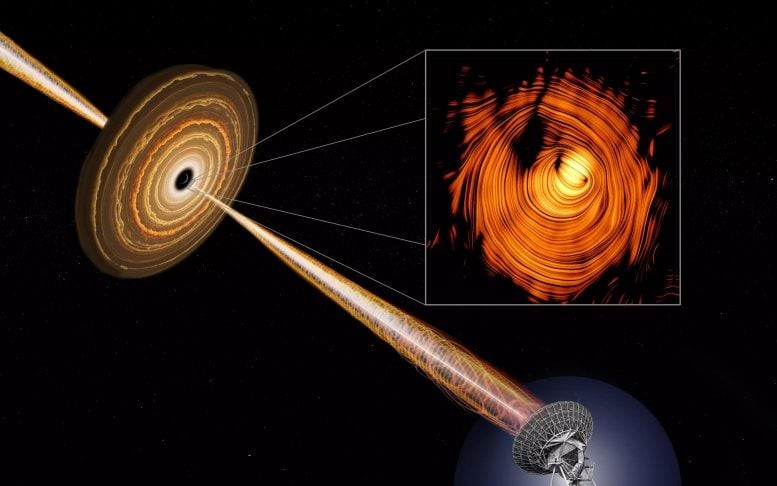
Figure 1. Eye of Sauron’ Cosmic Phenomenon Points at Earth.
After 15 years of meticulous monitoring with the Very Long Baseline Array (VLBA), astronomers have now produced the most detailed image of this enigmatic jet to date. Figure 1 shows Eye of Sauron’ Cosmic Phenomenon Points at Earth.
A Stunning Magnetic Field Discovery
“When we reconstructed the image, it looked absolutely stunning,” says Yuri Kovalev, lead author of the study and Principal Investigator of the ERC-funded MuSES project at the Max Planck Institute for Radio Astronomy (MPIfR). “We have never seen anything quite like it — a near-perfect toroidal magnetic field with a jet pointing straight at us.”
Because the jet is almost perfectly aligned with Earth, relativistic effects amplify its light enormously. “This alignment boosts the brightness by a factor of 30 or more,” explains Jack Livingston, a co-author at MPIfR. “At the same time, the jet appears to move slowly due to projection effects — a classic optical illusion.”
Peering Into the Blazar’s Heart
This head-on orientation allowed scientists to look directly into the heart of the blazar’s jet — a rare opportunity. Polarized radio signals helped map the jet’s magnetic field, revealing its likely helical or toroidal shape. This structure is crucial for launching and collimating the plasma flow and may be essential for accelerating particles to extreme energies.
“Solving this puzzle confirms that active galactic nuclei with supermassive black holes are not only powerful accelerators of electrons but also of protons — the origin of the observed high-energy neutrinos,” Kovalev concludes.
mojave: Decades of Jet Monitoring
The discovery is a triumph for the MOJAVE program, a decades-long effort to monitor relativistic jets in active galaxies using the Very Long Baseline Array (VLBA). By connecting radio telescopes across the globe via Very Long Baseline Interferometry (VLBI), MOJAVE forms a virtual telescope the size of Earth, achieving the highest resolution available in astronomy. This allows scientists to study the fine details of distant cosmic jets.
“When we started MOJAVE, the idea of directly linking distant black hole jets to cosmic neutrinos felt like science fiction. Today, our observations are making it real,” says Anton Zensus, Director at MPIfR and co-founder of the program.
A Milestone in Multimessenger Astronomy
This result strengthens the connection between relativistic jets, high-energy neutrinos, and the role of magnetic fields in shaping cosmic accelerators — marking a major milestone in multimessenger astronomy.
Background Information
A blazar is a type of active galactic nucleus powered by a supermassive black hole that launches a jet of plasma moving near the speed of light. What makes a blazar special is its orientation: one of its jets points within about 10 degrees of Earth. This alignment makes blazars appear bright across the electromagnetic spectrum and allows scientists to study extreme physical processes, including particle acceleration to energies far beyond those achieved in human-made accelerators.
The VLBA consists of ten antennas across the continental United States, Hawaii, and St. Croix, operating in VLBI mode. With antenna spacings up to roughly 10,000 kilometers, it provides angular resolution as fine as 50 micro-arcseconds — the highest in astronomy — enabling detailed studies of distant cosmic jets.
MOJAVE (Monitoring Of Jets in Active Galactic Nuclei with VLBA Experiments) is a long-term program that tracks radio brightness and polarization variations in jets from active galaxies visible in the northern sky. Observations are made using the Very Long Baseline Array (VLBA), which allows scientists to produce full polarization images with an angular resolution better than 1 milliarcsecond — roughly the apparent separation of a car’s headlights as seen by an astronaut on the Moon. These data help researchers study the complex evolution and magnetic field structures of jets on light-year scales, close to their origin in the active nucleus, and examine how this activity is connected to high-energy electromagnetic and neutrino emissions.
MuSES (Multi-messenger Studies of Energetic Sources) is a pioneering initiative in astrophysics focused on Active Galactic Nuclei, some of the universe’s most powerful particle accelerators. These extraordinary objects convert the gravitational energy of matter falling onto supermassive black holes into electromagnetic and kinetic energy, accelerating electrons and protons to near-light speeds. While the acceleration of electrons is fairly well understood, the mechanisms that accelerate protons and produce neutrinos remain a major scientific challenge. MuSES tackles these questions by leveraging the latest advances in multi-messenger astronomy, combining observations of light, particles, and neutrinos to better understand these cosmic powerhouses.
Source: SciTECHDaily
Cite this article:
Priyadharshini S (2025), Earth Targeted by the ‘Eye of Sauron’ in Stunning Astronomical Capture, AnaTechMaz, pp.487
Recent Post
-

Space Clues: How an Explosive Prebiotic Molecule Could Unlock Life’s Origins
This is essentially a prebiotic concentrate — a seed-of-life...
-
“Strange ‘Infinity’ Galaxy Baffles Scientists: How Do We Make Sense of It?”
Everything about this galaxy is unusual,” said the researcher....
-

Martian Rock’s Strange Spots Could Hold Clues to Ancient Life
Researchers tested O-PTIR on a basalt rock containing dark inclusions, similar in size.....
-
Webb Telescope Detects Most Ancient Black Hole Yet, Breaking Cosmic Record
Astronomers use spectroscopy to split light into its component...
-
Black Holes Could Act as Cosmic Supercolliders in the Search for Dark Matter
Instead of waiting decades and spending billions on massive particle...
-
Uncovering the Secrets Between Galaxies Through Mysterious Radio Signals
Most of the universe’s matter is invisible, detectable...
-
Earth Targeted by the ‘Eye of Sauron’ in Stunning Astronomical Capture
Billions of light-years away, the blazar PKS 1424+240 has long....
-
Hubble Spots a Rare Interstellar Comet Speeding at 130,000 MPH Through the Solar System
Hubble has captured striking details of comet 3I/ATLAS, including a...
-
Pink Nebulae Radiate Brilliantly in a Spiral Galaxy 35 million Light-Years Away
Pink Nebulae Radiate Brilliantly in a Spiral Galaxy 35 million...
AI Spots Rare Supernova That Flared Twice in a Lifetime
Astronomers have captured the violent death of a massive star locked in a deadly...
-
James Webb Reveals Planet-Forming Regions Under Intense Ultraviolet Radiation
Ultraviolet (UV) radiation is a form of light invisible to the human...
-
Webb Spots Mysterious “Little Red Dots” — Possible Birthplaces of the Universe’s First Black Holes
Astronomers at the Center for Astrophysics...
-
Next Solar Superstorm May Pose Greater Threat to Satellites
New research from the U.S. National Science Foundation’s National Center for ...
-
Rare Supernova Challenges Expectations, Unveiling the Hidden Layers of a Dying Star
Astrophysicists at Northwestern University, working...
-

Tiny Star, Giant Rule-Breaking Planet: A Cosmic Oddity
An international team of astronomers, including researchers from the University of Liège.....