

Webb Telescope Detects Most Ancient Black Hole Yet, Breaking Cosmic Record
Detecting the Signature of a Black Hole
Astronomers use spectroscopy to split light into its component wavelengths, revealing key details about distant objects. To spot a black hole, they look for the telltale signs of rapidly moving gas. As gas swirls around and falls into the black hole, its light shifts: wavelengths from gas moving away are stretched into redder tones, while those from gas moving toward us are compressed into bluer ones. “There aren’t many other phenomena that produce this pattern,” explained Taylor. “And this galaxy shows it perfectly!”
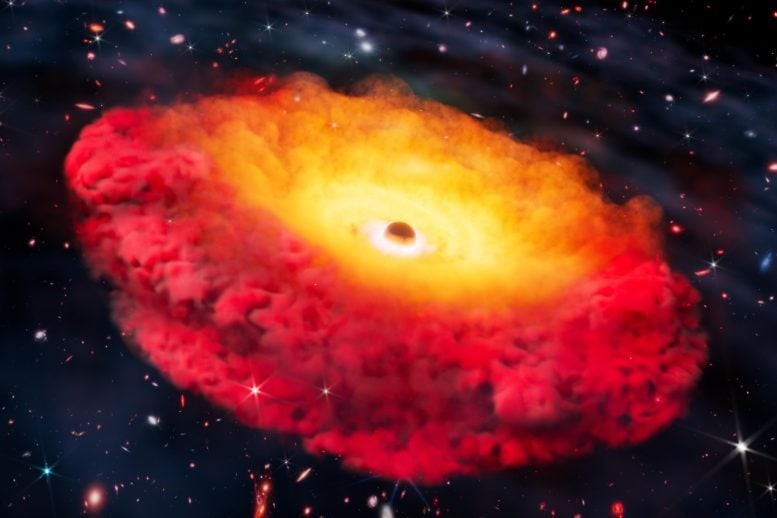
Figure 1. Webb Spots the Oldest Known Black Hole in the Universe.
“The primary goal of CAPERS is to identify and investigate the universe’s most distant galaxies,” said Mark Dickinson, CAPERS team lead and co-author of the study. “JWST’s spectroscopic data is essential for confirming their distances and revealing their physical properties.” Figure 1 shows Webb Spots the Oldest Known Black Hole in the Universe.
What first appeared as a small speck in CAPERS imagery, named CAPERS-LRD-z9, turned out to belong to a newly identified class of galaxies called “Little Red Dots.” Found only within the first 1.5 billion years after the Big Bang, these galaxies are unusually compact, distinctly red, and surprisingly luminous.
“The appearance of Little Red Dots was one of the biggest surprises in early JWST findings, as they looked nothing like the galaxies previously observed with the Hubble Space Telescope,” explained Finkelstein. “We’re now working to understand their nature and how they formed.”
Brightness, Color, and Black Holes
This galaxy strengthens the growing case that supermassive black holes are behind the unusual brightness of Little Red Dots. Normally, such luminosity would point to a galaxy brimming with stars. But at such an early stage in the universe, the existence of so many stars is unlikely.
Black holes, however, can shine brilliantly. As they pull in surrounding material, they compress and heat it, releasing enormous amounts of light and energy. By identifying one within CAPERS-LRD-z9, astronomers have found compelling evidence linking black holes to the luminosity of Little Red Dots.
The galaxy also offers clues about the striking red color of these objects. The team suspects the effect comes from a dense shroud of gas surrounding the black hole, which shifts the escaping light toward redder wavelengths. “We’ve seen these gas clouds in other galaxies,” explained Taylor. “When we compared this object with those, it was an exact match.”
Another remarkable feature of CAPERS-LRD-z9 is the size of its black hole. With a mass up to 300 million times greater than the Sun, it rivals half the mass of all the stars in its host galaxy. Even by supermassive standards, this is enormous.
Discovering such a huge black hole so early in cosmic history gives astronomers a rare window into their rapid growth. While black holes in the later universe had plenty of time and material to accumulate mass, one forming in the universe’s first few hundred million years did not. “This strengthens the case that early black holes either grew much faster than expected or began their lives far larger than our models predict,” said Finkelstein.
To build on these findings, the CAPERS team plans to obtain higher-resolution JWST observations of CAPERS-LRD-z9. These could shed more light on its properties and the role black holes played in shaping Little Red Dots. “This is an excellent test case,” said Taylor. “We’ve only recently gained the tools to explore early black hole evolution, and this object offers a unique opportunity to do just that.”
Source: SciTECHDaily
Cite this article:
Priyadharshini S (2025), Webb Telescope Detects Most Ancient Black Hole Yet, Breaking Cosmic Record, AnaTechMaz, pp.484
Recent Post
-
Space Clues: How an Explosive Prebiotic Molecule Could Unlock Life’s Origins
This is essentially a prebiotic concentrate — a seed-of-life...
-
“Strange ‘Infinity’ Galaxy Baffles Scientists: How Do We Make Sense of It?”
Everything about this galaxy is unusual,” said the researcher....
-

Martian Rock’s Strange Spots Could Hold Clues to Ancient Life
Researchers tested O-PTIR on a basalt rock containing dark inclusions, similar in size.....
-
Webb Telescope Detects Most Ancient Black Hole Yet, Breaking Cosmic Record
Astronomers use spectroscopy to split light into its component...
-
Black Holes Could Act as Cosmic Supercolliders in the Search for Dark Matter
Instead of waiting decades and spending billions on massive particle...
-
Uncovering the Secrets Between Galaxies Through Mysterious Radio Signals
Most of the universe’s matter is invisible, detectable...
-
Earth Targeted by the ‘Eye of Sauron’ in Stunning Astronomical Capture
Billions of light-years away, the blazar PKS 1424+240 has long....
-
Hubble Spots a Rare Interstellar Comet Speeding at 130,000 MPH Through the Solar System
Hubble has captured striking details of comet 3I/ATLAS, including a...
-
Pink Nebulae Radiate Brilliantly in a Spiral Galaxy 35 million Light-Years Away
Pink Nebulae Radiate Brilliantly in a Spiral Galaxy 35 million...
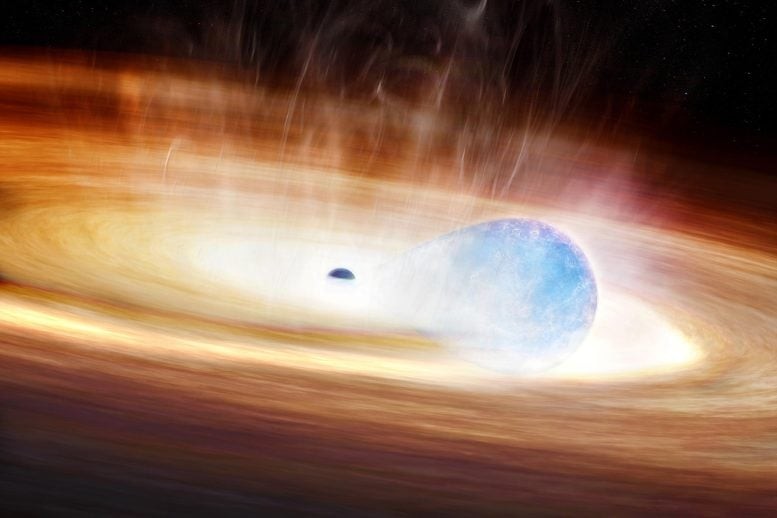
AI Spots Rare Supernova That Flared Twice in a Lifetime
Astronomers have captured the violent death of a massive star locked in a deadly...
-
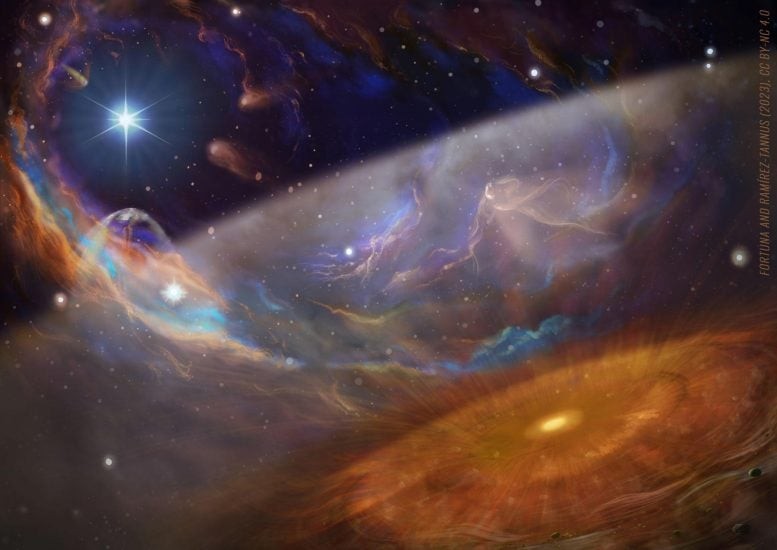
James Webb Reveals Planet-Forming Regions Under Intense Ultraviolet Radiation
Ultraviolet (UV) radiation is a form of light invisible to the human...
-
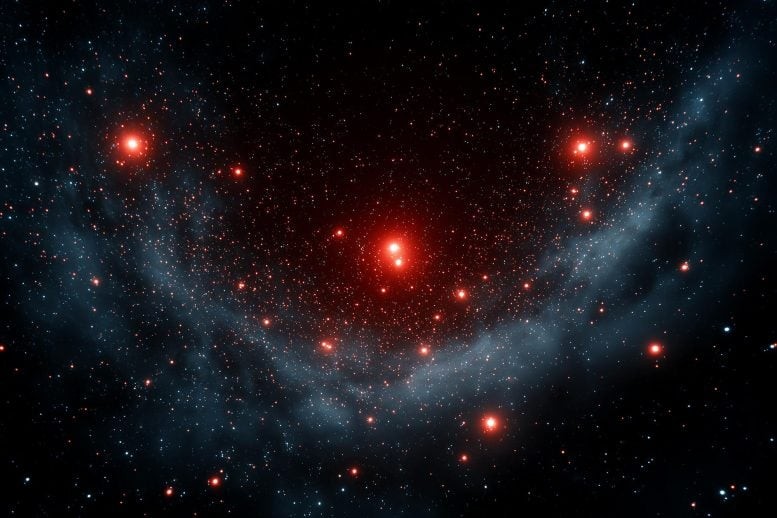
Webb Spots Mysterious “Little Red Dots” — Possible Birthplaces of the Universe’s First Black Holes
Astronomers at the Center for Astrophysics...
-
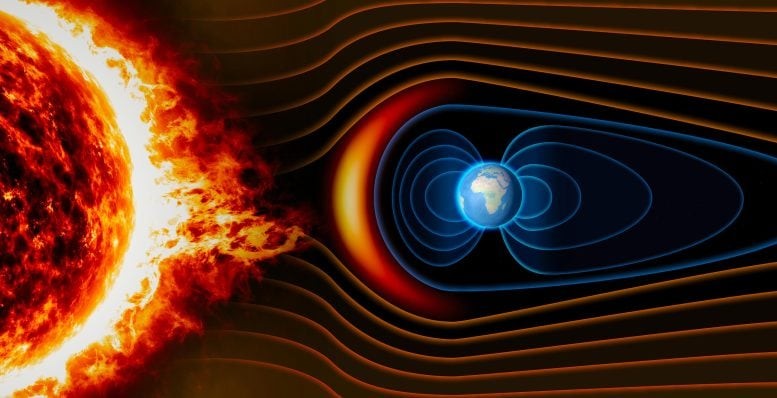
Next Solar Superstorm May Pose Greater Threat to Satellites
New research from the U.S. National Science Foundation’s National Center for ...
-
Rare Supernova Challenges Expectations, Unveiling the Hidden Layers of a Dying Star
Astrophysicists at Northwestern University, working...
-
Tiny Star, Giant Rule-Breaking Planet: A Cosmic Oddity
An international team of astronomers, including researchers from the University of Liège.....