

Pink Nebulae Radiate Brilliantly in a Spiral Galaxy 35 million Light-Years Away
New Insights from H-Alpha Light
What makes this latest image unique is its capture of H-alpha light—a specific wavelength of red light. This allows astronomers to pinpoint regions along the galaxy’s spiral arms where H-alpha emission shines brightest. In these regions, vibrant pink nebulae appear like scattered blossoms across the galaxy. H-alpha light is particularly valuable because it highlights different types of nebulae tied to various stages of stellar evolution: massive newborn stars ignite glowing H II regions, while dying stars leave behind supernova remnants or planetary nebulae, all traceable through their H-alpha signature.’
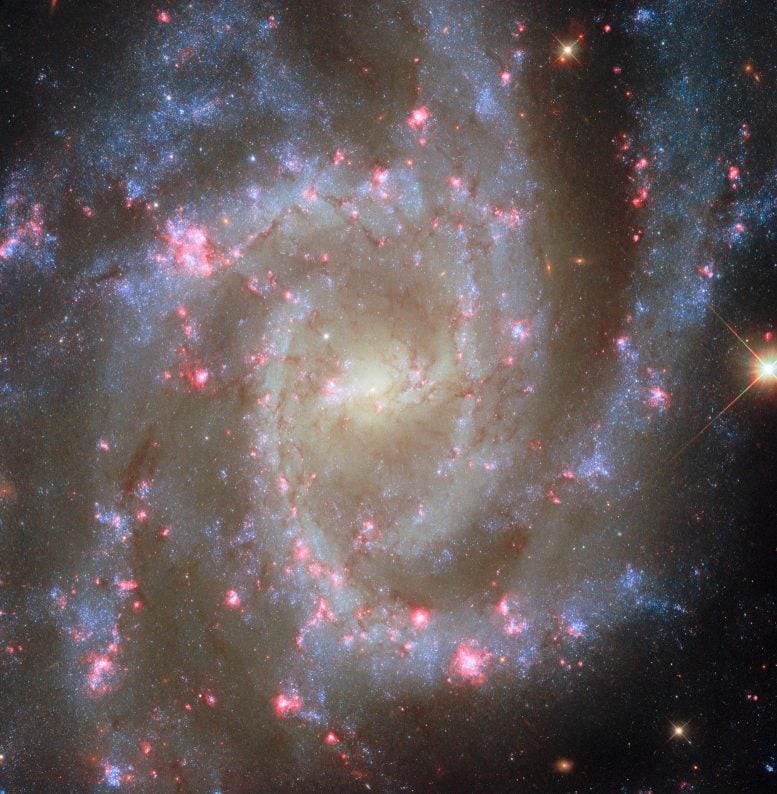
Figure 1. Brilliant Pink Nebulae Glow Across a Spiral Galaxy 35 million Light-Years Distant.
Leveraging this capability, the Hubble Space Telescope is surveying 19 nearby galaxies, aiming to catalog over 50,000 nebulae. This extensive effort will deepen scientists’ understanding of how stars influence and shape their surrounding environments through radiation and stellar winds. Figure 1 shows Brilliant Pink Nebulae Glow Across a Spiral Galaxy 35 million Light-Years Distant.
The Galaxy in Focus
Astronomers have captured stunning images of a spiral galaxy located 35 million light-years from Earth. Spiral galaxies, like our Milky Way, are characterized by their swirling arms filled with stars, gas, and dust.
Hubble’s H-Alpha Advantage
The image stands out thanks to H-alpha light, a specific red wavelength that highlights glowing regions within the galaxy. This light is key to revealing areas where stars are forming or ending their lives.
Pink Nebulae Illuminate the Arms
Along the spiral arms, bright pink nebulae sparkle like cosmic blossoms. These nebulae include both stellar nurseries and remnants of dying stars, all visible due to their strong H-alpha emission.
Mapping Star Formation
Hubble is using this technique to survey multiple galaxies, cataloging tens of thousands of nebulae. Studying these regions helps scientists understand how stars influence their surroundings through radiation and stellar winds.
Cosmic Significance
By analyzing these nebulae, astronomers gain insight into the life cycles of stars and the dynamic processes that shape galaxies over millions of years, revealing the intricate interplay of birth and death on a grand cosmic scale.
Source: SciTECHDaily
Cite this article:
Priyadharshini S (2025), Pink Nebulae Radiate Brilliantly in a Spiral Galaxy 35 million Light-Years Away, AnaTechMaz, pp.489
Recent Post
-
Space Clues: How an Explosive Prebiotic Molecule Could Unlock Life’s Origins
This is essentially a prebiotic concentrate — a seed-of-life...
-
“Strange ‘Infinity’ Galaxy Baffles Scientists: How Do We Make Sense of It?”
Everything about this galaxy is unusual,” said the researcher....
-

Martian Rock’s Strange Spots Could Hold Clues to Ancient Life
Researchers tested O-PTIR on a basalt rock containing dark inclusions, similar in size.....
-
Webb Telescope Detects Most Ancient Black Hole Yet, Breaking Cosmic Record
Astronomers use spectroscopy to split light into its component...
-
Black Holes Could Act as Cosmic Supercolliders in the Search for Dark Matter
Instead of waiting decades and spending billions on massive particle...
-
Uncovering the Secrets Between Galaxies Through Mysterious Radio Signals
Most of the universe’s matter is invisible, detectable...
-
Earth Targeted by the ‘Eye of Sauron’ in Stunning Astronomical Capture
Billions of light-years away, the blazar PKS 1424+240 has long....
-
Hubble Spots a Rare Interstellar Comet Speeding at 130,000 MPH Through the Solar System
Hubble has captured striking details of comet 3I/ATLAS, including a...
-
Pink Nebulae Radiate Brilliantly in a Spiral Galaxy 35 million Light-Years Away
Pink Nebulae Radiate Brilliantly in a Spiral Galaxy 35 million...
AI Spots Rare Supernova That Flared Twice in a Lifetime
Astronomers have captured the violent death of a massive star locked in a deadly...
-
James Webb Reveals Planet-Forming Regions Under Intense Ultraviolet Radiation
Ultraviolet (UV) radiation is a form of light invisible to the human...
-
Webb Spots Mysterious “Little Red Dots” — Possible Birthplaces of the Universe’s First Black Holes
Astronomers at the Center for Astrophysics...
-
Next Solar Superstorm May Pose Greater Threat to Satellites
New research from the U.S. National Science Foundation’s National Center for ...
-
Rare Supernova Challenges Expectations, Unveiling the Hidden Layers of a Dying Star
Astrophysicists at Northwestern University, working...
-
Tiny Star, Giant Rule-Breaking Planet: A Cosmic Oddity
An international team of astronomers, including researchers from the University of Liège.....