

Smart Infrastructure
Smart infrastructure is widely acknowledged as one of the main components of smart cities. It extends not only to smart roads, automated parking, and IoT but also to all the various signals and signs along the roadside that provide information to drivers and AVs. AI-based driving systems utilize a broad range of advanced sensors to understand their environment and make data-driven decisions. For example, sensors factor in road signs and other visual information to make an optimal driving decision. Startups develop many solutions for smart infrastructure and smart roads to enable vehicles to communicate with their environment and reduce the burden on drivers.
- StreetSense provides IoT for Transportation Management
- Anadue builds a Telematics Platform for Connected Cars [1]
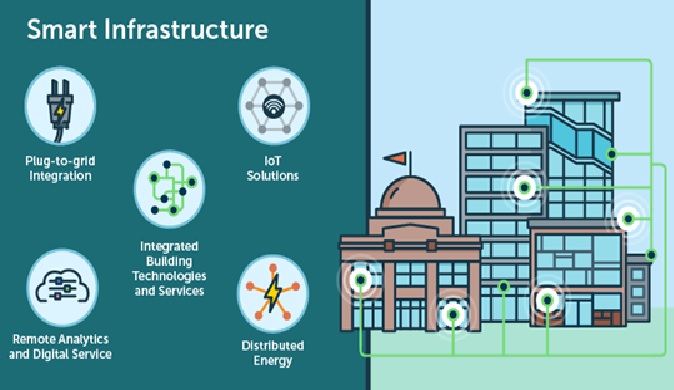
Figure 1. Smart Infrastructure
Smart Infrastructure is shown in figure 1. A smart infrastructure could be defined as a cyber-physical system that provides for an integral management of all elements that it comprises by means of different technological tools that help compile and analyze data to meet efficiency, sustainability, productivity and safety objectives.
“A smart infrastructure is a smart system that uses a data feedback loop to improve decision-making regarding a matter. A system that can monitor, measure, analyze, communicate and act based on data collected by sensors.”
types of smart infrastructures:
- Semi-intelligent infrastructure
- Intelligent infrastructure
- Smart networks
- Smart public infrastructures
- Smart beaches [2]
Benefits of smart infrastructure:
The benefits of smart infrastructure are numerous and can have a significant impact on a wide range of industries and sectors. Here are some of the main benefits:
- Increased efficiency: Smart infrastructure can help optimize the use of resources, reduce waste, and increase efficiency in various areas, such as energy consumption, water management, and transportation.
- Improved safety and security: Smart infrastructure can help detect and respond to potential safety and security risks in real-time, such as traffic accidents, natural disasters, and cyber threats
- Enhanced sustainability: Smart infrastructure can help reduce carbon emissions and promote sustainable practices by monitoring and managing resource consumption, promoting renewable energy sources, and encouraging environmentally friendly behaviors
- Improved connectivity: Smart infrastructure can enhance connectivity and communication between people, systems, and devices, enabling better coordination and collaboration across different sectors and industries.
- Increased data collection and analysis: Smart infrastructure can generate large amounts of data, which can be analyzed to gain insights into trends, patterns, and potential issues. This data can be used to inform decision-making and improve overall performance.
Overall, smart infrastructure has the potential to revolutionize the way we design, build, and manage our cities and infrastructure, leading to a more sustainable, efficient, and connected world.
References:
- https://www.startus-insights.com/innovators-guide/top-10-mobility-industry-trends-innovations-in-2021/#micromobility
- https://nexusintegra.io/smart-infrastructures-essential-for-smart-cities/
Cite this article:
Gokula Nandhini K (2023), Smart Infrastructure, AnaTechMaz, pp. 113
Recent Post
-
The Internet of E-mobility
Electro mobility(or e-Mobility) represents the concept of using electric powertrain technologies, in-vehicle information, and communication technologies and connected.........
-
Shared Mobility Solutions
New mobility services provide a continuum of choices that cover many types of personal trips, and together with a robust public transit system, allow people to get to work,..
-

Future Smartphone Predictions
It’s pretty clear that smartphones will soon be getting even smarter. In the mid-2000s, mobile phones could only do a tiny fraction of the things that their modern........
-

Augmented & Virtual Reality (AR/VR)
A big challenge for the mobility industry is reducing road accidents due to human negligence. Startups develop AR solutions to restrict the number of distractions for a driver........
-

Mobility-as-a-Service
Integrating various modes of transportation into a single mobility service presents a user-centric approach to mobility. To achieve this, startups are building a range of mobility........
-

Electrification
To accelerate the growth of electric mobility and promote sustainability, advances have to be spurred in electric drive solutions, EV charging, and infrastructure, as well as data analytics.......
-
Micromobility
Micromobility is gradually gaining in popularity across the world for its convenience and environmental benefits. It is a powerful approach to tackle vehicular greenhouse......
-
Smart Infrastructure
Smart infrastructure is widely acknowledged as one of the main components of smart cities. It extends not only to smart roads, automated parking, and IoT but also to all the various......
-
3D Printing
Startups and emerging companies are providing 3D printing solutions for creating various automotive parts. Additive manufacturing with different materials also allows.........
-
Smart Mobility
A new road revolution is upon us as the reality of autonomous/driverless cars comes ever closer. While the digitalisation, AI and sensors built into vehicles will power this new technology.......
-
Autonomous Driving
Autonomous driving technology has always been one of the most promising areas within the mobility industry and it continues to grow. This top mobility trend aims to minimize.......
-

Ride Sharing and Car-Sharing
Ride-sharing and car-sharing services are two popular forms of alternative transportation that have gained significant popularity in recent years. Ride-sharing is an innovative on-demand........
-
Integrated mobility solutions
Integrated mobility means mobility service providers working together to offer suitable transport options for each stage of a journey. The aim is to ensure seamless connections.........
-
Accessibility and inclusivity
Mobility is not just about transportation for the able-bodied, and there is a growing awareness of the need for accessible and inclusive transportation options for people.........
-

Increased Emphasis on Sustainable Transportation
Increased Emphasis on Sustainable Transportation.....