

New Low-Power Antenna Boosts Deep-Water Robot Communication
Communicating underwater has long been one of the biggest challenges facing autonomous underwater vehicles (AUVs). Traditional wireless signals struggle to travel through water, especially in deep or murky environments, limiting how robots share information and coordinate missions. Now, researchers have developed a breakthrough antenna system that could dramatically improve underwater connectivity.
Scientists at the University of Florida have created BlueME, a compact and energy-efficient magnetoelectric antenna capable of enabling underwater robots to exchange data across distances exceeding 700 meters (2,296 feet). Despite its impressive range, the system consumes only about 10 watts of power—roughly equivalent to a standard stereo camera system.
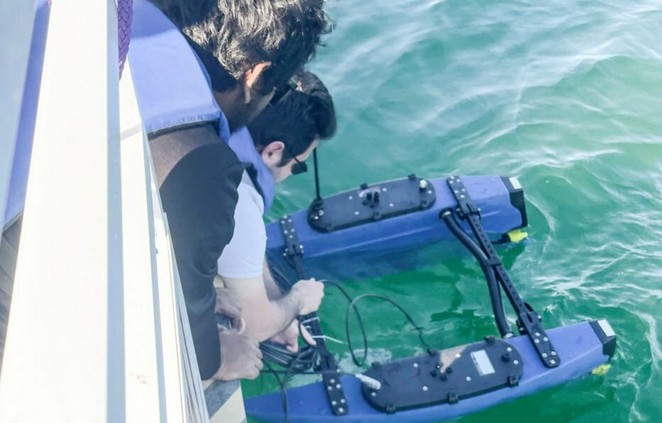
Figure 1. Deep-Water Robot.
Inspired by Medical Technology
The innovation emerged from an unexpected collaboration between marine robotics and biomedical engineering researchers. While studying wireless communication inside the human body, scientists realized that many of the same challenges found in biological tissues also exist underwater, where saltwater interferes with conventional radio signals.
This insight led the team to explore a new approach to underwater communication that relies on low-frequency electromagnetic signals rather than traditional radio, acoustic, or optical systems. Figure 1 shows deep-water robot.
A Different Way to Communicate Underwater
Instead of using high-power transmissions, BlueME employs an array of magnetoelectric antennas that operate at their natural resonance frequencies. These antennas generate very-low-frequency electromagnetic waves capable of traveling through water while remaining largely unaffected by obstacles, sediment, turbulence, or underwater echoes.
As a result, autonomous underwater vehicles can maintain reliable communication links without needing to surface frequently to transmit data or receive new instructions.
Expanding Possibilities Beneath the Surface
The technology could significantly improve the efficiency of coordinated underwater operations. Today, many subsea robots can only send basic status updates and often must return to the surface to transfer larger amounts of data.
With BlueME, underwater vehicles could communicate mission updates in real time, allowing operators to monitor progress, adjust objectives, and coordinate multiple robots more effectively during a mission.
Potential applications include naval surveillance, offshore energy infrastructure inspections, environmental monitoring, seabed mapping, and scientific research. Swarms of underwater drones could work together over long distances while remaining continuously connected.
Looking Ahead
The research team has already secured a provisional patent for the technology and is seeking industry partnerships to further develop and commercialize the system [1]. Future efforts will focus on integrating BlueME into operational autonomous submarines and expanding its capabilities for large-scale underwater networks.
If successful, the technology could mark a major step forward in underwater robotics, enabling smarter, more connected autonomous systems capable of operating efficiently in some of the most challenging environments on Earth.
References:
- https://interestingengineering.com/innovation/compact-energy-efficient-underwater-robot-antenna
Cite this article:
Keerthana S (2026), New Low-Power Antenna Boosts Deep-Water Robot Communication, AnaTechMaz, pp.373
Recent Post
-

Agile Robots Joins Forces with Google DeepMind in New Robotics Partnership
Agile Robots has entered into a new partnership with Google....
-
Amazon Buys Humanoid Robotics Startup Fauna Robotics
Amazon has acquired New York–based humanoid robotics startup Fauna Robotics, as confirmed....
-
DJI Brings Immersive Aerial Dogfighting Experience to Insta360
The imaging system is built around 1-inch–equivalent sensors with 2.4-micrometer....
-
Robot Legs Wow in Demo: Skating, Stair-Climbing, and One-Wheel Balancing
Launched in 2022 with a $400 million investment from Hyundai....
-

Tiny Robots, 50 Times Thinner Than a Hair, Can Track and Move Bacteria
Photon-powered nanorobots can precisely steer, capture, and.....
-
“Robot Explores 1.5 Miles Below, Captures 86,000 Images of French Shipwreck”
A cutting-edge underwater robot has captured thousands of....
-

“Notion Faces Data Exposure Risk from Unprotected API Access”
Privacy-focused browser maker Brave Software has rolled out its “Shred” feature to Android...
-

Humanoid Robot Passenger Sparks Flight Delay Over Oversized Banned Battery in the U.S.
An unusual airline incident unfolded in California when a....
-
China’s New Moon Robot Aims to Assist Future Lunar Missions
China has unveiled a new AI-powered lunar robot designed to assist future Moon missions by carrying....
-
Touch-Sensitive Robot Can Navigate Like Humans Without Vision
Researchers at the National University of Singapore have....
-

Brain-Like Navigation Gives Robots Smarter Mobility
For decades, robotics researchers have envisioned autonomous machines capable of navigating...

NVIDIA Builds the Foundation for an AI-Driven Robotic Future
As artificial intelligence moves beyond software and into the physical world, NVIDIA is positioning itself at....
New Low-Power Antenna Boosts Deep-Water Robot Communication
Communicating underwater has long been one of the biggest challenges facing autonomous underwater....

Hybrid Intelligence Revolutionizes Precision Manufacturing Robotics
Researchers led by Changtian Z., Jiaxuan H., and Xinyang L. have developed an...
Robots Break Free from Maps with Smarter LiDAR Technology
Autonomous robots are taking a major step toward operating independently in complex, real-world ....